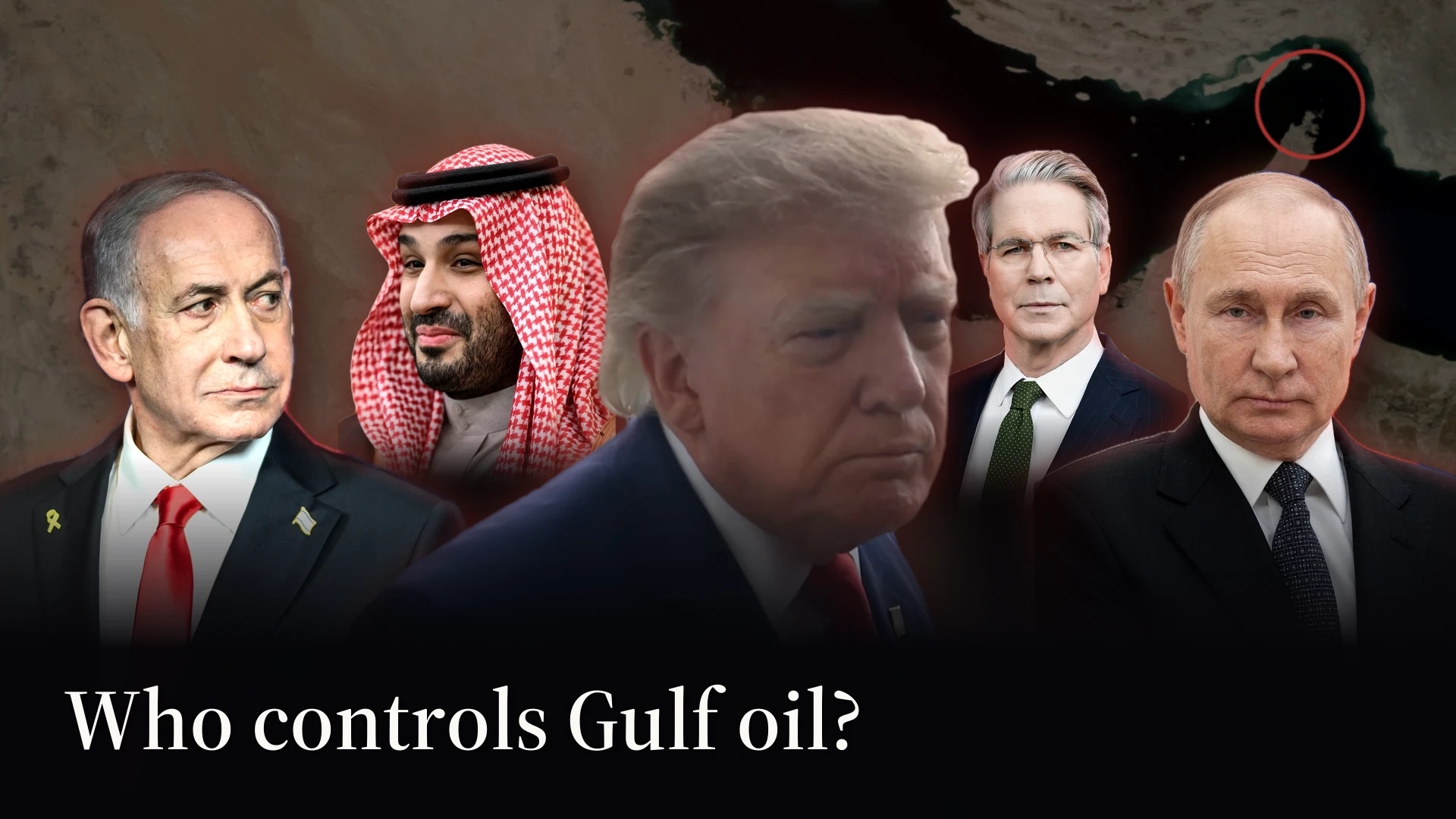
Key players- Donald TrumpLaunched the war; says it is making “a fortune”
- Scott BessentRunning the war on Iran’s income
- Benjamin NetanyahuPlanned the strike; wants pipelines through Israel
- Mohammed bin SalmanAsked Trump to hold off; now under fire
All 13
Washington
- Donald Trump
- President. Launched the war on Feb. 28, decides when it ends, and says the price spike is making the country money.
- Scott Bessent
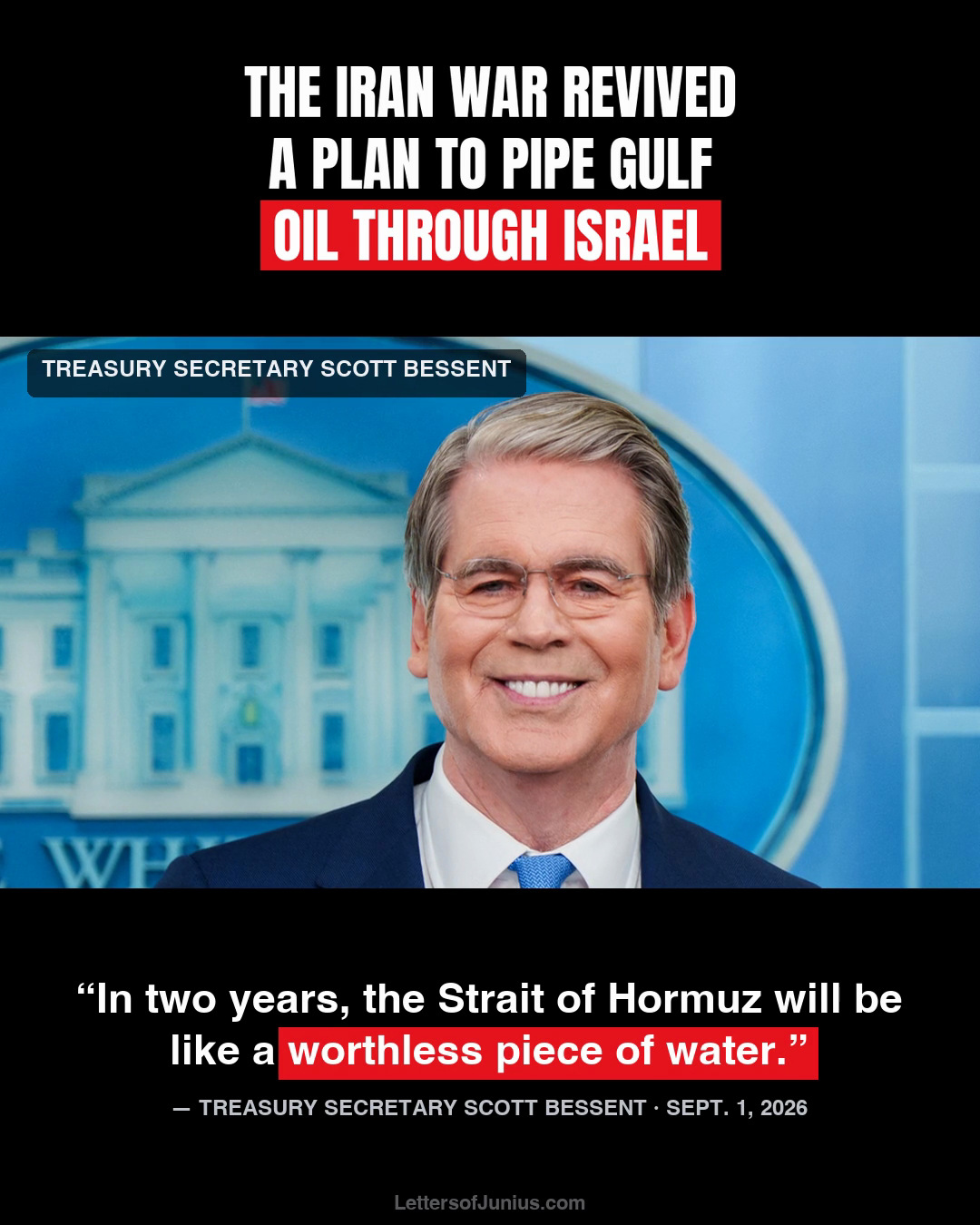
- Treasury secretary. Runs Operation Economic Outcast against Iran’s income and predicts Hormuz will be “a worthless piece of water.”
Israel
- Benjamin Netanyahu
- Prime minister. Planned the strike with Trump at Mar-a-Lago; wants Gulf pipelines rerouted to Israel’s ports; up for election Tuesday.
Iran
- Masoud Pezeshkian
- President. Signed the June memorandum that collapsed in July.
- Revolutionary Guards
- Declared the Strait of Hormuz closed on March 2; their adviser Ebrahim Jabari warned ships would be set ablaze.
The Gulf and Pakistan
- Mohammed bin Salman
- Saudi crown prince. Warned against the war, asked Trump to hold off, and is now under Houthi missile fire.
- The Houthis
- Yemeni group striking Saudi airports, a pipeline and Red Sea islands.
- Shehbaz Sharif
- Pakistan’s prime minister, who co-signed the memorandum with Trump and Pezeshkian.
Who is getting paid
- US energy exporters
- A record 13.6 million barrels a day in April; LNG shipments to Asia doubled.
- Russia
- Oil tax revenue doubled; Trump cleared Russian diesel sales to the United States after a call with Putin.
- Arms makers
- $16.5 billion in fast-tracked Gulf arms sales; an $18.2 billion request to replace missiles.
- Powerus
- Florida drone maker whose deal could give Eric Trump and Donald Trump Jr. a stake, selling interceptors to Gulf states.
- Oil traders
- Bets worth up to $7 billion placed minutes before Trump’s announcements; the CFTC referral was retracted.
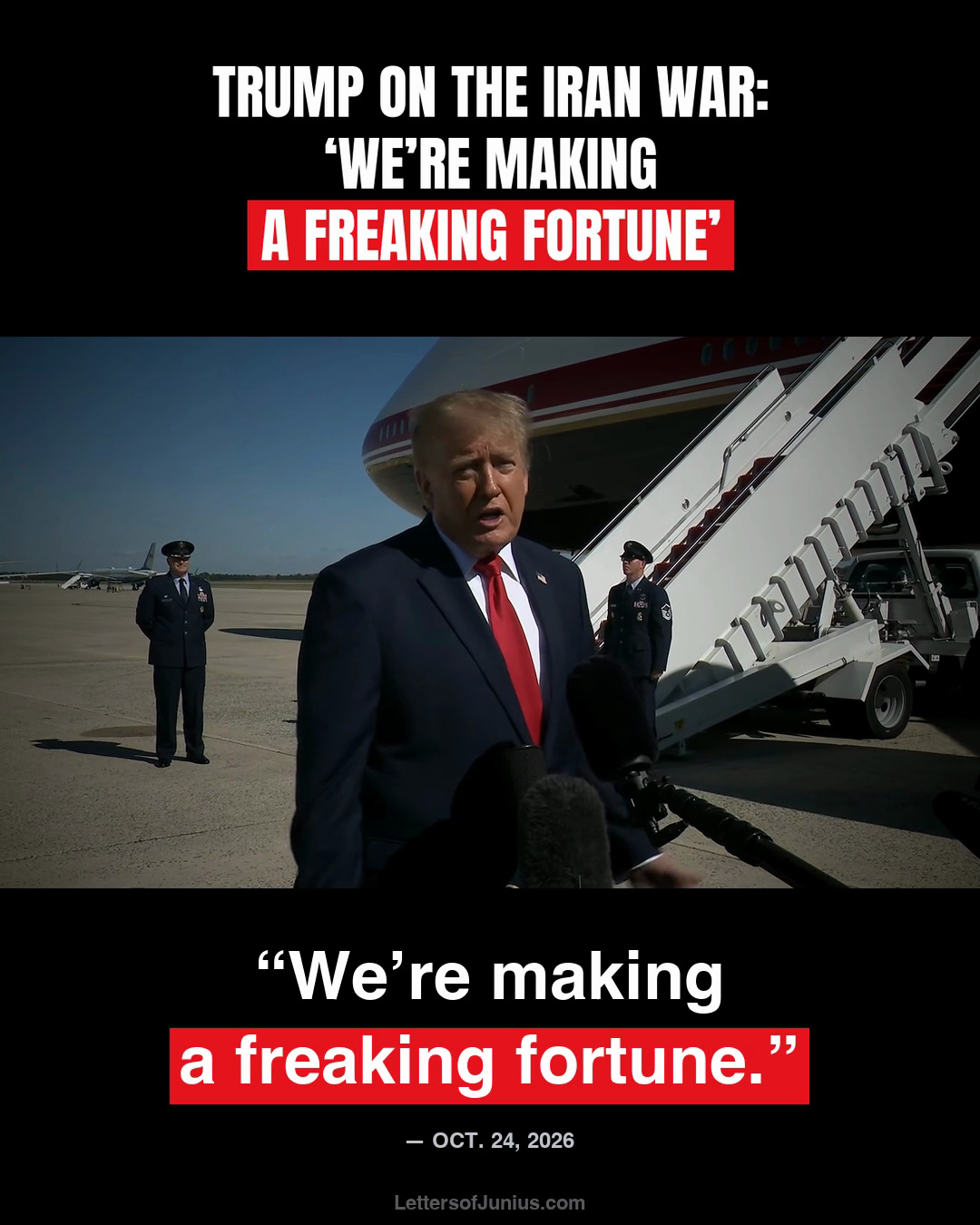
On Saturday, Oct. 24, at a campaign rally in Perry, Ga., President Trump told the crowd that the country "is making hundreds of billions of dollars because of what's happened in the Middle East." Then he told them his staff had asked him not to say so. "My people said, 'Please don't mention that, sir, because people are paying a little higher,'" he said, according to The Associated Press. "But I said I don't give a damn. I'm going to say it. We're making a freaking fortune."
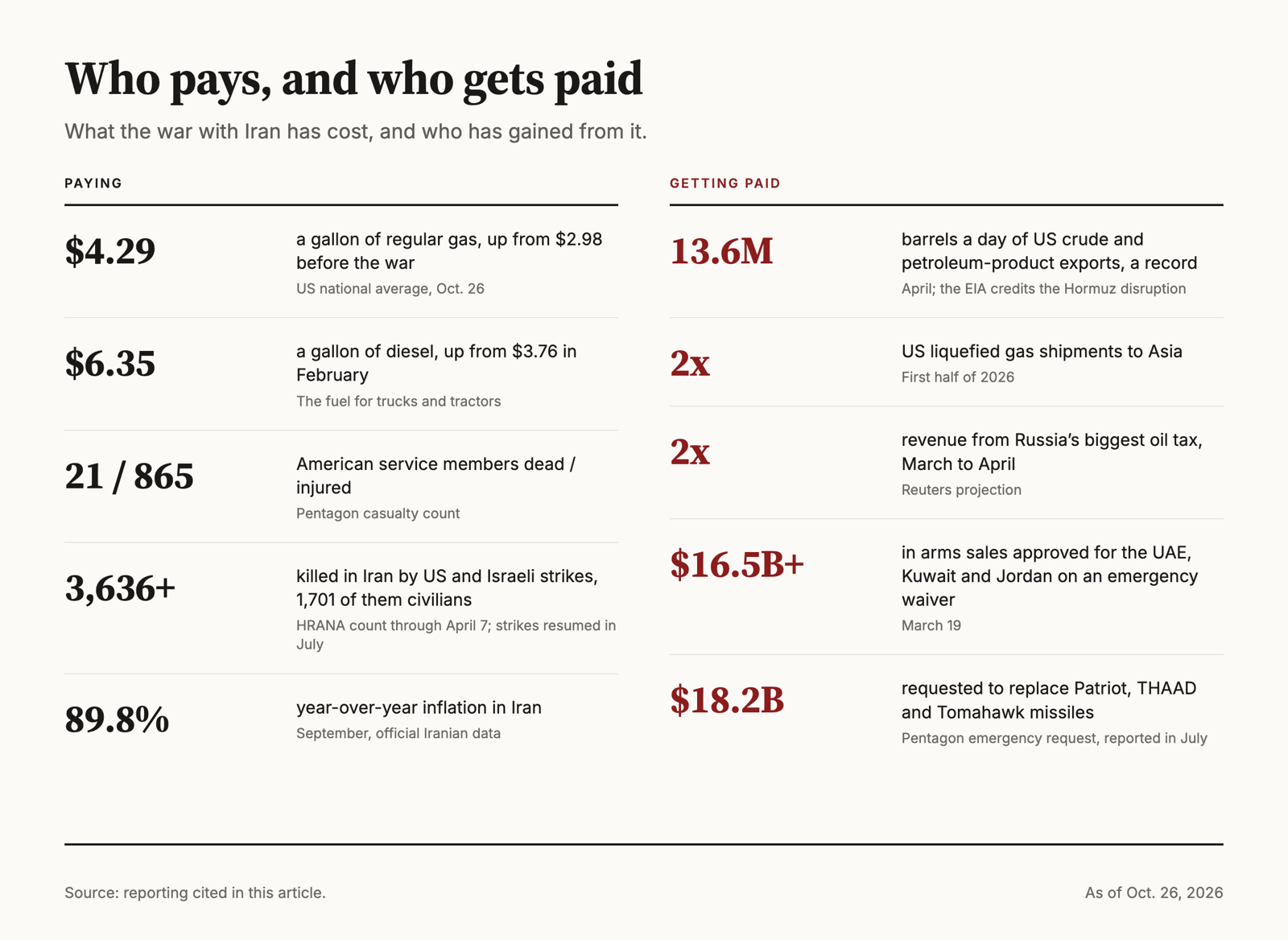
Trump was talking about the war that the United States and Israel launched against Iran on Feb. 28. As of Monday, Oct. 26, a gallon of regular gasoline cost $4.29 on average, up from $2.98 before the war. Diesel, which fuels the country's trucks and tractors, cost $6.35, up from $3.76 in February, the AP reported.
Twenty-one American service members have died and 865 have been injured, according to the Pentagon's latest casualty count.
In Iran, the Human Rights Activists News Agency, which documents the war from outside the country, had counted at least 3,636 people killed by American and Israeli strikes by April 7, 1,701 of them civilians, including at least 254 children. The strikes resumed in July.
Trump has been saying that higher oil prices make the country money since the war's second week. On March 12, with oil at $100 a barrel, Trump posted: "The United States is the largest Oil Producer in the World, by far, so when oil prices go up, we make a lot of money."
Put plainly: Trump, who decides when this war ends, has said at least twice that the price spike it caused is making the country money.
There are two wars with Iran. The first is the war over Iran's weapons, which Trump announced on Feb. 28. He promised to "raze their missile industry to the ground," to "annihilate their navy" and to "ensure that Iran does not obtain a nuclear weapon," according to the text of his address. It has been fought in bursts, with pauses in between. For now it is officially on hold: Trump has promised not to attack Iran before the midterm elections on Nov. 3, and the White House has repeated the promise since.
The second is the war behind it: a war on Iran's economy, and over who controls the routes that carry the Gulf's oil and trade. This one is still being fought. It has three parts. First, Washington cuts off Iran's income, with a naval blockade of its ports and a campaign to leave its oil with no buyers.
Second, Iran hits back where it can, as it has since the war's third day: at the ships that carry everyone else's oil through the Strait of Hormuz, the narrow channel between Iran and the Arabian Peninsula through which about a fifth of the world's oil passed before the war. In the week ending Oct. 16, at least 12 ships came under attack, according to UK Maritime Trade Operations, a British naval agency that said it was struggling to count them all. Oil flowing through the strait was running at about two-thirds of its prewar level, according to the shipping-data firm Kpler.
Third, with the strait unsafe, buyers turn to oil and gas that doesn't pass through it, much of it American. Governments also draw up plans for routes around the strait, including pipelines across Arabia that Israel wants to end at its own ports.
None of this was hard to foresee, and each part moves money from one set of people to another. The gains go to American energy exporters, to arms makers, to Russia and to traders who bet on oil just before Trump's announcements. The losses fall on American drivers, on the soldiers and sailors in the Gulf, on Gulf states, including those that warned against the war, and on ordinary Iranians.
Unlike the first war, the second has no pause. It ends only if Iran accepts Washington's terms. Treasury Secretary Scott Bessent has offered Iran one way out: "a path back to normalcy." On Oct. 9, Trump put the terms more starkly: "Either they give us everything, or they don't exist any longer."
The people paying for this war are not the people making money from it.
The cost everyone saw coming
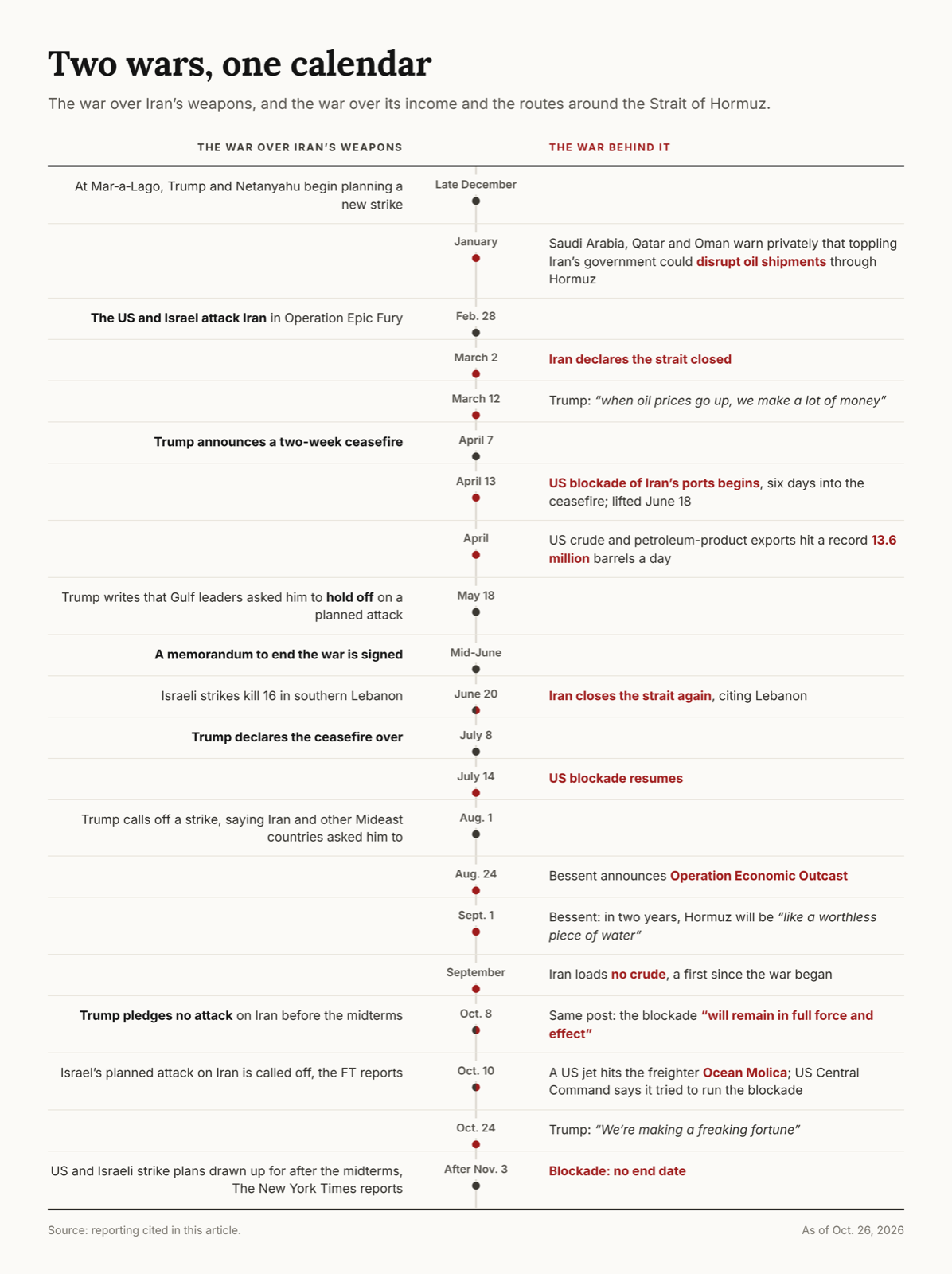
Planning for the war started in late December. At Mar-a-Lago, Trump and Israeli Prime Minister Benjamin Netanyahu began discussing the details of a new strike on Iran, Axios reported. In the two months before the war, the two leaders met twice and spoke by phone 15 times.
In January, as Trump weighed strikes on Iran over its crackdown on protesters, three Gulf states lobbied his administration in private. Saudi Arabia, Qatar and Oman warned that any effort to topple Iran's government could destabilize the region and disrupt oil shipments through the Strait of Hormuz, The Wall Street Journal reported.
The risk was no secret. In 2024, about 20 million barrels of oil a day moved through the strait, according to the Energy Information Administration. And Iran had threatened to close the strait before. In June 2025, after American strikes on its nuclear sites, Esmaeil Kowsari, a member of its parliament's national security committee, said lawmakers had concluded that the strait "should be closed," leaving the final decision to Iran's Supreme National Security Council.
On Feb. 28, the United States and Israel attacked, in what the Pentagon named Operation Epic Fury. Trump's address announcing the war did not mention oil, the strait or prices. Two days later, on March 2, Iran's Revolutionary Guards, the military force that answers to the supreme leader, declared the strait closed, and Ebrahim Jabari, a senior adviser to the Guards' commander, warned that ships trying to cross would be set ablaze. Brent crude, the global oil benchmark, had sold for about $70 a barrel in 2025. It passed $100 in March and touched about $126 on April 30, its highest since 2022.
Then a deal meant to end the war began to unravel over Lebanon. In mid-June, Trump, Iranian President Masoud Pezeshkian and Pakistani Prime Minister Shehbaz Sharif signed a memorandum. In its first clause, the United States, Iran "and their allies in the current war" declared "the immediate and permanent termination of military operations on all fronts, including in Lebanon." In its fifth clause, Iran pledged to work toward "safe passage of commercial vessels" through the strait. Netanyahu's office had already said, on June 11, that "Israel is not a party to the memorandum of understanding."
On June 20, Israeli strikes killed 16 people around the southern Lebanese city of Nabatieh, according to Lebanon's civil defense agency. The same day, Iran's central military command announced "that the Strait of Hormuz will be closed to vessel traffic," citing "the Zionist regime's continuous and relentless violation of the ceasefire in southern Lebanon." On June 25, a drone hit the container ship Ever Lovely. Iran did not claim it, but two US officials told Reuters that Iran had fired on the ship, and Trump called it "a foolish violation of our Ceasefire Agreement." On July 7, after Iran attacked three commercial ships, the United States struck about 80 targets. The next day, Trump declared the ceasefire over. "I think it's over," he said. "They're scum."
Washington signed a deal that depended on peace in Lebanon, even though Israel had said it was not a party to it. The text was published on June 18. Two days later, Iran closed the strait again.
A cost everyone could see coming is not a side effect. It is a choice.
Bankrupt, and broken
When the memorandum's ceasefire collapsed in July, Washington went back to squeezing Iran's income. On July 14, American forces resumed the blockade of Iran's ports. They had first imposed it on April 13, six days into a two-week ceasefire Trump announced on April 7, and lifted it on June 18 under the memorandum. The blockade began during a ceasefire. By Oct. 10, nearly three months after the blockade resumed, 135 ships had been turned around, four commercial vessels disabled and 10 tankers linked to the Revolutionary Guards destroyed, according to US Central Command.
On Aug. 24, Bessent gave the campaign a name: Operation Economic Outcast. Iran, he said, "now faces a very clear choice, with only two paths before them": either "complete global isolation and a subsistence economy, or a path back to normalcy with an opportunity to rejoin the global economy." He also said: "Our objective is to sever every economic lifeline that sustains this tyrannical regime until Tehran stands alone." The White House put the goal as "ensuring Tehran stands alone, bankrupt, and broken."
The campaign is working. In September, Iran loaded no crude onto tankers at all, the first such month of the war, down from about 250,000 barrels a day in August, according to Bloomberg's tanker tracking. The rial has lost more than a third of its value since the war began: it traded at about 1.75 million to the dollar on Feb. 28 and about 2.73 million on Oct. 22. Consumer prices in September were 89.8% higher than a year earlier, according to official Iranian data. The International Monetary Fund expects Iran's economy to shrink 7.6% this year.
In a subsistence economy, it is ordinary people, not the government, who go without. On Feb. 28, Trump told Iranians: "When we are finished, take over your government." The people he was speaking to now pay nearly twice what they paid a year ago for the same goods. On Monday, Oct. 26, Bessent told them, in an interview with Iran International, a Persian-language broadcaster based in London, to "start stocking up on heating fuel," warning of a "big heating fuel shortage."
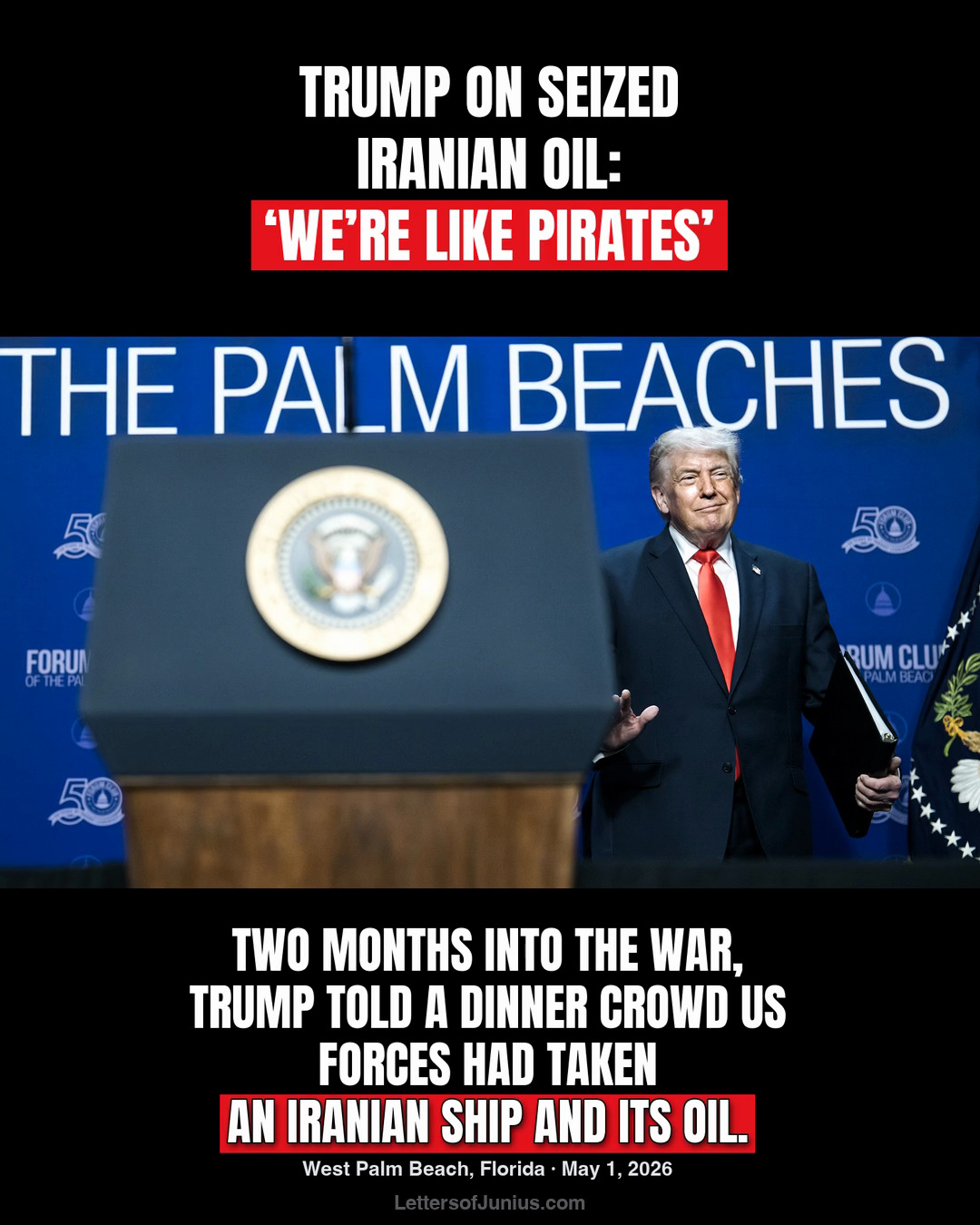
Washington is also trying to keep some of the oil Iran can no longer sell. The Justice Department is seeking to revive prize law, the old law of naval warfare under which a court can award a captured enemy ship and its cargo to the government that seized it, one the United States has not regularly used since the Spanish-American War. Two tankers boarded in the Indian Ocean in April, the Tifani and the Majestic X, and a third seized in June were headed toward US waters in late September, Bloomberg reported. Together they carried nearly 6 million barrels of crude worth almost $600 million. As of Oct. 23, no prize case had been publicly filed, according to the National Law Review. In May, talking about the seized oil, Trump said: "It's a very profitable business." He also said: "We're like pirates."
This is the war behind the war. It targets Iran's income, not its weapons.
The fortune
So who is making a fortune?
Start with American energy. In April, US exports of crude oil and petroleum products reached a record 13.6 million barrels a day, which the Energy Information Administration attributes to "disruptions to international crude oil and refined product flows through the Strait of Hormuz." Exports of American liquefied natural gas, the chilled gas shipped by tanker, rose 23% in the first half of the year, mostly because new export plants opened. But shipments to Asia more than doubled, and the EIA partly credits the strait: "Market disruptions from the closure of the Strait of Hormuz contributed to a doubling of U.S. LNG shipments to Asia."
The gains could last. Buyers in Thailand, Pakistan and Bangladesh were in talks in September to sign long-term contracts with US suppliers, as the war pushed them to look beyond the Middle East, Bloomberg reported. Takayuki Ueda, the chief executive of Japan's Inpex, said the flow of gas through the strait "will not return to the previous status quo." Buyers seeking years of American gas are not counting on a calm strait.
The war has also been good for Russia, the country Washington's sanctions are supposed to squeeze. In March, to calm prices, the Treasury widened a waiver letting any buyer purchase Russian oil already at sea, and it renewed the waiver through the spring. Washington eased sanctions on Moscow to soften a price spike its war on Tehran had caused. Reuters calculated that revenue from Russia's biggest oil tax would come to about 700 billion rubles (about $9 billion) in April, more than double March's 327 billion rubles. In September, Russia earned $17.67 billion from oil exports, up $3.6 billion from August, according to International Energy Agency data reported by the Russian state news agency TASS. On Oct. 9, shortly after Trump announced a diesel deal reached in a phone call with Russian President Vladimir Putin, the Treasury cleared Russian diesel sales until April 2027, in what the AP called "an attempt to address high fuel prices ahead of the U.S. midterm elections."
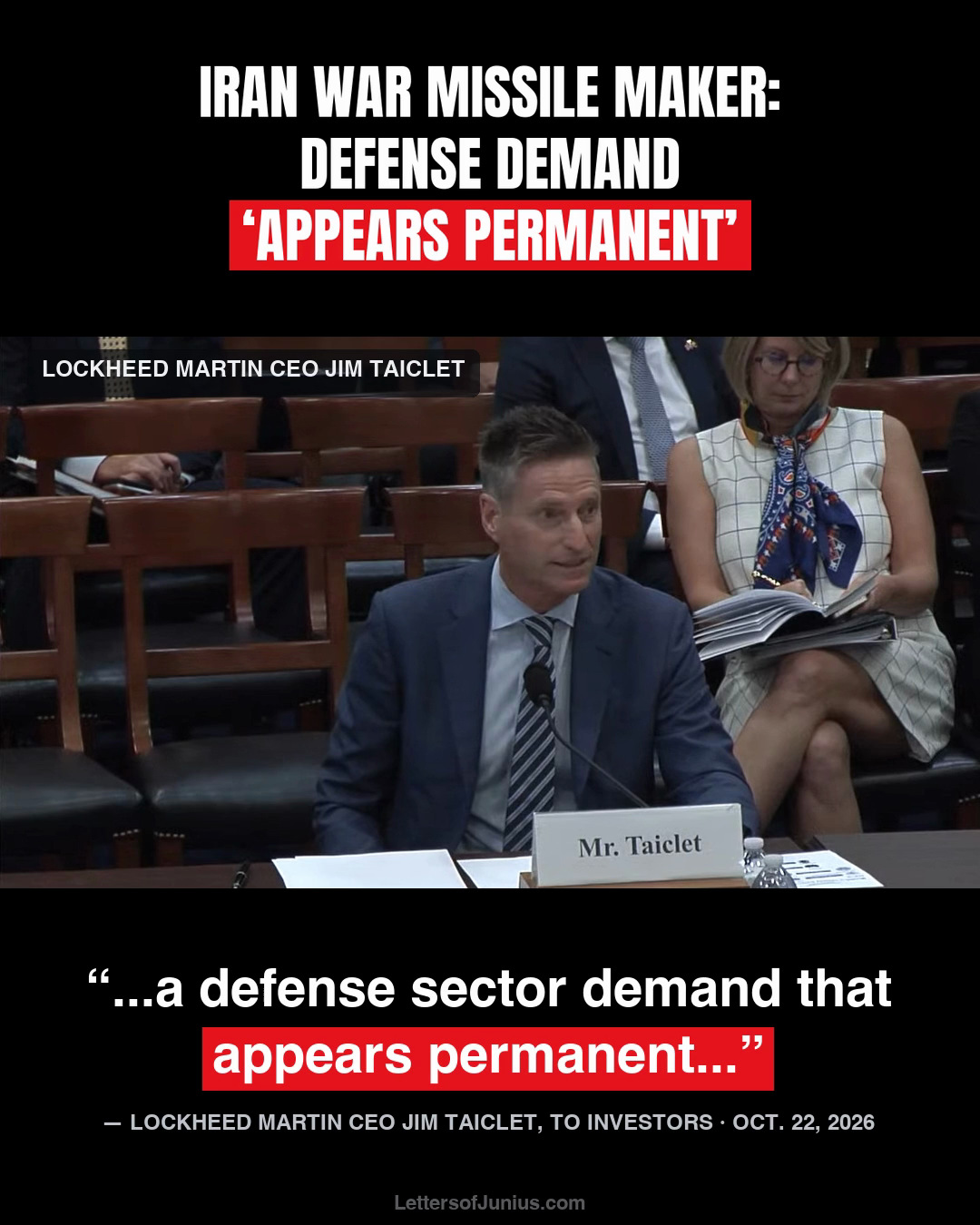
Then there are the weapons. On March 19, nearly three weeks into the war, the administration approved more than $16.5 billion in arms sales to the United Arab Emirates, Kuwait and Jordan, using an emergency waiver from Secretary of State Marco Rubio to skip the usual congressional review. The Pentagon's $67 billion emergency request to Congress includes $18.2 billion to replace Patriot and THAAD missile-defense interceptors and Tomahawk missiles, Bloomberg reported in July. That money would go to the companies that make those weapons.
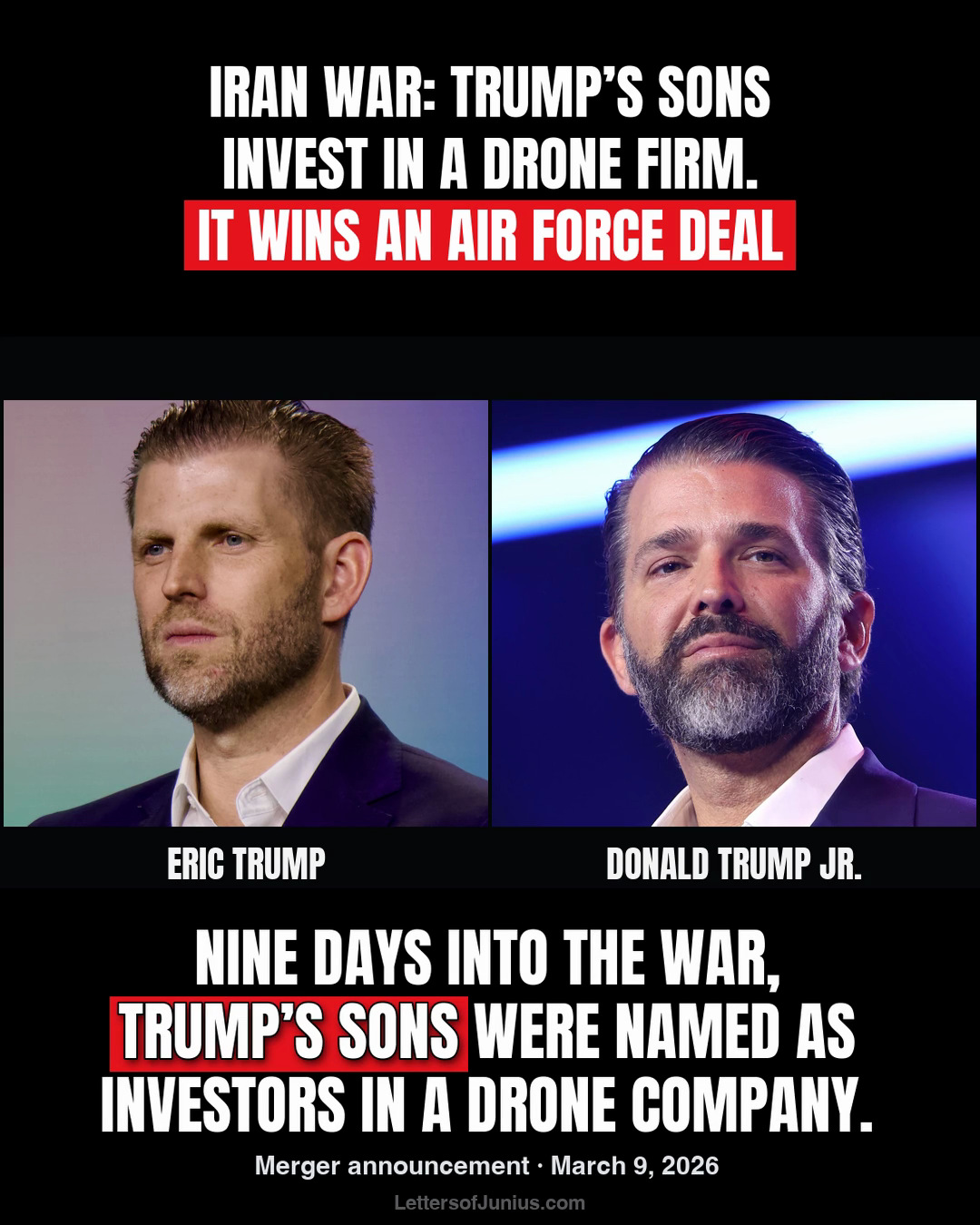
One company chasing war business has the president's sons behind it. In March, Powerus, a Florida drone maker, announced a deal that could give Eric Trump and Donald Trump Jr. sizable equity stakes. By April, it was pitching drone interceptors to Gulf states under Iranian attack, The Associated Press reported. Powerus denied any conflict of interest when the deal was announced.
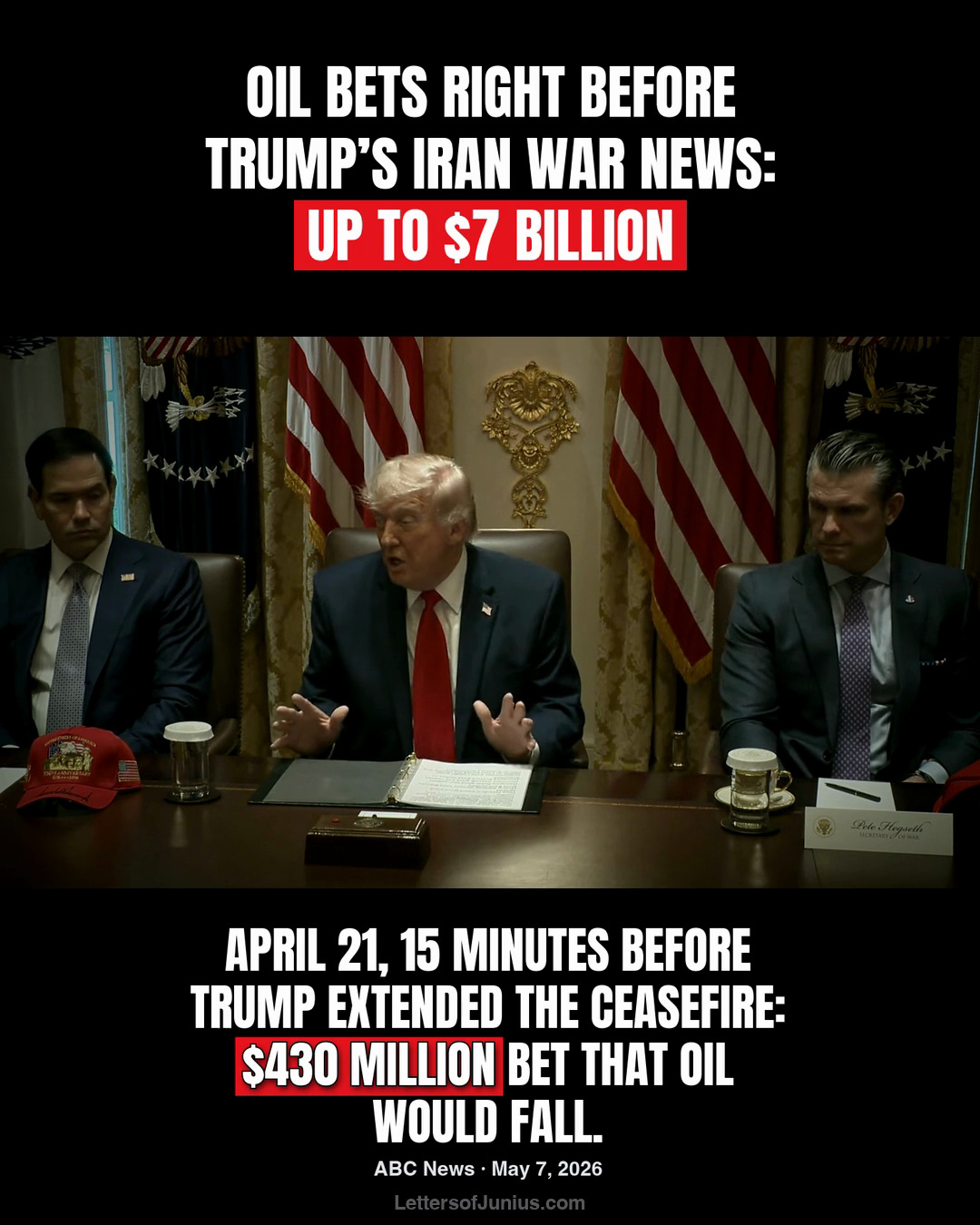
And there are the traders. On March 23, between 6:49 and 6:50 a.m. New York time, about $580 million in oil futures, contracts that bet on where oil prices are headed, changed hands, the Financial Times found. About 15 minutes later, Trump posted that the United States had been having "productive conversations" with Iran and paused his threat to strike its power plants. Oil prices fell sharply. A White House spokesman, responding to suggestions of insider trading, said at the time that "any implication that administration officials are engaged in such activity without evidence is baseless and irresponsible." In May, ABC News reported that the Justice Department and the Commodity Futures Trading Commission, which polices those markets, were examining bets placed shortly before four market-moving announcements about the war, three of them Trump's. ABC reported that more than $2.6 billion "was wagered on oil prices falling shortly before they did"; Reuters later put the bets as high as $7 billion and calculated that a trader who had bet $7 billion on falling prices could have made hundreds of millions of dollars. On Oct. 13, Bloomberg reported that the commission's analysts had referred the trades to its enforcement division as possible insider trading, and that an adviser to Michael Selig, the commission's chairman, had told staff to retract the referral and was trying to take over the review himself. The commission declined to comment. Neither it nor the Justice Department has announced charges.
Trump is right that there is a fortune. It goes to exporters, arms makers, Moscow and whoever placed those bets. None of it reaches the people paying for it: Americans handing over $4.29 for a gallon of gas and $6.35 for diesel, and the troops, 21 of them dead and 865 injured.
A worthless piece of water
On Sept. 1, on the sidelines of a G20 finance meeting in Asheville, N.C., Bessent predicted that the strait would stop mattering. "In two years, the Strait of Hormuz will be like a worthless piece of water," he said, because the oil would move through pipelines over land. Qatar disagrees. It ships its gas out through the strait: in 2024, about a fifth of the world's trade in liquefied gas passed through Hormuz, mostly from Qatar, according to the EIA. Qatar's energy minister, Saad al-Kaabi, who also runs QatarEnergy, answered on Sept. 20: "I mean, maybe this is his view. I think this is completely wrong."
If Bessent is right, Iran loses its strongest weapon, the power to choke the strait. Whoever controls the pipelines over land gains that power instead. The pipelines can be hit too: in September, Saudi Arabia shut its East-West pipeline to the Red Sea after a drone attack it blamed on Iranian-backed militias in Iraq, The Associated Press reported.
Israel wants those land routes to run through Israel. On March 30, a month into the war, Netanyahu told Newsmax: "There are ways to bypass the Strait of Hormuz." The long-term solutions, he said, "include rerouting energy pipelines westward, across Saudi Arabia to the Red Sea and Mediterranean." In July, his energy minister, Eli Cohen, told Reuters in Jerusalem: "If you create a land route, you bypass both Iran and the Houthis." The Houthis are the Iran-aligned rebels in Yemen who fire on ships in the Red Sea. "The best route is through the State of Israel," Cohen said. He had suggested to the United States a 700-kilometer pipeline from Saudi Arabia to Eilat, Israel's Red Sea port, feeding the line that runs on to Ashkelon on the Mediterranean, Reuters reported. The idea dates to at least 2020.
In August, Israel Hayom reported that Israel and Gulf states were holding secret talks on an energy corridor around Hormuz, citing unnamed Gulf officials who confirmed them. "In my view, the Israeli route for a pipeline to the Mediterranean is the ideal option," Cohen told the paper. A senior Israeli official put it more urgently: "If Israel fails to open the door, the window of opportunity will close."
Europe and Washington have been reviving another route. The India-Middle East-Europe Economic Corridor, or IMEC, was announced in 2023 by the United States, India, Saudi Arabia, the UAE, the European Union, France, Germany and Italy, to carry goods from India to the Gulf by sea, across Arabia by rail and on through Israel's port of Haifa to Europe. In three years it has never held a meeting of ministers and has had only "a steering committee, not a ministerial committee," France's envoy for the project, Gérard Mestrallet, said in October; he hopes for a ministerial meeting by the end of the year. Greece and Cyprus want to become full members, Mestrallet said, and Egypt, Lebanon and Oman are interested. The war gave the project new urgency. In April, European Commission President Ursula von der Leyen said the EU was "ready to join forces with Gulf countries to diversify export infrastructure so that it does not depend exclusively on the Strait of Hormuz." At the G7 in June, she added: "Other routes will be built — for example, a typical one is IMEC." On June 17, the Senate Foreign Relations Committee approved a bill whose stated purpose is "to support the role of Eastern Mediterranean countries as a strategic gateway in the India-Middle East-Europe Economic Corridor." The full Senate has not voted on it.
The Gulf wants a way around Hormuz too. So far, the routes it is pursuing on its own avoid Israel. The UAE is speeding up a new pipeline, expected to open in 2027, to its port of Fujairah, outside the strait. In June, Turkey and Saudi Arabia signed agreements for a railway through Syria and Jordan that a former US diplomat, Hady Amr, said "deliberately bypasses Israel and the UAE." Even before the war, Saudi Arabia was considering routing a data cable to Greece through Syria instead of Israel, Middle East Eye reported. And Haifa, IMEC's planned gateway, is a midsize port: in 2024 it handled about 1.5 million twenty-foot containers' worth of cargo, against roughly 5.3 million at Egypt's Alexandria, according to the European Council on Foreign Relations. Its analysts wrote that "Saudi Arabia is already seeking alternatives that escape dependency on Israel." Saudi Arabia has not publicly committed to a pipeline through Israel.
A pipeline from Saudi Arabia to Israel would first require Saudi Arabia to establish relations with Israel. Washington has been demanding exactly that since May.
Protection, at a price
Gulf governments have tried at least three times to stop strikes on Iran. In January, Saudi Arabia, Qatar and Oman warned against them. On May 18, Trump wrote that the leaders of Qatar, Saudi Arabia and the UAE had asked him "to hold off on our planned Military attack." On Aug. 1, after Saudi Crown Prince Mohammed bin Salman raised concerns in a call, Trump called off another strike, writing that Iran and "other Middle Eastern Countries" had asked him to while a deal was worked out. "And frankly, Saudi Arabia didn't want it either," he said the next day. Gulf governments have not always wanted the war to stop: in March, a month in, Gulf allies led by Saudi Arabia and the UAE privately urged Trump to keep fighting until there were "significant changes in the Iranian leadership" or a "dramatic shift in Iranian behavior," The Associated Press reported.
Washington has made its own demand of the Gulf. On May 25, as a deal with Iran took shape, Trump posted: "I am mandatorily requesting that all Countries immediately sign the Abraham Accords," the agreements, begun in 2020, under which Arab and Muslim countries establish relations with Israel. The process, he wrote, "should start with the immediate signing by Saudi Arabia and Qatar." He allowed that "one or two" countries might have a reason not to sign, "and that will be accepted," but said that those who didn't "should not be part of this Deal in that it shows bad intention." Two days later, at a Cabinet meeting, he turned to his envoy: "Steve, are you going to get them to sign?" Steve Witkoff answered: "We're definitely pushing it, Mr. President." Trump added: "I'm not sure we should make the deal if they don't sign — you want to know the truth."
The demand didn't make it into the memorandum, whose text never mentions the Accords, Israel or Saudi Arabia. Instead, Trump attached the demand to a different deal. On July 22, the United States and Saudi Arabia signed a nuclear cooperation agreement that, according to an administration memo seen by NPR, would give American companies priority to supply reactors and fuel for a Saudi nuclear power program. The next day, Trump wrote that it "will be approved, but is totally subject to Saudi Arabia joining the very respected and successful Abraham Accords." Karoline Leavitt, then the White House press secretary, said the deal "is contingent on this condition, as far as the president is concerned."
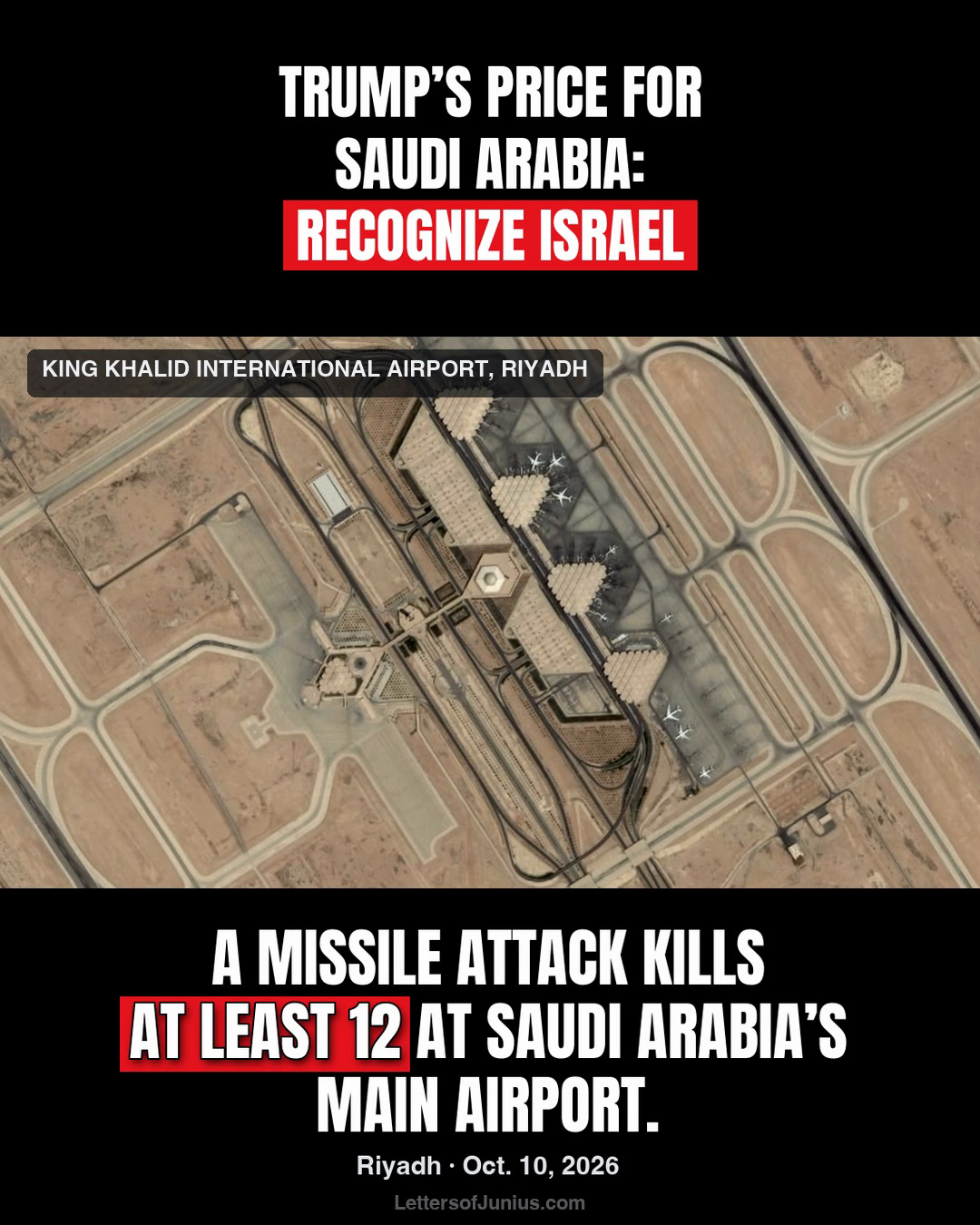
Since then, Saudi Arabia has come under attack from the Houthis. In September, Mohammed bin Salman called Trump twice urging American strikes on the Houthis, Axios reported. Trump declined, and US officials said there was no intention of direct military action "at this time." On Oct. 10, a Houthi missile attack on King Khalid International Airport in Riyadh killed at least 13 people and wounded more than 300, in fighting that Al Jazeera reported had erupted amid the regional tensions set off by the war on Iran. Trump said the Houthis were "misbehaving very badly. No good."
Trump suggested Saudi Arabia turn to Israel. On Oct. 16, asked if he thought Saudi Arabia should accept Israel's help, he said: "I do, I think they will. Israel's been very helpful to Saudi Arabia." Asked whether that could revive Saudi normalization with Israel, he said: "Yeah, I think so, maybe more than ever." Five days later, the State Department ordered nonemergency staff to leave Saudi Arabia, citing Houthi attacks on airports and critical infrastructure.
Washington has less protection to offer. Its own missile defenses were drawn down defending Israel earlier in this war. Against Iranian missiles aimed at Israel, the United States fired more than 200 THAAD interceptors, about half its stock, plus more than 100 interceptors from Navy ships, The Washington Post reported. And Trump wants to be paid for the protection he does provide. "I want to be reimbursed because we're protecting a very rich portion of the world," he said on July 13, naming Saudi Arabia, the UAE, Qatar, Bahrain and Kuwait.
Israel is offering to fill the gap. Saudi Arabia approached Israel indirectly, through US Central Command, for intelligence to keep the Houthis from closing the Bab al-Mandab, the strait at the southern mouth of the Red Sea, Israel Hayom reported, citing regional officials. Netanyahu is trying to "indirectly pressure the Saudis via Washington to advance toward normalization" and to present Israel as "the kingdom's only reliable regional partner," Ben Caspit reported in Al-Monitor, citing two senior Israeli political sources. Early in the war, Israel sent the UAE an Iron Dome battery and several dozen soldiers to run it, the first time it had sent the system abroad, a senior Israeli official told Axios. "We are not going to forget it," a senior Emirati official said. The UAE later denied receiving "any Israeli military delegation." Kuwait has begun proceedings to repeal or amend parts of its law boycotting Israel, unnamed Gulf officials told Israel Hayom.
Riyadh is also looking elsewhere. In August, it signed a mutual-defense pact with Turkey and Pakistan, The Associated Press reported. On Monday, Oct. 26, Saudi Arabia's defense minister, Khalid bin Salman, Pakistan's army chief, Field Marshal Asim Munir, and Turkey's intelligence chief, Ibrahim Kalin, met Iran's top security officials in Tehran to push for a deal between Iran and Washington.
The harder the Gulf is hit, the more protection it needs. And Washington has named its prices: cash and a deal with Israel.
Until after the midterms
On Oct. 8, Trump promised that "we will not be attacking Iran at any time prior to the Midterm Elections to be held in the United States on November 3rd." In the same post, he wrote that "the Blockade will remain in full force and effect."
The promise covers attacks on Iran. It does not cover the war on Iran's economy. Two days later, on Oct. 10, an American fighter jet hit the Chinese-owned freighter Ocean Molica with a precision munition after, according to US Central Command, its crew tried to run the blockade.
Israel had planned its own attack for that same weekend. The Israeli military had been ready to strike Iran's nuclear sites, regime sites and energy plants, the Financial Times reported, citing three people familiar with the matter. Trump, they said, decided not to restart the war before the midterms.
The American and Israeli militaries have also drawn up plans for a "short but intensive" operation after Nov. 3 against Iran's energy infrastructure, nuclear facilities and missile and drone arsenal, The New York Times reported. Some American planners believe that three days of strikes "could cause enough economic damage to change the Iranian position." It is far from certain that Trump will approve them, the Times reported, and a White House official said the administration does not comment on plans "that may or may not exist." Even the next round of the war over Iran's weapons is being measured in economic damage.
Netanyahu wants more than another round of strikes. On Oct. 18, Trump endorsed him in Israel's election. Three days later, at a graduation for Israeli army officers, Netanyahu said: "There is only one way to eliminate this threat once and for all: to topple the regime in Iran. That is my directive to the IDF, the Mossad and the security agencies." On Oct. 23, Trump said: "We may do another little Epic Fury, or they'll agree." On Sunday, Oct. 25, he posted: "Vote for Bibi Netanyahu for Prime Minister, we have to finish the job that we started!" Late that night, on television, Netanyahu said it again: he had "already instructed the Mossad and the IDF" to "bring down this regime." Asked about Netanyahu's remarks, White House deputy press secretary Anna Kelly repeated that "the United States will not be attacking Iran at any time prior to the midterm elections," and said the blockade would stay in place. Israelis vote on Tuesday, Oct. 27. The last Maariv poll gave Netanyahu's coalition 48 of the Knesset's 120 seats, well short of a majority.
Whoever wins in Israel on Tuesday and in America on Nov. 3, the blockade has no end date. Trump's election promise excluded it in writing.
The war over Iran's weapons is on hold until after the midterms. The war behind it is not.
Sources
- 41NBC: live updates from Trump's rally in Perry, Ga. (Oct. 24, 2026)
- AP via Fortune: Trump says the US is "making a freaking fortune" as gas and diesel prices climb (Oct. 26, 2026)
- Fox 5 DC: Pentagon casualty report shows 21 deaths and 865 injured (Oct. 19, 2026)
- HRANA: casualty totals in Iran after 39 days of US and Israeli attacks (Apr. 7, 2026)
- AP via PBS NewsHour: Trump suggests high oil prices are a positive (March 12, 2026)
- AP via PBS NewsHour: read Trump's full statement on the Iran attacks (Feb. 28, 2026)
- The National: Trump rules out an attack on Iran before the midterm elections (Oct. 8, 2026)
- Reuters via Al-Monitor: Netanyahu touts Trump's endorsement on the eve of the vote (Oct. 26, 2026)
- US Energy Information Administration: the Strait of Hormuz remains a critical oil chokepoint (June 16, 2025)
- Qatar Tribune, citing UKMTO and Kpler: the US and Iran both claim control of Hormuz (Oct. 18, 2026)
- Deseret News: Bessent announces Operation Economic Outcast (Aug. 24, 2026)
- Jerusalem Post: Trump says Iran must "give us everything" (Oct. 10, 2026)
- Times of Israel, citing Axios: Netanyahu and Trump began planning a joint strike in December (March 1, 2026)
- Axios: how Trump and Netanyahu coordinated before the war (March 3, 2026)
- Axios: Netanyahu asked Trump to hold off on striking Iran (Jan. 16, 2026)
- Anadolu via A News, citing The Wall Street Journal: Gulf states warn the US against striking Iran (Jan. 14, 2026)
- Bernama via Free Malaysia Today: Iran's parliament votes to close the Strait of Hormuz (June 22, 2025)
- US Central Command: US forces launch Operation Epic Fury (Feb. 28, 2026)
- Marine Insight: the IRGC declares the Strait of Hormuz closed (March 3, 2026)
- Keystone-SDA via blue News: Brent rises to its highest level since early 2022 (April 30, 2026)
- 8am Media: Shehbaz Sharif signs the Iran-US memorandum of understanding (June 18, 2026)
- NPR via Michigan Public: full text of the preliminary US-Iran agreement (June 18, 2026)
- Middle East Monitor: Netanyahu says Israel is not a party to the US-Iran memorandum (June 12, 2026)
- AFP via Khaleej Times: Iran closes the Strait of Hormuz again after strikes in Lebanon (June 20, 2026)
- Al Jazeera: Trump blames Iran for a "foolish" strike on a cargo ship (June 26, 2026)
- NPR: Trump says the ceasefire with Iran is over (July 8, 2026)
- US Central Command: US forces to resume the naval blockade against Iran (July 13, 2026)
- NPR: Trump announces a two-week ceasefire with Iran (April 7, 2026)
- The Maritime Executive: the US hits a Chinese-owned freighter, claiming it ran the blockade (Oct. 11, 2026)
- The White House: Operation Economic Outcast (Aug. 24, 2026)
- Shafaq News, citing Bloomberg: Iran's crude loadings fall to zero in September (Oct. 1, 2026)
- bne IntelliNews: Iran's rial slides past 2 million per dollar on the open market (Aug. 24, 2026)
- JFeed: the Iranian rial loses over half its value in 2026
- Iran International: official data show consumer prices 89.8% higher than a year earlier (Oct. 2, 2026)
- Iran International: the IMF projects Iran's economy will shrink 7.6% (Oct. 13, 2026)
- Iran International: Bessent predicts Iran’s economy will shrink more than 25% and tells Iranians to stock up on heating fuel (Oct. 26, 2026)
- CBS News: the administration turns to prize law for seized Iranian tankers (Sept. 3, 2026)
- Bloomberg via gCaptain: seized Iranian tankers head toward the US with a $600 million cargo (Sept. 25, 2026)
- The Maritime Executive: the US appears set to seize $600 million in Iranian crude from three tankers (Sept. 25, 2026)
- National Law Review: the new Houston prize court (Oct. 26, 2026)
- Reuters via MarketScreener: Trump likens the Navy's seizure of oil cargo to pirates (May 2, 2026)
- US Energy Information Administration: US petroleum exports reach a record in April (July 8, 2026)
- US Energy Information Administration: US LNG exports rose 23% in the first half of 2026 (Sept. 1, 2026)
- Bloomberg via Energy Connects: LNG buyers look to the US to hedge Hormuz risk (Sept. 15, 2026)
- Euronews: the US expands its Russian oil waiver to all buyers (March 13, 2026)
- Platts via Hellenic Shipping News: the US lets the Russian oil waiver expire (June 19, 2026)
- Reuters via AOL: the Iran war doubles Russia's oil tax revenue (April 9, 2026)
- TASS, citing the IEA: Russia's oil export revenue in September (Oct. 14, 2026)
- AP via Spectrum News: Trump says the US will get diesel from Russia (Oct. 9, 2026)
- Clyde & Co: OFAC authorizes US imports of Russian diesel (October 2026)
- Al-Monitor: the US fast-tracks $16.5 billion in arms sales to the UAE, Jordan and Kuwait (March 2026)
- Bloomberg News via Bloomberg Law: the Pentagon seeks $18.2 billion in war funds for interceptors (July 31, 2026)
- AP via KSAT: company backed by Trump's sons looks to sell drone interceptors to Gulf states being attacked by Iran (April 2, 2026)
- IBTimes UK: the FT's count of oil futures traded before Trump's March 23 post, and the CFTC referral (Oct. 13, 2026)
- NPR: trades made before Trump delayed plans to attack Iran raise insider-trading concerns (March 26, 2026)
- ABC News via ABC7 New York: DOJ probing $2.6 billion in oil trades related to the Iran war (May 7, 2026)
- Reuters via Mining.com: oil price bets ahead of Iran war news totaled $7 billion (May 8, 2026)
- The New Republic, citing Bloomberg: a Trump official tries to kill a report on perfectly timed oil trades (Oct. 13, 2026)
- Yonhap via The Korea Times: Bessent says Hormuz will be "like a worthless piece of water" (Sept. 2, 2026)
- Bloomberg via gCaptain: Qatar's energy chief says Bessent is "wrong" about Hormuz (Sept. 20, 2026)
- AP via Fox59: a drone-hit Saudi pipeline will be out for weeks as Houthi rebels seize more Red Sea islands (Sept. 14, 2026)
- Breitbart, on Netanyahu's Newsmax interview: rerouting pipelines to the Mediterranean (March 31, 2026)
- Reuters via EnergyNow: Israel's energy minister touts an oil pipeline to bypass Hormuz (July 2026)
- The New Arab: Israel to propose a Saudi-Israel oil pipeline (2020)
- Israel Hayom: Israel and Gulf states pursue a secret energy corridor to bypass Hormuz (Aug. 5, 2026)
- The American Presidency Project: memorandum of understanding on the India-Middle East-Europe Economic Corridor (Sept. 9, 2023)
- Australian Institute of International Affairs: the India-Middle East-Europe Economic Corridor, promises and challenges
- ANI via Devdiscourse: France's IMEC envoy on new members and a ministerial meeting (Oct. 6, 2026)
- Kyiv Post: von der Leyen after the EU summit in Nicosia (April 25, 2026)
- AP via Fortune: Europe looks to IMEC and other routes around Hormuz (June 18, 2026)
- Congressional Budget Office: S. 4443, Eastern Mediterranean Gateway Act (2026)
- GovInfo: text of S. 4443, the Eastern Mediterranean Gateway Act
- GovInfo: S. 4443 as reported in the Senate (July 27, 2026)
- Semafor: the UAE plans a new pipeline to bypass Hormuz (May 18, 2026)
- Times of Israel: Turkey and Saudi Arabia agree on a regional railway bypassing Israel (June 2026)
- Siasat, citing Middle East Eye: Saudi Arabia eyes a Syria route for its Greece fiber-optic cable (Feb. 21, 2026)
- European Council on Foreign Relations: the India-Middle East-Europe corridor needs a wartime redesign (May 22, 2026)
- Eastern Eye: Israel's oil pipeline pitch to Gulf states (Aug. 10, 2026)
- Hawaii News Now: Trump delays a planned Iran attack (May 18, 2026)
- Axios: Trump calls off an attack on Iran (Aug. 2, 2026)
- AP via KUTV: Trump cites Gulf leaders' input in holding off on Iran strikes (Aug. 2, 2026)
- AP via WSLS: Gulf allies privately make the case to Trump to keep fighting (March 30, 2026)
- The American Presidency Project: Trump's Truth Social posts of May 25, 2026
- Jewish Insider: Trump presses Gulf countries on the Abraham Accords (May 27, 2026)
- NPR: a look at Trump’s plan to build on the Abraham Accords (May 28, 2026)
- NPR: Trump says Saudi Arabia’s nuclear deal hinges on normalizing ties with Israel (July 23, 2026)
- AP via KFVS12: Karoline Leavitt will leave at month's end (Aug. 12, 2026)
- Reuters via WHBL, citing Axios: Trump declines the Saudi crown prince's call for strikes on the Houthis (Sept. 10, 2026)
- Al Jazeera: Houthi missile attack targets Riyadh for a third day (Oct. 12, 2026)
- Times of Israel: Trump says Israel has been "very helpful" to Saudi Arabia (Oct. 16, 2026)
- CBS News: the US orders nonemergency staff out of Saudi Arabia (Oct. 21, 2026)
- The Washington Post: the US used about half its THAAD interceptors defending Israel (May 21, 2026) · free summary via LIGA.net
- Washington Examiner: Trump wants to be reimbursed for protecting the region (July 13, 2026)
- Voz: Trump says Gulf countries will have to pay the US to protect Hormuz (July 14, 2026)
- Israel Hayom: Saudi Arabia and Israel in talks through CENTCOM over the Houthi threat (Sept. 15, 2026)
- Al-Monitor (Ben Caspit): how Netanyahu is leveraging the Houthi threat (September 2026)
- Axios: Israel sent an Iron Dome battery to the UAE (April 26, 2026)
- AFP via Free Malaysia Today: the UAE denies reports of a secret Netanyahu visit (May 14, 2026)
- Israel Hayom: Kuwait moves on its boycott law (Sept. 16, 2026)
- AP via News4JAX: how the Mecca defense agreement between Turkey, Pakistan and Saudi Arabia will work (Oct. 21, 2026)
- AP via PBS NewsHour: delegations meet in Iran as the Middle East fears renewed fighting (Oct. 26, 2026)
- Colorado Politics: Trump pledges not to attack Iran before the midterm elections (Oct. 8, 2026)
- Times of Israel, citing the Financial Times: Netanyahu planned an attack on Iran earlier this month but Trump opposed it (Oct. 21, 2026)
- The New York Times via The Irish Times: US and Israel draw up plans for renewed strikes on Iran after the elections (Oct. 22, 2026)
- AP via ITV: Trump endorses Netanyahu for reelection (Oct. 18, 2026)
- Ynet: Netanyahu's directive to topple the regime in Iran (Oct. 21, 2026)
- Ynet: Trump says "we may do another little Epic Fury" (Oct. 23, 2026)
- Jerusalem Post: the final Maariv poll before Israel's election (Oct. 23, 2026)
Video article: footage, photo, map and document credits
Scenes of the people in this story come from official U.S. government video and photographs (works of the United States government, public domain) and from photographs published under Creative Commons licences. The map is NASA's Blue Marble satellite image with places and routes drawn from public data. The calendar is drawn from the article's own graphic. Documents shown are the published pages of the documents the narration quotes. Creative Commons material, with the credit each licence requires:
- 186th Flight Course Graduates Receiving Their Wings, June 2023 IX — IDF Spokesperson's Unit photographer, CC BY-SA 3.0
- 186th Flight Course Graduates Receiving Their Wings, June 2023 VII — IDF Spokesperson's Unit photographer, CC BY-SA 3.0
- 2018-09-26 Iran, Tehran, Azadi Tower (3) — Laurens R. Krol, CC BY 4.0
- 2019-07-16 11 19 07 View south along Interstate 95 (John F. Kennedy Memorial Highway) from the overpass for Maxa Road in Chapel, Harford County, Maryland — Famartin, CC BY-SA 4.0
- AC SO Karlspreisverleihung 2026 14. Mai Krönungssaal Ursula von der Leyen I — Grunpfnul, CC BY-SA 4.0
- Ambassador Mike Huckabee visits Chevron with Minister of Energy Eli Cohen on August 18, 2025 - 15 — U.S. Embassy Jerusalem, CC BY 4.0
- Andriy Yermak and İbrahim Kalın in Istanbul (2022-10-02) — President of Ukraine, CC BY 4.0
- Benjamin Netanyahu, February 2023 (head cropped) — Avi Ohayon, CC BY-SA 3.0
- Cheniere Sabine Pass LNG Terminal — Quintin Soloviev, CC BY 4.0
- Consensus 2025 - Eric Trump 10 — Xuthoria, CC BY-SA 4.0
- Donald Trump, Jr. (55021618832) (cropped 2) — Gage Skidmore from Surprise, AZ, United States of America, CC BY-SA 4.0
- Eli Cohen (ISH 7909) — Itzhak Harari, CC BY-SA 4.0
- Gas Nozzle (14319856710) — Mike Mozart from Funny YouTube, USA, CC BY 2.0
- Grand Bazaar, Tehran (41723682865) — Ninara from Helsinki, Finland, CC BY 2.0
- Grand Bazaar, Tehran (41906451204) — Ninara from Helsinki, Finland, CC BY 2.0
- Gérard Mestrallet — MEDEF, CC BY-SA 2.0
- Haifa Port P1040621 — Deror_avi, CC BY-SA 3.0
- Official Portrait of Ursula von der Leyen (cropped) — Etienne Ansotte, CC BY 4.0
- Oil tanks, Fujairah Port — Jpbowen, CC BY-SA 4.0
- PikiWiki Israel 41738 Oil terminal in Eilat — Dr. Avishai Teicher, CC BY 2.5
- President Putin meeting President of Iran Masoud Pezeshkian (2025) 01 — President of Russia, CC BY 4.0
- Prime Minister Orpo and His Highness the Amir of the State of Qatar, Sheikh Tamim bin Hamad Al Thani met in Helsinki 5 September 2024 (53972916770) (cropped) — FinnishGovernment, CC BY 2.0
- Ras Laffan LNG terminal in 2012 — Matthew Smith @ Flickr, CC BY 2.0
- Tajrish Bazaar (38993400174) — # IranOpenAlbum (Barbara Slavin), CC BY 2.0
- Tehran Skyline, Milad Tower and Alborz Mountains, Iran (10059004754) — Julia Maudlin from Lake Oswego, Oregon, USA, CC BY 2.0
- VP Pence visits the Knesset VP Pence visits the Knesset (39810052212) — U.S. Embassy Tel Aviv, CC BY 2.0
- Vladimir Putin (2026 02 23) (cropped) — Kremlin.ru, CC BY 4.0
- Vladimir Putin (2026 02 23) — Kremlin.ru, CC BY 4.0
- Vladimir Putin and Marat Kambolov 13 July 2026 (1) — Press Service of the President of the Russian Federation, CC BY 4.0
Cover image, a composite of these pictures over the video's map:
- Donald Trump, a frame of the White House video of his remarks on the South Lawn, Oct. 16, 2026 — The White House, public domain
- Benjamin Netanyahu at Mar-a-Lago, Dec. 29, 2025 — The White House, public domain
- Mohammed bin Salman at the White House, Nov. 18, 2025 — The White House, public domain
- Scott Bessent, official portrait — U.S. Department of the Treasury, public domain
- Vladimir Putin, Feb. 23, 2026 — Kremlin.ru, CC BY 4.0
Map data:
- Base map: NASA Blue Marble: Next Generation, via NASA GIBS (public domain)
- Pipeline routes: © OpenStreetMap contributors (ODbL)
Public-domain sources (The White House, U.S. Department of Defense/DVIDS, U.S. Central Command, U.S. Department of State, U.S. Air Force, U.S. Navy, U.S. Army, NASA, U.S. Treasury, U.S. Energy Information Administration):
- 10000 Rials banknote of the Islamic Republic of Iran (Parsa 2au)
- 2025 Crown Prince and Prime Minister Mohammed bin Salman Al Saud of Saudi Arabia on November 18 (cropped) (MBS_identity.jpg, 1350x1791)
- 230315-F-WM701-1002 - F-35I Adir at Red Flag (Airman 1st Class Trevor Bell)
- 230317-F-WM701-1015 - F-35I Adir at Red Flag (Airman 1st Class Trevor Bell)
- Ambassador Shapiro Tours the Iron Dome Battery in the South of Israel (6025573531) (U.S. Department of State)
- Anna Kelly (Kelly_identity.jpg, 944x1132)
- Asim Munir in the Oval Office - 2025 (cropped) (none needed)
- Donald Trump state visit to Saudi Arabia, 2025-05-13 P20250513DT-0172 (President Donald Trump speaks with Saudi Crown Prince Mohammed Bin Salman Al Saud after his arrival to King Khalid International Airport in Riyadh, Saudi Arabia, Tuesday, May 13, 2025. (Official White)
- Donald Trump state visit to Saudi Arabia, 2025-05-13 P20250514DT-0220 (President Donald Trump poses for a group photo with leaders of the Gulf Cooperation Council, Wednesday, May 14, 2025, at the Ritz Carlton Riyadh in Saudi Arabia. (Official White House Photo by Daniel Torok))
- Donald Trump state visit to the United Arab Emirates, 2025-05-15 P20250515DT-1571 (President Donald Trump meets with UAE President Sheikh Mohamed bin Zayed Al Nahyan, Thursday, May 15, 2025, in the Presidential Flight Terminal at Abu Dhabi International Airport in the United Arab Emirates. (Official Wh)
- Donald Trump state visit to the United Arab Emirates, 2025-05-15 P20250515DT-1641 (cropped) (President Donald Trump meets with UAE President Sheikh Mohamed bin Zayed Al Nahyan, Thursday, May 15, 2025, in the Presidential Flight Terminal at Abu Dhabi International)
- Hadi Amr 2021 (Amr_identity.jpg, 1600x2000)
- Iss064e046338 (NASA Johnson Space Center)
- Khalid bin Salman Al Saud 2025 (cropped) (KhalidBinSalman_identity.jpg, 1500x2000)
- Kharg Island.webp (NASA)
- Michael Selig.jpg) (Selig_identity.jpg, 1333x2000)
- Official portrait of Secretary Marco Rubio, January 2025 (U.S. Department of State)
- Official portrait of Treasury Secretary Scott Bessent (head cropped) (Bessent_identity.jpg, 890x1352)
- P20250925DT-0884 President Donald Trump meets with Prime Minister Shehbaz Sharif and Field Marshal Asim Munir of Pakistan (cropped) (Sharif_identity.jpg, 533x649 (crop))
- P20251229DT-0215 President Donald Trump hosts a bilateral meeting with Israeli Prime Minister Benjamin Netanyahu (President Donald Trump hosts a bilateral meeting with Israeli Prime Minister Benjamin Netanyahu, Monday, December 29, 2025, at the Mar-a-Lago Club in Palm Beach, Florida. (Official White House Photo by Daniel Torok))
- P20251229DT-0476 President Donald Trump hosts a bilateral meeting with Israeli Prime Minister Benjamin Netanyahu (President Donald Trump participates in a bilateral press conference with Israeli Prime Minister Benjamin Netanyahu, Monday, December 29, 2025, at the Mar-a-Lago Club in Palm Beach, Florida. (Official White House Photo by)
- P20251229DT-0522 President Donald Trump hosts a bilateral meeting with Israeli Prime Minister Benjamin Netanyahu (President Donald Trump participates in a bilateral press conference with Israeli Prime Minister Benjamin Netanyahu, Monday, December 29, 2025, at the Mar-a-Lago Club in Palm Beach, Florida. (Official White House Photo by)
- P20251229DT-0571 President Donald Trump hosts a bilateral meeting with Israeli Prime Minister Benjamin Netanyahu (The White House)
- P20260307DT-1380 The Dignified Transfer of Remains of Six U.S. Soldiers (President Donald J. Trump and First Lady Melania Trump attend the Dignified Transfer of remains of six U.S. soldiers killed in an Iranian drone strike in Kuwait, Saturday)
- P20260501DT 3794 President Donald J. Trump attends a dinner for the Forum Club of the Palm Beaches (The White House)
- P20260528AM-0092 Treasury Secretary Scott Bessent holds a White House Press Briefing (cropped) (The White House)
- Pinckney conducts blockade operations (1003285) (NAVCENT Public Affairs)
- President Donald J. Trump meets with Israeli Prime Minister Benjamin Netanyahu (55428012347) (The White House)
- President Donald J. Trump meets with Israeli Prime Minister Benjamin Netanyahu (55428988096) (The White House)
- President Donald J. Trump meets with Israeli Prime Minister Benjamin Netanyahu (55429150214) (President Donald J. Trump meets with Israeli Prime Minister Benjamin Netanyahu, Tuesday, July 28, 2026, in the Oval Office. (Official White House Photo by Daniel Torok))
- President Donald J. Trump on the United States Military Major Combat Operations in Iran - February 28, 2026 (The White House)
- President Donald J. Trump oversees Operation Epic Fury at Mar-a-Lago (55124355922) (President Donald J. Trump oversees Operation Epic Fury at Mar-a-Lago, Palm Beach, FL, March 1, 2026. (White House photo by Daniel Torok))
- President Donald J. Trump oversees Operation Epic Fury at Mar-a-Lago, Palm Beach, FL, Feb. 28, 2026. (White House photo by Daniel Torok) (55121342816) (President Donald J. Trump oversees Operation Epic Fury at Mar-a-Lago, Palm Beach, FL, Feb. 28, 2026. (White House photo by Daniel Torok))
- President Donald J. Trump oversees Operation Epic Fury at Mar-a-Lago, Palm Beach, FL, Feb. 28, 2026. (White House photo by Daniel Torok) (55121599274) (President Donald J. Trump oversees Operation Epic Fury at Mar-a-Lago, Palm Beach, FL, Feb. 28, 2026. (White House photo by Daniel Torok))
- President Donald J. Trump oversees Operation Epic Fury at Mar-a-Lago, Palm Beach, FL, Feb. 28, 2026. (White House photo by Daniel Torok) (55121599389) (President Donald J. Trump oversees Operation Epic Fury at Mar-a-Lago, Palm Beach, FL, Feb. 28, 2026. (White House photo by Daniel Torok))
- President Donald Trump meets with Qatar’s Emir Sheikh Tamim bin Hamad Al-Thani and Prime Minister and Foreign Minister Sheikh Mohammed bin Abdulrahman bin Jassim Al-Thani aboard Air Force One (54883750949) (Secretary of State Marco Rubio looks on as President Donald Trump meets with Qatar’s Emir Sheikh Tamim bin Hamad Al-Thani and Prime Minister and Foreign Minister Sheikh Mohammed bin Abdulrahman bin Jassim Al-Thani aboard)
- President Donald Trump participates in a bilateral meeting with Crown Prince and Prime Minister Mohammed bin Salman Al Saud of Saudi Arabia, Tuesday, November 18, 2025 52 ite 25 (President Donald Trump participates in a bilateral meeting with Crown Prince and Prime Minister Mohammed bin Salman Al Saud of Saudi Arabia, Tuesday, November 18, 2025, in the Oval Office. (Official White House Photo by)
- President Trump Gaggles with Press Upon Arrival at Fort Myers, FL, Oct. 23, 2026 (The White House)
- President Trump Gaggles with Press Upon Departure from the White House, Oct. 12, 2026 (The White House)
- President Trump Gaggles with Press Upon Departure from the White House, Oct. 16, 2026
- President Trump Gaggles with Press Upon Departure from the White House, Oct. 23, 2026 (The White House)
- President Trump Gaggles with Press Upon Departure from the White House, Oct. 25, 2026 (The White House)
- President Trump Gaggles with Press at Joint Base Andrews, Oct. 25, 2026 (The White House)
- President Trump Gaggles with Press on Air Force One En Route Joint Base Andrews, Aug. 2, 2026 (The White House)
- President Trump Participates in a Cabinet Meeting, May 27, 2026
- President Trump Participates in a Greeting with the Secretary General of NATO (The White House)
- President Trump Signs an Executive Order, Jul. 13, 2026
- President Trump and The First Lady Participate in an Abraham Accords Signing Ceremony (The White House)
- Press Secretary Karoline Leavitt Briefs Members of the Media, Jul. 23, 2026 (The White House)
- Riyadh-airport (http://www.amc.af.mil/)
- Secretary Pompeo Meets with the Sultan of Oman Haitham bin Tariq Al Said (49565238561) (Secretary of State Michael R. Pompeo meets with Sultan of Oman Haitham bin Tariq Al Said, in Muscat, Oman, on February 21, 2020. [State Department Photo by Ron Przysucha/ Public Domain])
- Secretary of the Treasury Scott Bessent Briefs Members of the Media, May 28, 2026
- Steven Mnuchin and Qatari MOE Al-Kaabi Feb 2020 (Office of U.S. Treasury Secretary)
- U S Army Soldiers Conduct Operations in the Middle East (9669020) (U.S. Army USARCENT by [null Courtesy])
- U S Forces Enforce Blockade (1016268) ([null Courtesy])
- U S Forces Enforce Blockade Against Iran (1006058) ([null Courtesy])
- U.S. Central Command / DVIDS, "CENTCOM Destroys 3 IRGC Oil Tankers" (1021952)
- U.S. Central Command / DVIDS, "U.S. Forces Complete New Round of Retaliatory Strikes Against Iran" (1013909)
- U.S. Central Command / DVIDS, "U.S. Forces Disable Cargo Vessel Attempting to Violate Blockade" (1026100)
- U.S. Central Command / DVIDS, "U.S. Forces Launch Operation Epic Fury" (997733)
- U.S. Central Command / DVIDS, "U.S. Forces Launch Operation Epic Fury" (997748)
- U.S. Navy / DVIDS, "USS Arleigh Burke (DDG 51) launches a missile for ballistic missile defense" (1008000)
- U.S. Navy / DVIDS, "USS Thomas Hudner supports Operation Epic Fury" (997753)
- USS Rafael Peralta Enforces Blockade (1009085) ([null Courtesy])
- USS Rafael Peralta Watchstanding in the Combat Information Center (1009327) ([null Courtesy])
- Donald Trump: Public domain, White House
Documents shown:
- Federal Register via GovInfo, public domain
- NPR's published text of the memorandum (Copyright 2026 NPR), via Michigan Public; shown as a labelled excerpt
- OFAC General License 134, public domain
- OFAC General License 135, public domain
- S. 4443 as introduced, GovInfo, public domain
- The American Presidency Project (UCSB) archive of the President's posts; shown as a labelled excerpt
- The American Presidency Project (UCSB) archive of the President's posts; shown as a labelled excerpt
- The American Presidency Project (UCSB) archive of the President's posts; shown as a labelled excerpt
- The American Presidency Project (UCSB) archive of the President's posts; shown as a labelled excerpt
- The American Presidency Project (UCSB) archive of the President's posts; shown as a labelled excerpt
- The American Presidency Project (UCSB) archive of the President's posts; shown as a labelled excerpt
- The American Presidency Project (UCSB) archive of the President's posts; shown as a labelled excerpt
- The White House, public domain
- U.S. Department of the Treasury, public domain
- U.S. Energy Information Administration (July 2026), public domain
- U.S. Energy Information Administration (June 2025), public domain
- U.S. Energy Information Administration (Sept. 2026), public domain
The appearance of U.S. Department of Defense visual information does not imply or constitute endorsement.