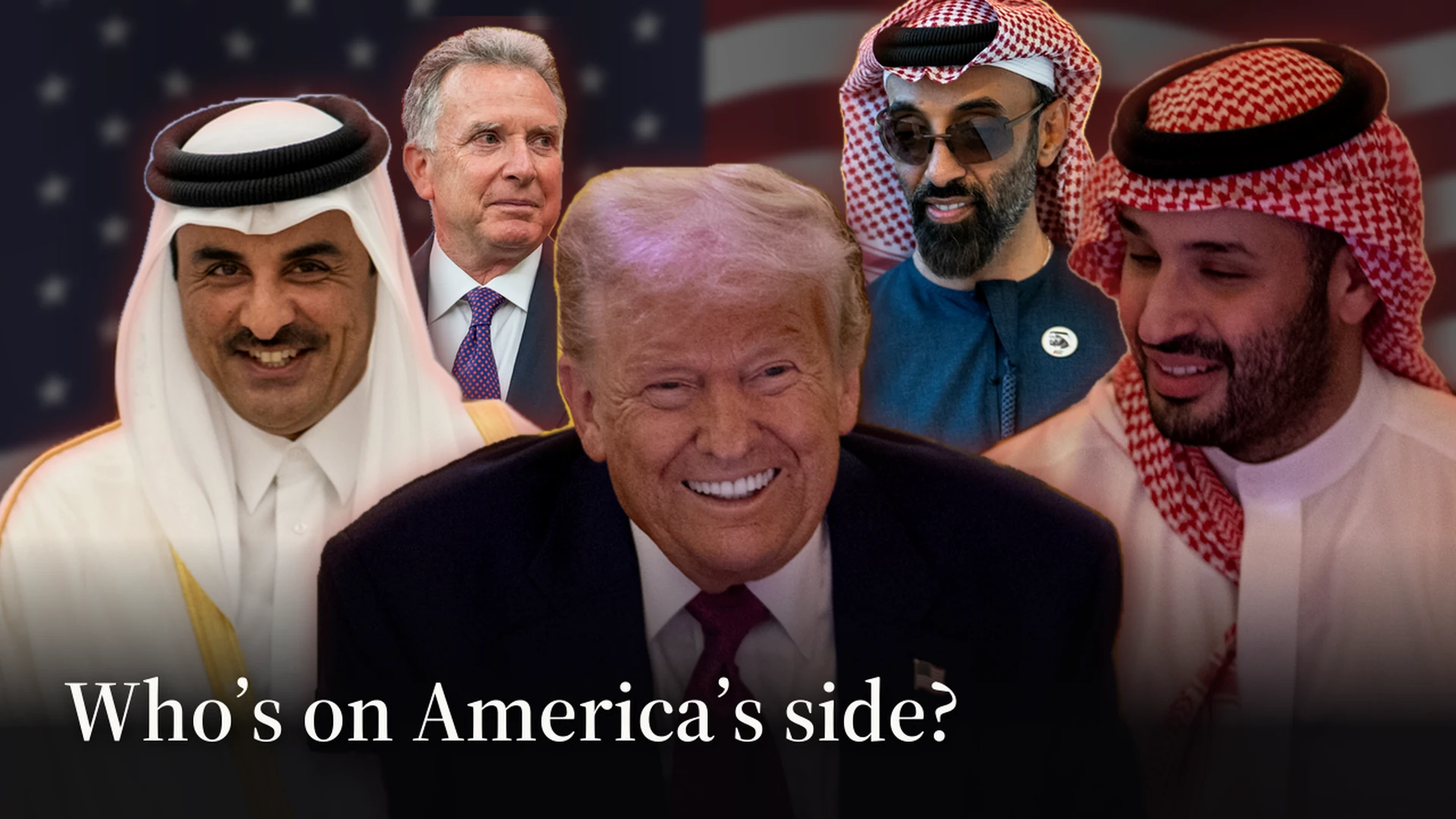
Key players- Donald TrumpPresident; his family’s companies get paid
- Sheikh Tahnoon bin ZayedUAE spy chief; the buyer
- Steve WitkoffTrump’s envoy; World Liberty co-owner
- Jared KushnerSon-in-law and envoy; Gulf-backed fund
All 24
Washington
- Donald Trump
- President. His family’s crypto company, World Liberty Financial, and the Trump Organization sit on the receiving end of the deals.
- Eric Trump
- The president’s son. Helped sign away 49 percent of World Liberty four days before the inauguration.
- Steve Witkoff
- Trump’s Middle East envoy. His family co-owns World Liberty and was paid $48 million by Tahnoon’s company while he negotiated over Gaza and Ukraine.
- Zach Witkoff
- Steve Witkoff’s son and a World Liberty co-founder. Announced the Binance payment and signed both Pakistan deals.
- Jared Kushner
- Trump’s son-in-law and peace envoy. His fund, Affinity Partners, is backed by Saudi, Qatari and Emirati money.
- Pam Bondi
- Attorney general. Listed on a Qatar lobbying contract in 2019; cleared the Qatari jet.
- Kash Patel
- FBI director. His consulting firm advised Qatar’s embassy until November 2024.
Abu Dhabi
- Sheikh Tahnoon bin Zayed Al Nahyan
- The UAE’s national security adviser and the president’s brother. The buyer behind Aryam; chairs MGX and ADQ, controls IHC and G42.
- Aryam Investment 1
- The company that paid $500 million for 49 percent of World Liberty, run with G42 executives.
- World Liberty Financial
- The Trump and Witkoff families’ crypto company. Issues the digital dollar USD1; conditionally approved to run a national trust bank.
- G42
- Tahnoon’s artificial intelligence company. Its executives sit on World Liberty’s board; the main beneficiary of the chip approvals.
- MGX
- A fund Tahnoon chairs. Paid $2 billion into Binance in USD1 and holds 15 percent of TikTok’s American business.
- Binance and Changpeng Zhao
- The world’s largest crypto exchange and its founder. The SEC dropped its case; Trump pardoned Zhao; Binance then adopted USD1.
Qatar
- Qatar’s sovereign fund
- Through Qatari Diar and affiliates: a golf resort with the Trump Organization, the 666 Fifth Avenue rescue, the Park Lane Hotel purchase and a stake in Affinity Partners. The emir’s government supplied the Boeing 747-8.
- Benjamin Netanyahu
- Israel’s prime minister. Let Qatar’s cash into Hamas-run Gaza from 2018; his aides are under investigation for working for Qatar.
- Jonatan Urich and Eli Feldstein
- Netanyahu’s top strategist and former spokesman, arrested in March 2025 over paid work for Qatar.
- Jay Footlik
- American lobbyist for Qatar whose firm paid Feldstein. The Justice Department called off its inquiry into him.
- Hamas
- Received Qatar’s cash in Gaza, at times $30 million a month, with Netanyahu’s approval.
Saudi Arabia
- Mohammed bin Salman
- Crown prince. Overruled his fund’s advisers to put $2 billion into Kushner’s Affinity Partners; left the White House with F-35 clearance and chips for Humain.
- Public Investment Fund
- Saudi Arabia’s sovereign fund. Affinity’s anchor investor; partner in the Trump golf club outside Riyadh and the Paramount deal.
- Humain
- The Saudi state AI company. Cleared to buy the same chips as G42; put $3 billion into Elon Musk’s xAI.
- Ballard Partners
- The lobbying firm closest to the president. Paid $60,000 a month by the Saudi embassy; Bondi’s former firm.
Pakistan
- Field Marshal Asim Munir
- Pakistan’s army chief. Lunch at the White House, then a mediator in the Iran talks.
- Muhammad Aurangzeb
- Pakistan’s finance minister. Signed the World Liberty stablecoin memorandum and the Roosevelt Hotel deal with a US agency.
Four days before Donald Trump was sworn in for a second time, his son Eric helped sign away nearly half of the family's newest business to a buyer almost no one had heard of.
The buyer, a company called Aryam Investment 1, paid $500 million for 49 percent of World Liberty Financial, the crypto company the Trumps run with the family of Steve Witkoff, the real estate developer Trump had already picked as his Middle East envoy. Half the money came upfront: about $187 million to Trump family entities and at least $31 million to the Witkoffs, according to the Wall Street Journal, which uncovered the deal a year later.
Behind Aryam stood Sheikh Tahnoon bin Zayed Al Nahyan, the United Arab Emirates' national security adviser and the brother of its president. He oversees the country's security and intelligence apparatus, which is why Western reporters call him the spy sheikh, and he controls a sprawling network of state investment funds. Executives from his artificial intelligence company, G42, helped run Aryam and took seats on World Liberty's board.
Put plainly: a foreign government's spy chief became the president's family's business partner days before the president took office.
Then American decisions started going his way. What his companies needed most was access to America's most advanced AI chips, the technology Washington guards most tightly, because it decides who leads in artificial intelligence and in the weapons that will run on it. Over the next 19 months, Washington widened the Emirates' access to those chips three times. The Commerce Department's own staff warned that wider access raised the risk the technology would leak to America's adversaries, E&E News reported. The administration went ahead anyway, and its rule credited the Emirates with "a key role advancing U.S. interests during Operation Epic Fury," the war on Iran.
Five weeks later, federal regulators conditionally approved a national trust bank for World Liberty, clearing the way for the family's crypto company to enter the American banking system with Washington's seal on it. Tahnoon and his co-investors own 49 percent of that bank's parent company, the Journal reported.
Asked about the Emirati deal in February, the president said he hadn't known about it. "My sons are handling that, my family is handling it," he said. "And I guess they get investments from different people."
They do. And the people investing tend to need something from Washington.
This isn't one deal. Over 21 months, three Gulf monarchies and Pakistan's army-dominated government sent money or business to the president's family company and to the family firms of both of his Middle East envoys. Qatar's money went further still, into the office of Israel's prime minister. Again and again, the decision the payer wanted arrived within days or weeks. The federal offices built to catch exactly this kind of foreign money looked away or were overruled.
Our Founding Fathers saw this coming. They barred anyone holding federal office from accepting "any present, Emolument, Office, or Title, of any kind whatever, from any King, Prince, or foreign State" without the consent of Congress. Congress consented to none of this.
Call it what it is: a market in American decisions. Foreign rulers who want a chip license, a security guarantee, a better tariff or a deal approved have learned that the fastest route runs through the president's family and his envoys' businesses. Each capital plays its part. Abu Dhabi buys. Doha pays nearly everyone, including, for years and with Netanyahu's blessing, Hamas. Riyadh comes in through side doors. Islamabad signed two deals with the Trump and Witkoff families' crypto firm, then found itself mediating the Iran talks.
What's for sale is not a hotel room or a round of golf. It's access to the technology America guards most closely, the power to make a federal case go away, a place inside the American banking system, a say in how America's wars end, and, as of this month, a stake in one of its biggest news networks. The people paying the real price aren't in the room. They are the Americans whose security rides on those chips, the American troops who could be sent to defend Qatar, and the Israelis and Palestinians who paid in blood for the years Qatar's cash flowed into Gaza.
The buyer
The clearest look at how this market works is one Abu Dhabi fund, over a single spring.
On May 1, 2025, Zach Witkoff, the envoy's son and a World Liberty co-founder, announced that a $2 billion investment in Binance, the world's largest crypto exchange, would be paid in USD1, the digital dollar his family's company had launched weeks earlier. The investor was MGX, a fund Tahnoon chairs. Binance, Bloomberg later reported, had written the coin's code.
That choice was worth a fortune to the family's company. A digital dollar earns money for its issuer on every dollar parked in it, and Tahnoon's fund chose to route $2 billion through this one. With a single announcement, a foreign government's fund turned the president's family coin into one of the largest digital dollars in the world.
Two weeks later, the White House approved a framework letting the Emirates import up to 500,000 of Nvidia's best chips a year, a fifth of them reserved for G42. Witkoff and David Sacks, the White House AI and crypto adviser, backed it, The New York Times reported. Two weeks after that, the Securities and Exchange Commission dropped its case against Binance.
In October, Trump pardoned Binance's founder, Changpeng Zhao. Zhao had pleaded guilty in 2023 to failing to maintain an adequate anti-money-laundering program. As part of the same 2023 settlement, the Treasury found that his exchange had failed to report transactions with Hamas's armed wing, al-Qaeda and ISIS. While Zhao was seeking clemency, according to the Wall Street Journal, a Binance team was negotiating business with World Liberty. Seven weeks after the pardon, Binance added USD1 trading pairs and moved collateral on its platform into the coin.
One payment in the family's coin. Then a chip deal, a dropped case, and a pardon for the man whose exchange had let terrorist groups trade, all inside six months. The Times summed up that spring in a line: the Emirates got chips, and the Trump team got crypto riches.
By the fall, Tahnoon's network was buying from the envoy's family directly. In September 2025, the Witkoffs sold about half of their World Liberty stake to Aryam for about $48 million after tax, Forbes reported. At that moment Steve Witkoff was negotiating for the United States over Gaza and Ukraine, two wars in which the Emirates had interests of its own. He kept the rest of the stake, and later reported about $107 million in 2025 income from the company that holds it. The family of Trump's special envoy was paid $48 million by a foreign spy chief's company while he was negotiating on America's behalf.
The approvals kept coming. In November 2025, Commerce cleared G42 to buy the equivalent of 35,000 of Nvidia's top processors. Two of G42's leaders sat on World Liberty's board: Martin Edelman, its general counsel and a longtime adviser to Tahnoon's Royal Group, and Peng Xiao, its chief executive, whom the chairman of the House China committee had accused in 2024 of links to Chinese firms developing technology with military uses. In January 2026, World Liberty applied for a federal bank charter. In July, the Emirates moved into the top tier of American export partners, which lets approved Emirati companies receive advanced chips without even applying for a license. In August, the charter was conditionally approved. Two weeks later, the Journal revealed who owned 49 percent of the bank's parent: Tahnoon's group.
Sit with that. A foreign intelligence chief is the president's family's partner in a company the president's regulators have conditionally approved to run a national trust bank, while his government receives American chips that Washington's own experts warned could reach America's adversaries. A mid-level federal employee with a business partner like that would struggle to keep a security clearance.
The public price of the chips was a pledge: in March 2025 the Emirates announced a $1.4 trillion, ten-year investment framework in the United States. The private price was $187 million to the president's family, four days before his inauguration. If those decisions were coming anyway on strategic merit, no one needed to make the second commitment. Someone in Abu Dhabi decided the purchase was worth making.
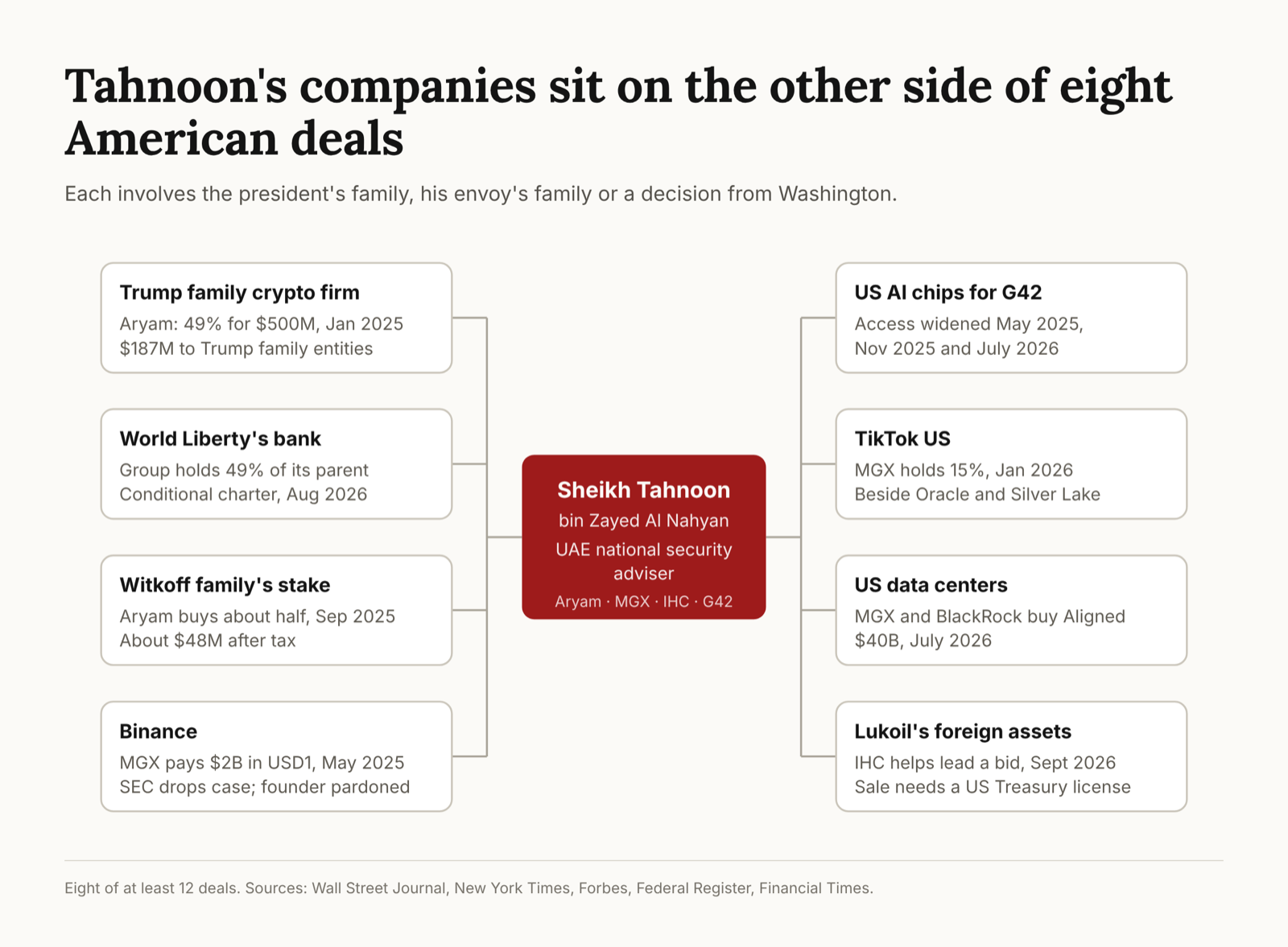
On the far side of every one of these deals sits an American decision.
Tahnoon's reach goes well past the family business. When TikTok's American business was spun off in January 2026, on terms the administration negotiated, MGX took 15 percent. The whole point of that sale was to pull an app used by 170 million Americans out of a foreign government's reach. It ended with a fund chaired by another government's spy chief holding a piece of it.
Silver Lake, MGX's partner in the TikTok deal, is also Kushner's partner, with Saudi Arabia's sovereign fund, in the $55 billion takeover of Electronic Arts. In July 2026, MGX and BlackRock closed a $40 billion purchase of Aligned Data Centers, which runs server campuses in Virginia, Dallas and Phoenix, the facilities that store America's data and run its AI. In March 2026, Tahnoon's holding company, IHC, bought control of Alpha Wave Global, the firm of Kushner's friend Rick Gerson. After the 2016 election, according to the Mueller report, Gerson worked with Kirill Dmitriev, the head of Russia's sovereign wealth fund, on a plan for US-Russian relations that reached Kushner. Dmitriev went on to become Witkoff and Kushner's counterpart in the Ukraine talks.
Abroad, his funds turn up wherever Washington or its closest allies hold the gate. IHC put $2 billion into Gautam Adani's companies months before Adani won Israel's Haifa port. ADQ, the state fund Tahnoon chairs, is backing a consortium, alongside a US government development lender, that agreed to buy 40 percent of Glencore's Congo copper and cobalt, the metals inside electric-car batteries. IHC is helping lead a bid, headed by the Trump donor Todd Boehly, for Lukoil's foreign assets, a sale that can't close without a license from the US Treasury. Those deals are a story of their own.
In 19 months, Tahnoon's companies sat across the table from at least a dozen American decisions. The shortest wait between his money and Washington's answer was two weeks.
The paymaster
If Abu Dhabi is the buyer, Qatar is the paymaster. Its money turns up on nearly every side of the table: with the American president, inside the office of Israel's prime minister, and in Hamas-run Gaza, the enemy of both.
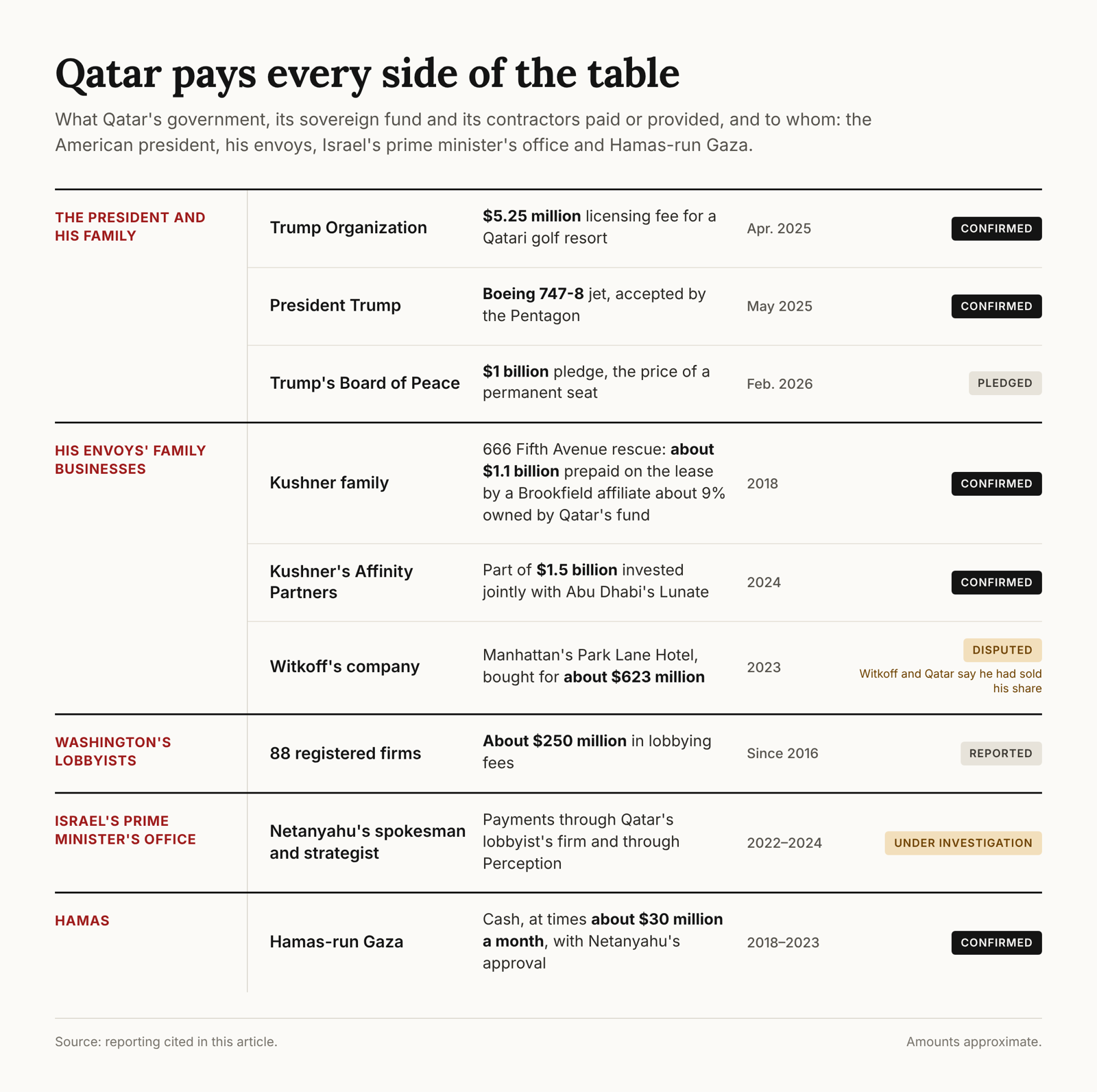
Start with the president. On April 30, 2025, Qatari Diar, the real estate arm of Qatar's sovereign wealth fund, signed with the Trump Organization and the Saudi developer Dar Global to build a $5.5 billion golf resort on the coast north of Doha. The Trump family's licensing fee: $5.25 million.
Two weeks later Trump was in Doha. Qatar Airways ordered up to 210 Boeing jets, and the emir's government offered the president a Boeing 747-8 to fly as Air Force One. The Pentagon took it on May 21. The legal green light came from Pam Bondi, then the attorney general, who six years earlier had been listed as key personnel on the lobbying firm Ballard Partners' contract to represent Qatar's embassy. A memo from Defense Secretary Pete Hegseth calls the plane an "unconditional gift" and lets Trump keep using it after he leaves office. Taxpayers are covering the refit, which the Air Force says cost less than $400 million and Democratic senators put above $1 billion.
The Pentagon calls it a gift to the United States. The memo lets one man keep flying it after he leaves office. A golf deal, then a 747 two weeks later, the jet cleared by a former Qatar lobbyist. If the Constitution's ban on presents from foreign states means anything, it means this.
Qatar had already done business with the family companies of both men Trump sent to the region. In 2018, Kushner's family was drowning in debt on its flagship tower, 666 Fifth Avenue, while Kushner worked in the White House. Brookfield rescued it by prepaying about $1.1 billion on a 99-year lease; Qatar's sovereign fund owned about 9 percent of the Brookfield affiliate that made the deal. In 2023, the same Qatari fund paid about $623 million for the Park Lane Hotel on Central Park South in Manhattan, and property records list Witkoff's company as a seller. Witkoff and Qatar say he had already sold his share. Take them at their word: a company bearing his name still sold a Manhattan hotel to the government he would soon depend on to bring Hamas to the table. In 2024, Qatar's fund and Abu Dhabi's Lunate put $1.5 billion into Kushner's Affinity Partners. And in September 2025, while his father negotiated the Gaza ceasefire, Alex Witkoff pitched a $4 billion fund to Qatari, Emirati and Kuwaiti sovereign funds, The New York Times reported.
So when Trump's two peace envoys sat down with Qatar, Hamas's go-between, each was dealing with a government that had already done business with his family.
Qatar has also spent nearly $250 million on 88 registered lobbying firms in Washington since 2016, according to the Quincy Institute. The people Trump put in charge of American law enforcement came out of that world. Bondi was one. The FBI director, Kash Patel, ran a consulting firm that advised Qatar's embassy until November 2024, Quincy reported, and he received an ethics waiver to work on Qatar matters. The officials who would decide whether to investigate Qatar's influence had worked for Qatar.
Qatar's money was moving through Israel's government too, and for far longer.
From 2018, Netanyahu's governments let Qatar send cash into Hamas-run Gaza, at times about $30 million a month, delivered at first in suitcases. Netanyahu's government defended it as the price of quiet. His own security service concluded it bought far more. A Shin Bet review in March 2025 named the Qatari money as one of the main reasons Hamas grew strong, and the agency's former chief, Ronen Bar, says in a court filing that it was tied to tunnel building. The strength that money helped build was on display on Oct. 7, 2023, when Hamas killed about 1,200 people in Israel and took 251 hostages, starting a war that went on to kill tens of thousands of Palestinians.
About two weeks before Oct. 7, the head of Mossad, David Barnea, flew to Doha and asked Qatar to keep paying for two more months, according to documents published by TIME and confirmed by Israeli and Arab officials, as Israel Hayom reported. Qatar agreed. A senior official from Trump's first administration described the routine: Israeli officials condemned the payments in public and asked Doha to continue them in private. In June 2026, Israel's High Court halted four of the state comptroller's audits into the failures behind Oct. 7. One of them covered Israel's Hamas policy, including the arrangements that let Qatar's cash in. So the cash kept flowing, at Israel's own request, into the last weeks before the attack, and the official audit that would have examined it has been halted.
The money reached Netanyahu's own office. In March 2025, Israeli police arrested his former spokesman, Eli Feldstein, and his top strategist, Jonatan Urich, in an investigation into work for Qatar. Investigators say Feldstein was paid through Third Circle, the firm of the American lobbyist Jay Footlik, by way of two Israeli businessmen. Footlik's Qatar contract let Doha approve his subcontractors, and one $120,000 payment to him landed on Oct. 7, 2023, the investigative outlet Shomrim reported. Urich and his partner, police say, were paid through their firm, Perception, to polish Qatar's image. So while Israel fought Hamas, the men who spoke for Israel's prime minister were, investigators say, also working for the country that hosted Hamas's leaders.
Netanyahu called the allegations fake. On Oct. 19, 2026, eight days before Israel's election, Channel 12 aired leaked transcripts of Urich telling interrogators he kept working for Qatar after Oct. 7 and was paid hundreds of thousands of shekels. "I don't report to the prime minister about what I do," he said. A convenient thing for the prime minister's top strategist to tell the police. Officially, Netanyahu is only a witness. Look at what he witnessed: Qatar's money flowing into Gaza under his government, and Qatar's money flowing to the aides in his own office. The one man who never has to answer for either approved the first and hired the men in the second.
In Washington, the thread was cut. In early July 2025, the Justice Department called off a planned inquiry into Footlik that it had coordinated with Israeli police, i24 News reported. The Israelis were never told why. It came two months after Bondi cleared the Qatari jet, and five months after her first-day memo told prosecutors to stop bringing criminal charges against unregistered foreign agents unless the case resembled espionage.
The steepest price Trump has made Netanyahu pay was paid to Qatar. After Israel bombed Hamas leaders in Doha on Sept. 9, 2025, Netanyahu apologized to Qatar's prime minister by phone from the White House, at Trump's insistence. That same day, Trump signed an executive order treating an armed attack on Qatar as a threat to the United States, to be answered with "diplomatic, economic, and, if necessary, military" measures. The United States is now pledged to defend, with force if necessary, the country that hosted Hamas's leaders and sent cash into Gaza for years, by order of a president whose family business Qatar had paid months earlier.
Even the prices aren't new. During the 2017 Gulf blockade, Jeffrey Epstein advised that Qatar recognize Israel or pledge $1 billion to a victims' fund to stay in favor with Trump's administration, according to documents in the Epstein files the Justice Department released in January. Qatar did neither at the time. Nine years later, the charter of Trump's Board of Peace, the body he chairs to oversee Gaza's future, set the price of a permanent seat at $1 billion in cash. Qatar pledged $1 billion. In May, Trump named Qatar among six states he said must join the Abraham Accords. The same two prices, nine years apart.
In June 2026, Qatar picked up one more job. Under a plan Washington and Doha drew up to carry out the US-Iran memorandum, Qatar would approve how Iran spends the $6 billion of its money held in Qatar. The paymaster holds the enemy's money too.
Riyadh's side doors
Saudi Arabia never needed the family's coin. It got in early, through the son-in-law. In 2021, six months after Kushner left the White House, where he had been the crown prince's most important ally, including after the 2018 murder of the journalist Jamal Khashoggi, Saudi Arabia's Public Investment Fund put $2 billion into his brand-new firm, Affinity Partners. The fund's own advisers recommended against it; Crown Prince Mohammed bin Salman overruled them, The New York Times reported. By mid-2024, Senate Finance Committee staff found, Affinity had collected up to $157 million in fees, $87 million of it from the Saudi government, while reporting no returns to its investors. A fund that collected that much in fees while returning nothing looks less like an investment than a retainer. By 2025 it managed about $6 billion, roughly 99 percent of it foreign.
When Kushner went back to work for his father-in-law, the money kept coming. In March 2026, the Times reported he was raising $5 billion or more for a second fund, with Saudi Arabia's fund as the anchor investor. In September, The New Yorker reported that Affinity had raised about $5 billion from Middle Eastern investors while Kushner was negotiating with Iran, and that Saudi money paid for about $300 million of Affinity's stake in Phoenix Financial, an Israeli insurer that holds $265 million of Elbit Systems, Israel's largest listed arms maker. As an unpaid envoy, Kushner files no public financial disclosure. Americans cannot see who is paying the man negotiating for them.
So the man negotiating with Iran for the United States was raising money from the Gulf governments with the most riding on those talks, and some of that money ended up behind an Israeli weapons maker.
Then the crown prince came to Washington. On Nov. 18, 2025, he left the White House with major non-NATO ally status, which moves a country to the front of the line for American weapons and military cooperation; and clearance to buy F-35s, America's most advanced fighter jet, which no Arab country has ever received. The next day, Commerce approved Humain, his state AI company, to buy the same volume of chips as G42. Fifty-five days after the visit, the Trump Organization announced two Saudi projects: a $1 billion Trump Plaza in Jeddah and a Trump golf club outside Riyadh, built with a company the Saudi sovereign fund owns. On Feb. 18, Humain put $3 billion into xAI, the AI company of Elon Musk, the biggest donor of the 2024 election, Semafor reported. All the while, Saudi Arabia's embassy has been paying Ballard Partners, the lobbying firm closest to the president, $60,000 a month.
Humain got the same chips as G42 without owning a piece of World Liberty. It didn't need to. Saudi Arabia paid through other doors: the son-in-law's fund before the decision, the family business after it, the lobbyists closest to the president throughout.
Gulf money also bought into what Americans watch. When Paramount bid $108 billion for CNN's parent, Warner Bros. Discovery, funds from Saudi Arabia, Qatar and Abu Dhabi took $24 billion of non-voting equity, structured, Fortune reported, to avoid a national security review. In March 2026, after CNN reported on the Strait of Hormuz, Hegseth said he hoped David Ellison would get the network. In September, the Federal Communications Commission cleared foreign investors to hold up to 100 percent of the merged company's non-voting equity; the Saudi, Emirati and Qatari state funds hold 38.5 percent of it. Paramount closed the deal on Oct. 6. On Oct. 19, Christiane Amanpour said she was leaving after 43 years. Three of the governments in this article now hold a large stake in the company that owns the network that reports on them.
What none of this has bought is Saudi Arabia's signature on the Abraham Accords. Riyadh still demands an irreversible path to a Palestinian state first. That tells you exactly what the money is for. It buys American decisions. It doesn't buy Saudi ones.
Islamabad
Pakistan's story is the strangest of the four, because almost no money changed hands at all.
Days after the April 2025 massacre of tourists at Pahalgam pushed India and Pakistan, two nuclear powers, toward war, a World Liberty delegation including Zach Witkoff landed in Islamabad. On April 26, the company signed a letter of intent with the Pakistan Crypto Council, a body set up under the finance ministry, whose chief executive became a World Liberty adviser.
Pakistan's year in Washington then went remarkably well. On May 10, Trump announced the India-Pakistan ceasefire. In June he hosted Field Marshal Asim Munir, Pakistan's army chief, for lunch at the White House, the first time a US president had received a Pakistani army chief who wasn't also head of state. Pakistan nominated Trump for the Nobel Peace Prize. In July its tariff was set at 19 percent. India's, America's supposed partner against China, climbed to 50 percent by the end of August and stayed there for five months. In September, a US company signed a $500 million minerals deal with the army-run Frontier Works Organisation.
In January 2026, a week after World Liberty applied for its bank charter, Pakistan's finance minister, Muhammad Aurangzeb, signed a memorandum with a World Liberty affiliate to explore using USD1 for cross-border payments. Zach Witkoff signed for the company; Munir and Prime Minister Shehbaz Sharif met the delegation. Five weeks later, Aurangzeb signed a second memorandum, this one with the US General Services Administration, the agency that manages the federal government's own buildings, to "operate, maintain, renovate and redevelop" the Roosevelt Hotel in Manhattan, a property owned by Pakistan's national airline and worth, industry insiders say, about $1 billion. Pakistan's finance ministry said Steve Witkoff had "negotiated and stewarded" it. Bisnow found no US financial interest in the property and called the arrangement unusual. An American agency agreed to help run and redevelop a foreign government's hotel, steered by an envoy whose son had just signed a crypto deal with that same government.
By April, Pakistan was brokering a two-week ceasefire in the Iran war and hosting talks led by Vance, and Munir was flying to Tehran. In June, Pakistan, with Qatar's help, brokered a US-Iran memorandum, and the two then mediated the follow-up talks in Bürgenstock, Switzerland. A government that had signed with the president's family firm a year earlier now sat in the middle of America's biggest negotiation.
Six months after the stablecoin memorandum, there had been no pilot, no licenses and no transactions, officials told Al Jazeera. The paperwork never needed to do anything. A banking professional quoted in that report called it "pay for access." The Pakistani economist Khurram Husain put it more admiringly: access "was the calculation, and it paid off spectacularly."
Nobody checked
Deal after deal passed a checkpoint, a federal office whose whole job is to catch exactly this kind of money. None of those offices stopped it.
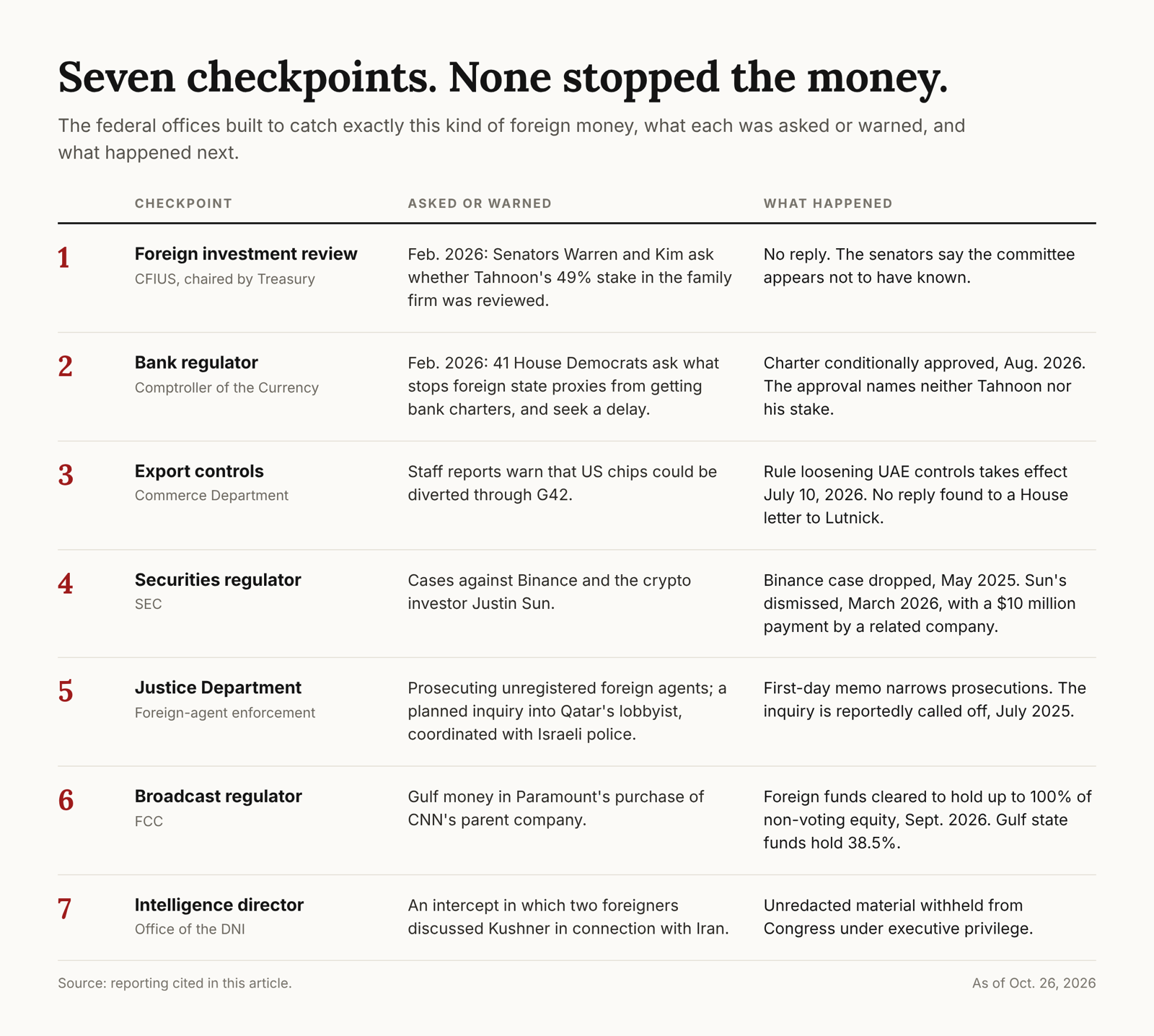
CFIUS, the committee that exists to stop foreign governments from buying sensitive stakes in American companies, apparently didn't know that a foreign intelligence chief had bought 49 percent of the president's family company. That is what Senators Elizabeth Warren and Andy Kim told Treasury Secretary Scott Bessent, who chairs it, in February 2026, when they asked whether the deal had been reviewed. Treasury hasn't answered. Five senior Senate Democrats asked for sworn hearings in June. There have been none.
The Comptroller of the Currency, the regulator that licenses national banks, refused to delay World Liberty's charter and wouldn't say whether the company had disclosed its foreign owner. The approval names neither Tahnoon nor his stake. Warren called it "the most brazen act of self-dealing our financial system has ever seen."
At Commerce, staff had spent months documenting the risks of G42. One person familiar with their reports told E&E News that "the UAE is the primary diversion point for sensitive U.S. technologies in the Middle East." The administration loosened the rules anyway. When House Democrats asked Commerce Secretary Howard Lutnick whether he had discussed the Emirati rules with World Liberty or the Trump family, no answer surfaced.
The intelligence agencies stepped aside too. A whistleblower complaint says that in spring 2025, an intercept of two foreigners discussing Kushner in connection with Iran was restricted by the then-director of national intelligence, Tulsi Gabbard, after she met with the White House chief of staff, Susie Wiles. The DNI's office has refused to give Congress the unredacted material, citing executive privilege, though Kushner held no government job at the time.
Add the SEC, the Justice Department and the FCC from earlier in this story, and that makes seven checkpoints. Not one of them slowed the money down. Every congressional letter about them is still waiting for a real answer.
There is a reason none of this has led to charges. In 2024, a jury convicted Senator Bob Menendez of taking gold bars and cash in bribery schemes that included helping a New Jersey businessman land money from a fund tied to a member of Qatar's royal family. He was sentenced to 11 years. A senator can still be prosecuted for selling his office. A president, since the Supreme Court's immunity ruling that same year, effectively can't. His pardons are beyond any prosecutor's reach, his other official acts are presumed immune, and those acts can't even be used as evidence against him. The scandal isn't what's illegal. It's how much of this the law now allows.
Who can't buy
The market makes the most sense once you see where it breaks down.
The Trump Organization announced 13 foreign projects in nine countries after the 2024 election and took in about $117 million in foreign revenue in its first year back, according to Citizens for Responsibility and Ethics in Washington. Look at where the family's foreign projects have run into trouble.
Indonesia's government halted a Trump-linked resort project in February 2025. In Serbia, prosecutors indicted the culture minister and three others after a heritage official admitted forging the opinion that had cleared Kushner's planned redevelopment of the bombed army headquarters in Belgrade; Affinity walked away in December 2025. In Albania, an anti-corruption prosecutor opened an investigation in June 2026 into the protected-status changes behind Kushner's island resort at Sazan.
Now look at Vietnam, a one-party state. In May 2025, while it was negotiating its tariff rate with Washington, its government approved a $1.5 billion Trump golf resort outside Hanoi. In June 2026, local authorities enforced farmland evictions to clear the site, Bloomberg reported. In a one-party state, there is no independent prosecutor or court to get in the way.
The difference isn't the size of the deal. It's whether the government on the other side can guarantee its part of it. A monarch, a ruling party or an army chief can promise a result and make it happen, with no one in between. A democracy can't. Its prosecutors open cases, its ministries halt projects, its courts get in the way. That is the quiet consequence of all this: in this market, being an autocracy is an advantage.
At home, the favors take the form of pardons and dropped cases. The pardon is the one presidential power no court or Congress can undo, and under this president it keeps going to big donors and their relatives.
Isabela Herrera gave $2.5 million to the pro-Trump super PAC MAGA Inc. in late 2024, while her father, the banker Julio Herrera Velutini, faced federal felony charges. In May 2025, a senior Trump appointee authorized a plea to a single misdemeanor over the objections of career prosecutors, The New York Times reported. She gave $1 million more. In January 2026, Trump pardoned him. Trevor Milton, the founder of Nikola, and his wife gave about $1.8 million before his pardon in March 2025, which ended prosecutors' bid for about $660 million in restitution for the investors a jury found he had defrauded. Paul Walczak was pardoned less than three weeks after his mother attended a $1 million-a-plate dinner for Trump. Crypto.com gave MAGA Inc. at least $10 million, and the SEC closed its investigation of the company in March 2025. The Winklevoss twins gave about $10 million in bitcoin three weeks after the Commodity Futures Trading Commission joined their exchange's request to undo a settlement.
None of this is over. World Liberty's bank is still waiting on final approval. The Treasury license that keeps the Lukoil sale alive expires Nov. 21. And the biggest prize hasn't been handed out yet. The US-Iran memorandum signed in June committed Washington and unnamed "regional partners" to plan a reconstruction fund for Iran worth at least $300 billion. The ceasefire broke down in July before the fund was set up, but the number is now on the table. Read "regional partners" as what it almost certainly means: the same Gulf governments that invest in Kushner's fund.
Asked on 60 Minutes last year about conflicts of interest, Kushner answered: "What people call conflicts of interest, Steve and I call experience and trusted relationships."
He's right about the relationships. Tahnoon's money was promised four days before the inauguration. Qatar's came as a golf deal and a jet. Saudi Arabia's came through the son-in-law. Pakistan spent almost nothing; it signed paperwork that never had to do anything. Each was followed by the decision its sender wanted.
That is the whole story. America's decisions are on the table. The sheikhs are on every side of it. The only people without a seat are the Americans who will live with what gets decided.
Sources
The main sources for this article:
- The Block, summarizing the Wall Street Journal on the Aryam purchase (Feb. 1, 2026)
- E&E News: staff warned of security risks in UAE tech access (July 22, 2026)
- Federal Register: BIS rule on the UAE, effective July 10, 2026
- The Block, summarizing the Journal on Tahnoon's stake in the bank's parent (Aug. 27, 2026)
- Cointelegraph: the OCC's conditional approval (Aug. 17, 2026)
- Bloomberg Government: Trump denies knowledge of the stake (Feb. 2, 2026)
- The National: the Trump Organization's Gulf projects (Sept. 3, 2026)
- Quincy Institute: Qatar's lobbying in Washington
- TIME: documents on how Israel steered Qatari payments to Gaza (Oct. 18, 2026)
- Times of Israel: US reportedly cancels its inquiry into Footlik (July 4, 2025)
- Haaretz: Urich admitted working for Qatar after Oct. 7 (Oct. 19, 2026)
- Semafor: Humain invests $3 billion in xAI (Feb. 18, 2026)
- Bisnow: Pakistan's Roosevelt Hotel agreement (Feb. 20, 2026)
- Al Jazeera: Pakistan's crypto bet (July 3, 2026)
- CREW: 13 foreign developments since the election (Sept. 24, 2026)
- Forbes: donors and clemency (May 7, 2026)
- Bloomberg Law: Binance lapses let Hamas, ISIS and al-Qaeda trade (Nov. 2023)
- Federal Register: Executive Order 14353, Assuring the Security of the State of Qatar (Sept. 29, 2025)
- CBS News: Menendez charged with aiding Qatar (Jan. 2024)
Video article: footage and photo credits
Scenes of the people in this story come from official U.S. government video and photographs (works of the United States government, public domain) and from photographs published under Creative Commons licences. Creative Commons material, with the credit each licence requires:
- 666 Fifth Ave aka Kushner's Burden (41790747711) — oinonio from New York City, USA, CC BY-SA 2.0
- Skyline of Abu Dhabi by night — Darthjipsu, CC BY-SA 4.0
- 2022 - Q&A PO1 4621 (52471974406) — Web Summit, CC BY 2.0
- Doha, skyline by night 01 — Francesco Bini, CC BY-SA 4.0
- Consensus 2025 - Eric Trump 05 — Xuthoria, CC BY-SA 4.0
- Islamabad at night from Damn-e-Koh — Khurram Abbas, CC BY-SA 4.0
- Kushner and Witkoff meeting with President Putin of Russia — kremlin.ru, CC BY 4.0
- Trevor Milton — Miljøstiftelsen ZERO, CC BY 2.0
- Boeing 747-8KB(BBJ) ‘A7-HBJ’ — HawkeyeUK, CC BY-SA 2.0
- Riyadh at night — Kharban wala Ghaltaan, CC BY-SA 4.0
- Roosevelt Hotel — gargola87 from Charlottesville, VA, CC BY-SA 2.0
- Roosevelt Hotel with migrant asylum seekers outside June 2023 — Jonathan Schilling, CC BY-SA 4.0
- NOIRLab HQ Server Racks (6V6A0402-CC) — NOIRLab/NSF/AURA/T. Slovinský, CC BY 4.0
- CERN Computer Center 12 — SimonWaldherr, CC BY-SA 4.0
- TechCrunch Disrupt NY 2015 - Day 3 (17367098816) — TechCrunch, CC BY 2.0
- Steve Witkoff meets members of hostages families forum in Tel Aviv on May 13th 2025 - 2 — U.S. Embassy Jerusalem, CC BY 2.0
- Steve Witkoff (2025) (cropped) — U.S. Embassy Jerusalem, CC BY 2.0
- Wikimedia Foundation Servers 2015 — VGrigas (WMF), CC BY-SA 3.0
- Zach Witkoff at Consensus 2025 — Xuthoria, CC BY-SA 4.0
Public-domain sources (The White House, U.S. Department of Defense/DVIDS, U.S. Senate, U.S. Department of Justice, Architect of the Capitol, U.S. National Archives):
- Pardon of Changpeng Zhao — Pardon Attorney (Public domain)
- President Trump Arrives Amiri Diwan, May 14, 2025 — The White House (Public domain)
- President Trump Participates in a Signing Ceremony and an Exchange of Agreements, May 14, 2025 — The White House (Public domain)
- U.S. Forces Launch Operation Epic Fury, U.S. Central Command (DVIDS, public domain)
- F-35A night operations, 325th Fighter Wing, Tyndall AFB (DVIDS, public domain)
- President Trump Participates in Swearing In Ceremony for the Director of National Intelligence-001 — The Trump White House (Public domain)
- Senate Banking Committee hearing, Feb. 26, 2026 (Senate feed, public domain)
- Hart Senate Office Building Hearing Room — Architect of the Capitol (Public domain)
- Hearing Room in the Hart Building — Architect of the Capitol (Public domain)
- President Trump Participates in a Ceremonial Swearing In of Secretary of Commerce Howard Lutnick — The Trump White House (Public domain)
- Jared Kushner 2025 — The White House (Public domain)
- U.S. - Saudi Investment Forum - November 20, 2025 — The White House (Public domain)
- President Trump Participates in a Bilateral Meeting with the Crown Prince of Saudi Arabia - November 18, 2025 — The White House (Public domain)
- President Trump Participates in a Colonnade Walk with the Crown Prince of Saudi Arabia — The White House (Public domain)
- Crown Prince of Saudi Arabia at The White House - November 19, 2025 — The White House (Public domain)
- Senate floor, Jan. 9, 2024 (Senate floor feed, public domain)
- Senate floor, Jan. 9, 2024 (Senate floor feed, public domain)
- Asim Munir and Shehbaz Sharif in Washington - 2025 (cropped) — The White House (Public domain)
- P20250925DT-0714 President Donald Trump meets with Prime Minister Shehbaz Sharif and Field Marshal Asim Munir of Pakistan — The White House (Public domain)
- P20250925DT-0884 President Donald Trump meets with Prime Minister Shehbaz Sharif and Field Marshal Asim Munir of Pakistan — The White House (Public domain)
- Donald Trump and Elon Musk hold a press conference, May 30th 2025 — The White House (Public domain)
- President Trump Greets the Prime Minister of the State of Israel (20250929) — The Trump White House (Public domain)
- P20250707DT-0415 President Donald J. Trump Welcomes Israeli Prime Minister Benjamin Netanyahu to the White House — The White House (Public domain)
- P20250929JB-0493 President Donald Trump and Israeli Prime Minister Benjamin Netanyahu hold a joint press conference — The White House (Public domain)
- President Trump Reveals New Air Force One — The White House (Public domain)
- Swearing-In Ceremony of Kash Patel as Director of the Federal Bureau of Investigation — The Trump White House (Public domain)
- Donald Trump state visit to Qatar, 2025-05-14 P20250514DT-1484 — The White House (Public domain)
- President Trump Visits Saudi Arabia- "My Job is to Defend America" — The White House (Public domain)
- Hotel Monthly v 33 (1925) Roosevelt Hotel p 27 (main lobby) — Text: staff author for Hotel Monthly magazine. Building: George B. Post & So (Public domain)
- The White House - 54410581379 — The White House (Public domain)
- Tahnoun bin Zayed Al Nahyan with Donald Trump - 2025 — U.S. Embassy in U.A.E. (Public domain)
- The White House - 54409530382 — The White House (Public domain)
- The White House - 54410582749 — The White House (Public domain)
- President Trump signs executive orders in the Oval Office, Feb. 10, 2025 (The White House, public domain)
- President Donald J. Trump Visits the UAE 🇺🇸🇦🇪 (alternate) — The White House (Public domain)
- Senate Banking Committee hearing, Feb. 26, 2026 (Senate Recording Studio feed, public domain)
- President Trump meets the Emir and Prime Minister of Qatar aboard Air Force One, Oct. 25, 2025 — The White House (Public domain)
The appearance of U.S. Department of Defense visual information does not imply or constitute endorsement. Congressional video is used as part of a public-affairs documentary and carries no commercial sponsorship. The Constitution page is the National Archives scan of the engrossed original.