
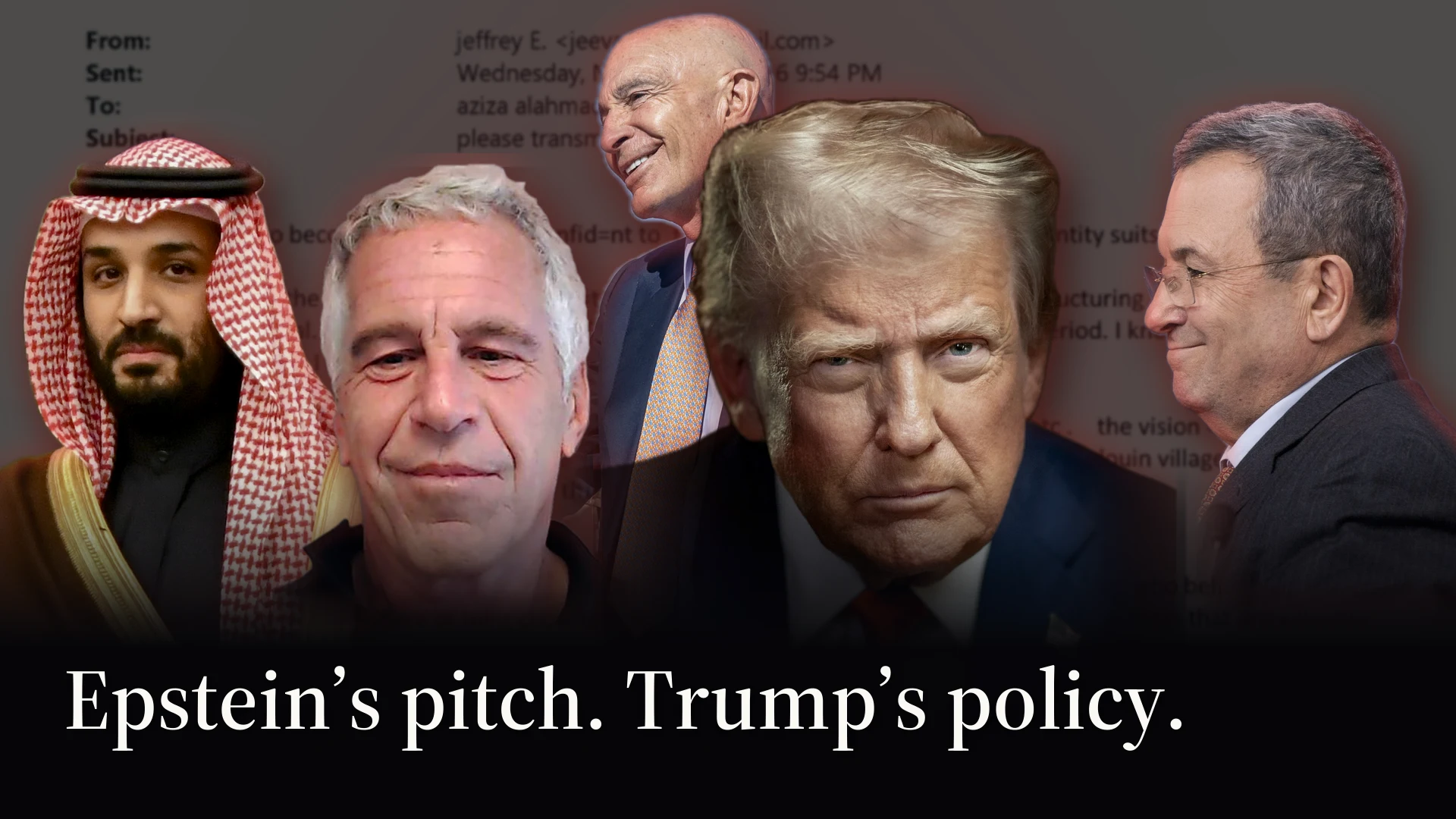
Key players- Jeffrey EpsteinThe fixer who pitched the trade first
- Tom BarrackEpstein’s “point person”; now Trump’s envoy
- Ehud BarakIsrael’s former PM; Epstein’s partner
- Sultan bin SulayemDubai’s port chief, Epstein’s friend
All 15
The fixer
- Jeffrey Epstein
- Financier and convicted sex offender. Between 2012 and 2018 pitched Gulf royals a trade: open ties with Israel to win Trump’s favor, Gulf money for Israeli ports, Israeli security technology for the Gulf.
Trump’s circle
- Donald Trump
- President. Now demands that Saudi Arabia and Qatar sign the Abraham Accords, and chairs the Board of Peace.
- Tom Barrack
- Investor Epstein named to the Saudis as “your point person” the day after the 2016 election. Now ambassador to Turkey and envoy to Syria and Iraq.
- Jared Kushner
- Trump’s son-in-law. Sits on both Board of Peace executive boards; appears in the files as a name others sought to reach.
- Howard Lutnick
- Commerce secretary who opened AI chip exports to the UAE. Was in business alongside Epstein as recently as 2014.
- Marc Rowan
- Apollo chief executive on both Board of Peace boards; valued Gaza’s coastline at $50 billion. Met Epstein after the 2008 plea.
- Tony Blair
- Former British prime minister on both Board of Peace boards; appears in the files.
- Todd Blanche
- Attorney general. Sent the July 2025 memo on the files and is withholding about 2.5 million pages.
Israel
- Ehud Barak
- Former prime minister and defense minister. Epstein’s partner in the security start-up Carbyne and his link to Qatar’s royals and Dubai’s port chief.
- Carbyne
- The Israeli security start-up Barak chaired, pitched to Qatar and Dubai. Sold to Axon for $625 million in 2025.
The Gulf
- Sultan Ahmed bin Sulayem
- Ran Dubai’s port giant DP World; “one of my most trusted friends,” Epstein wrote. Replaced in February after the files came out.
- DP World
- Dubai port operator that signed Israeli port deals the day the Abraham Accords were signed. Discussed as the logistics operator for Gaza.
- Sheikh Jabor Al Thani
- Qatari royal whom Epstein told to recognize Israel and put $1 billion into a victims’ fund.
- Hamad bin Jassim
- Qatar’s former prime minister, brought to Barak by Epstein in 2018.
- Mohammed bin Salman
- Saudi crown prince. Epstein asked to be his “financial confidant.”
Years before Trump's Board of Peace, Jeffrey Epstein was pitching Gulf royals and tycoons a trade: open ties with Israel to win Trump's favor, Gulf money for Israeli ports, and Israeli security technology for the Gulf. As president, Trump now presses a strikingly similar trade. The records do not show that one led to the other. They do show that people who appear in Epstein's files now help run Trump's Middle East policy, and that the Justice Department is still withholding millions of pages.
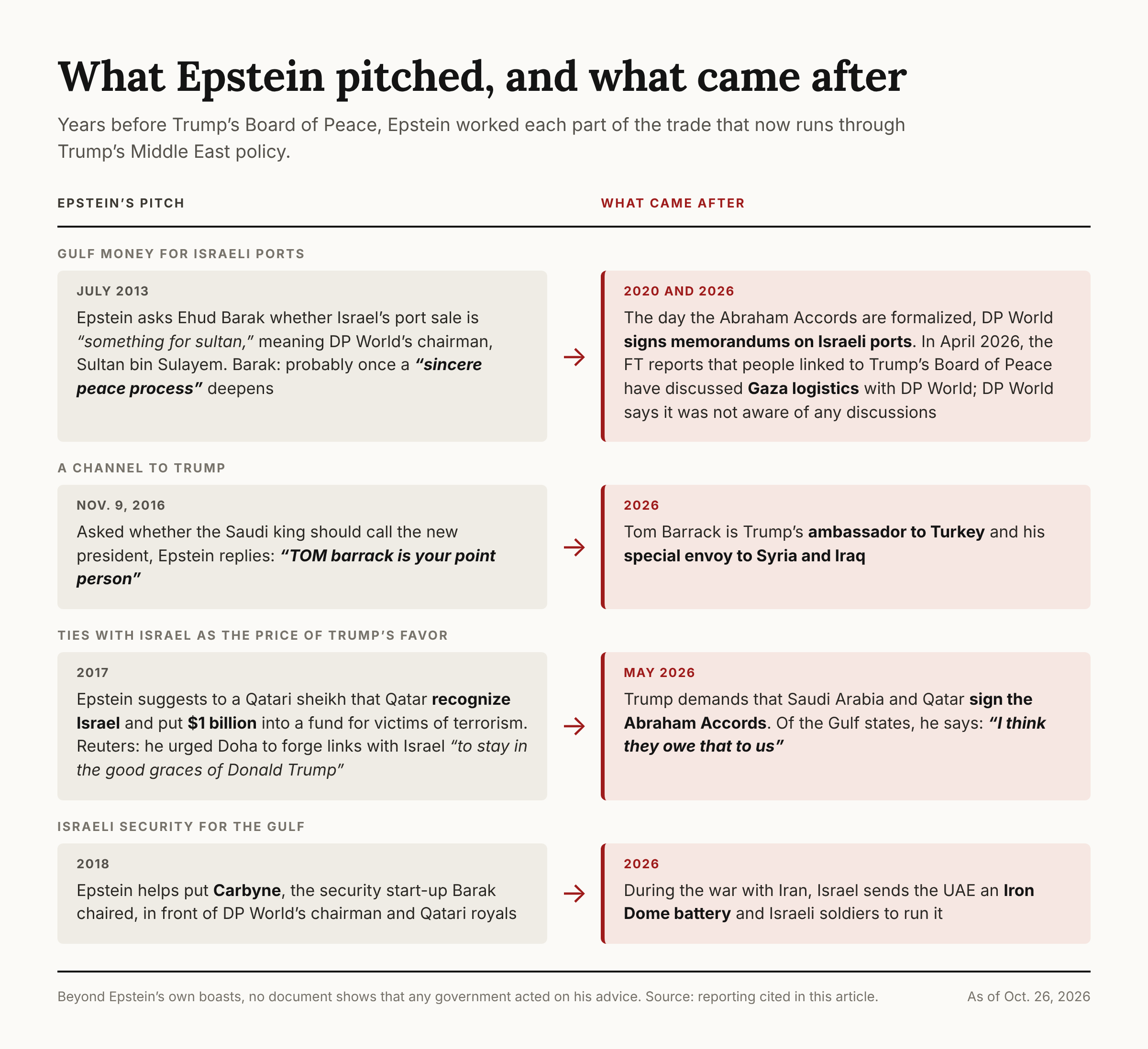
On election night in 2016, Jeffrey Epstein was in Saudi Arabia. He was meeting King Salman and watched the results come in from there, CBS News reported, citing flight records and a source close to Epstein. The next day, Wednesday, Nov. 9, a senior Saudi official texted Epstein to ask whether the king should call the new president to congratulate him. "TOM barrack is your point person," Epstein replied. Tom Barrack, an investor close to Trump who had founded the firm Colony Capital, would be named six days later to run Trump's inauguration. Also on Nov. 9, Epstein wrote to an aide of Raafat Al-Sabbagh, a close adviser to Prince Mohammed bin Salman, now Saudi Arabia's crown prince: "I am happy to represent KSA interests," meaning the Kingdom of Saudi Arabia, the Miami Herald reported. Around the same time, he asked to be made the prince's "financial confidant."
Epstein held no government post. He was a financier and convicted sex offender who had pleaded guilty in 2008 and left jail in 2009. In 2017, during a blockade of Qatar by Saudi Arabia, the UAE, Bahrain and Egypt, he wrote to Sheikh Jabor Yousuf Jassim Al Thani, a businessman in Qatar's ruling family. Among his suggestions: recognize Israel, and put $1 billion into a "fund to benefit the victims of terrorist acts," the Miami Herald reported. Reuters, reporting on the same emails, summed up the advice: Epstein "urged Doha to forge links with Israel to stay in the good graces of Donald Trump."
Nine years later, the same names and the same terms run through Trump's Middle East policy. Barrack is now Trump's ambassador to Turkey and his special envoy to Syria and Iraq, Reuters reported in October. In May, Trump demanded that Saudi Arabia and Qatar sign the Abraham Accords, the deals his first administration brokered in 2020, under which countries open formal ties with Israel. Sultan Ahmed bin Sulayem, whom Epstein called "one of my most trusted friends," ran Dubai's port giant DP World until February. People linked to the Board of Peace, the international body Trump chairs to oversee Gaza's transition, have discussed having DP World run logistics for Gaza, the Financial Times reported in April; DP World said it was not aware of any discussions. And members of the Board of Peace's executive boards, including Marc Rowan, chief executive of Apollo Global Management, and former British Prime Minister Tony Blair, appear in the Epstein files, CNN and Al Jazeera reported.
The files show Epstein working a three-part trade years before Trump made it policy. First, Gulf rulers want favor in Washington. Second, the price of that favor is open ties with Israel. Third, those ties open business in both directions: Gulf money for Israel's ports and trade routes, and Israeli security technology for the Gulf. Between 2012 and 2018, Epstein pitched or brokered every part of it in dealings with a Saudi official, a Qatari sheikh, Dubai's port chief and Israel's former prime minister, Ehud Barak.
The files have limits. Beyond Epstein's own boasts, no document shows that any government acted on his advice. Reuters could not establish "whether his advice was heeded," and Qatar, it noted, "stuck to its independent course." CBS found the communication through Barrack running "only in one direction," with no sign that Epstein's messages reached Trump, and no evidence that Barrack took part in or knew of Epstein's crimes. Epstein did not need to steer American policy for his files to matter. He laid out the trade years before the Abraham Accords, and Trump now pushes it from the White House.
For Americans, the stakes are not historical. Trump has said the Gulf states owe the United States ties with Israel. The United States pledged $10 billion to the Board of Peace, and by April it was one of only three countries that had paid in anything, according to a person with direct knowledge of the board's operations cited by Reuters. The House voted 427 to 1, and the Senate unanimously, to force the release of the Epstein files, yet the Justice Department is still withholding about 2.5 million pages, USA Today reported in July. Americans are paying for Trump's Middle East bargain, and they still can't see all the files of the man who pitched it first.
Epstein pitched the trade as a private fixer. Trump pursues it as president, and people who appear in Epstein's files serve in his administration and on his board.
A channel to Trump
Epstein spent 2016 courting Saudi Arabia's rulers. By August, he was advising Saudi contacts against selling shares in the state oil company, Saudi Aramco, an idea he found "silly," the Miami Herald reported. "Shareholders are the last thing the kingdom needs," he wrote that month. Among his chief concerns about listing the shares in New York, the Herald reported, was a 2016 US law that lets Americans sue foreign countries over terrorist attacks. In early November, Epstein visited Riyadh. Soon after, in a message to Al-Sabbagh's aide, he asked for a "small palace" to live in while he tutored the prince, the Herald reported. "The records do not show if Epstein's advice was considered by the Saudi rulers," the Herald noted, and a Saudi source told the paper that Epstein "was known to exaggerate and misrepresent his connections." The Justice Department's release includes an undated photograph of Epstein with the prince, Middle East Eye reported. Aramco listed its shares three years later, in Riyadh.
Epstein appeared to treat Tom Barrack as a possible line into Trump's world, CBS News reported, though nothing in the records shows that anything was passed on to Trump. CBS reviewed more than 100 texts and emails between Epstein and Barrack, beginning in September 2009. Their dealings already touched the Gulf. In January 2012, Barrack and Epstein arranged for Qatar's prime minister, Sheikh Hamad bin Jassim, to view Epstein's Manhattan mansion; the visit was canceled, and the sheikh later bought a house across the street for $47 million, CBS reported. Epstein's calendar for Aug. 29, 2016, lists "Lunch w/Ehud Barak, Tom Barrack and Vitaly Churkin," then Russia's ambassador to the UN. About a month later, Epstein bought roughly $1 million of stock in Barrack's firm, Colony Capital.
After the election, Barrack's invitations reached Epstein's Gulf circle. In January 2017, bin Sulayem asked Epstein whether he should accept Barrack's invitations to various events, and bin Sulayem attended the Salute to Our Armed Services Ball, one of the inaugural balls, CBS reported, citing the New York Post. In May 2017, with "legal trouble bearing down on Barrack as a result of the Mueller probe," as CBS put it, Epstein recommended a white-collar lawyer, Reid Weingarten. Barrack replied that Weingarten was "on the bosses list," which CBS read as a reference to Trump. Barrack later faced charges, CBS noted, that he served as a back channel for the UAE; a jury acquitted him in 2022. He did not respond to CBS's requests for comment.
Others appear to have seen Epstein as a route into Trump's circle, too. In March 2017, the Indian businessman Anil Ambani purportedly texted Epstein: "Leadership wld like ur help for me to meet jared and bannon asap," ThePrint reported, apparently referring to Jared Kushner, Trump's son-in-law and then a senior White House adviser, and Steve Bannon, then Trump's chief strategist. Ambani did not respond to ThePrint, which did not report any meeting with Kushner or Bannon. In February, the Justice Department sent Congress a list of government officials and "politically exposed persons" named in the files, and Kushner is on it; the list warns that names appear "in a wide variety of contexts," some only in press reporting.
Before Trump took office, Epstein was telling a Saudi official how to reach Trump. The man he named, Tom Barrack, is now Trump's envoy to Syria and Iraq.
Qatar's price
Epstein told a Qatari sheikh what Trump's favor would cost. Beyond recognizing Israel and the $1 billion fund, his suggestions to Sheikh Jabor included paying for electricity in Gaza and coming out "against terrorism LOUD," the Miami Herald reported. In an email to "Jabor Y" after Prime Minister Narendra Modi's July 2017 visit to Israel, Epstein held up India's leader as the model. "The Indian Prime minister modi took advice. and danced and sang in israel for the benefit of the US president," he wrote. "IT WORKED," he added, Al Jazeera reported. India's foreign ministry acknowledged Modi's visit but said the rest of the email was "little more than trashy ruminations by a convicted criminal." In June 2017, Epstein had given Anil Ambani his reading of the blockade: "Qatar complicating Israel deal. Gets punished," ThePrint reported.
The next year, Epstein brought Ehud Barak to Qatar's door. In November 2018, he wrote to Barak: "just left hbj. He would like to sit with you," Reason reported, referring to Hamad bin Jassim, who had stepped down as Qatar's prime minister in 2013. Barak and Hamad bin Jassim arranged to meet on Dec. 20 at One Hyde Park in London, without Epstein. Afterward, Sheikh Jabor sent Barak a thank-you note, copied to Epstein, asking for "more specific details about the security company." At the time, Barak and Epstein were working together on Carbyne, an Israeli security start-up, Reason reported. Barak pitched Carbyne to the Qataris for security at the 2022 World Cup, the Miami Herald reported. "We can work through a European company of your choice and minimize Israeli profile," he wrote. Bruce Goodman, a lawyer for Barak, told the Herald it "quickly became clear that the company was not suited for that role," and Carbyne did not pursue a bid.
Qatar never recognized Israel, and the blockading countries restored ties with Qatar in 2021 anyway. In 2026, the price came back, this time from the president. On May 25, Trump wrote that he was "mandatorily requesting that all Countries immediately sign the Abraham Accords," and that "It should start with the immediate signing by Saudi Arabia and Qatar," according to his post. Two days earlier, on a call with regional leaders, he had tied the demand to a hoped-for deal to end this year's war with Iran, Axios reported. On May 27, he said of Saudi Arabia, the UAE, Qatar and the others: "I think they owe that to us, to be honest." Qatar did not publicly respond at the time, the Kuwait Times reported, citing news agencies. Qatar says full relations with Israel depend on an Israeli-Palestinian peace agreement, The Media Line reported in October.
Trump's board has a price, too. Membership is limited to three years unless Trump, as chairman, renews it, but the board's charter exempts any member state that pays more than $1 billion in cash within the first year. Qatar and Saudi Arabia each pledged exactly $1 billion in February, just short of the charter's bar. By April, only the UAE, Morocco and the United States had paid anything, according to the source cited by Reuters, and no payment by Qatar has been reported since.
In 2017, Epstein told a Qatari sheikh that ties with Israel would keep Qatar in Trump's good graces. In 2026, Trump said the Gulf states owe America those ties.
The ports
Epstein tried to match Gulf money with Israeli assets years before the two sides had open ties. He had already lobbied a government on DP World's behalf. In 2009, bin Sulayem told Epstein he wanted the British government to guarantee the debt on DP World's £1.8 billion port on the Thames; Epstein forwarded an investment request to Peter Mandelson, then Britain's business secretary, and edited a message bin Sulayem drafted to Mandelson, The Telegraph reported. No guarantee is documented.
Then Epstein brought in Israel. In March 2012, he told bin Sulayem he was in Berlin "with the Israeli defense minister," who was then Barak, and that the minister "would like to meet" him and "sheik Mohamed," CNN reported. In June 2013, after Barak had left government, Epstein urged him to meet bin Sulayem, "the right hand of maktoum," apparently meaning Dubai's ruler, Sheikh Mohammed bin Rashid Al Maktoum. Weeks later, on July 4, 2013, Epstein sent Barak a Fox News story about Israel inviting international bids for its ports and asked whether it was "something for sultan," meaning bin Sulayem. Barak answered: "Probably once (and IF) we'll start getting deeper into a sincere peace process." He added: "we have to think harder on how to leverage this acquaintance." Two summers later, when bin Sulayem asked Epstein to arrange a meeting, Barak replied, "Yes, of course." Bin Sulayem traveled to Israel years before the UAE normalized ties with it, AFP reported, and his name appears in the files more than 9,400 times.
The sincere peace process Barak named did not come. The Abraham Accords did. Israel, the UAE and Bahrain formalized them on Sept. 15, 2020, and the same day, DP World signed a series of memorandums with DoverTower, co-owner of Israel Shipyards in Haifa, Maritime Executive reported. They covered Israeli ports and free zones and a direct shipping route between Eilat and Dubai's Jebel Ali port; DoverTower also announced a plan for a joint venture to bid for the Port of Haifa. DP World pulled out of the Haifa bid in December 2021 without saying why, while saying it remained interested in investing in Israel, Al Jazeera reported. India's Adani Group won the port the next year.
On Feb. 13, after the files showed years of contact with Epstein, Dubai replaced bin Sulayem as DP World's chairman and chief executive in an announcement that did not name him or give a reason, the AP reported. The AP said the emails do not appear to implicate him in Epstein's crimes. By July, he was executive chairman of MMC Port Holdings, Malaysia's largest port operator, and took direct charge of it after its chief executive left, Reuters reported. He has not commented publicly on any links with Epstein.
DP World has since come up in plans for Gaza. People linked to the Board of Peace have discussed DP World overseeing logistics for aid and commercial goods in Gaza, including warehousing, cargo tracking and security, the Financial Times reported in April. The options included a new port in Gaza or on Egypt's Mediterranean coast and a free-trade zone inside Gaza, and a draft the paper reviewed described a "port-led economic ecosystem." DP World told the FT it was not aware of any discussions.
In 2013, Barak said a Gulf bid for Israel's ports would probably have to wait for a sincere peace process. It waited for the Abraham Accords instead.
The security trade
Carbyne was where Epstein's money and Barak's met. In 2015, Barak invested about $1 million in the Israeli start-up, then called Reporty, through a partnership he set up for the purpose; in 2016, Epstein put $1 million into that partnership through a company called Southern Trust, Calcalist reported in 2019, citing Israel's public broadcaster Kan. Carbyne said its founders had "never been in contact with Barak's other business partners." By 2018, Barak was Carbyne's chairman. That August, bin Sulayem emailed Epstein and Barak about investing in Carbyne and said he had discussed with its founder using it for "Dubai 911" and personnel security at DP World's ports, Drop Site News reported, drawing partly on emails hacked from Barak's account; it could not confirm that Carbyne was ever used in Dubai. Barak later sold his shares, and in November 2025 the American police-technology company Axon agreed to buy Carbyne for $625 million in cash, Globes reported.
Most of what is documented about Israel and Epstein runs through Barak. Barak, Israel's former prime minister and defense minister, made multiple visits to Epstein's Manhattan apartment, flew on his private plane and stayed in touch for years after Epstein's 2008 plea deal, NBC News reported. Epstein wrote, about a week before his 2019 arrest, that he was "dealing with Ehud in Israel. Making me crazy." While Epstein was a trustee of the Wexner Foundation, Barak received some $2 million in grants from it for unspecified "research," NBC reported. Barak has said he regrets knowing Epstein. "I promise you that nothing will be discovered, because there is nothing," he said.
Israeli state security staff were involved, too. From early 2016, staff from Israel's mission to the UN, including the head of Barak's security detail, which Israeli law provides to former prime ministers, arranged the installation of alarms and remote-access security in a Manhattan apartment Epstein controlled, at 301 E. 66th St., for Barak's stays, and controlled access to it for at least two years, Drop Site News reported, citing Justice Department emails. "Jeffrey says he does not mind holes in the walls and this is all just fine!" Epstein's assistant wrote, Al Jazeera reported. Barak and the Israeli mission did not respond to Drop Site's requests for comment. Yoni Koren, a former Israeli military intelligence officer who had been Barak's bureau chief at the Defense Ministry, stayed at Epstein's apartment at least three times between 2013 and 2015, according to Epstein's calendars and Barak's hacked emails, Drop Site reported.
Whether Epstein worked for Israeli intelligence is a separate question, and the files do not settle it. One email in the files, citing an anonymous tipster to the FBI, said the source had been "convinced that Epstein was a co-opted Mossad agent," without further information, the Times of Israel reported. In 2018, Epstein had written to Barak, "You should make clear that I don't work for Mossad," followed by a smiley face. The files "have not turned up any conclusive proof that he was an intelligence agent or asset for Mossad," the New York Times reported. Vice President JD Vance said in July that Epstein "clearly had connections" to the highest levels of both American and Israeli intelligence. But Vance said he had asked whether any documents connected Epstein directly to "our intelligence agencies or anybody else's," and "the answer is no." Israeli leaders past and present deny that Epstein worked for Israel. Prime Minister Benjamin Netanyahu said Epstein's closeness to Barak "proves the opposite"; former Prime Minister Naftali Bennett said, "Epstein never worked for the Mossad"; and Yossi Cohen, a former head of the Mossad, said he was "not an agent, not an operative, nothing."
In 2026, Israeli security reached the Gulf in the open. During the war with Iran, Israel sent the UAE an Iron Dome air-defense battery and several dozen Israeli soldiers to run it, which a senior Israeli official called the first Iron Dome battery Israel had sent to another country, Axios reported. An Israeli official said it intercepted dozens of Iranian missiles. Mike Huckabee, the US ambassador to Israel, later said publicly that Israel had sent Iron Dome air defenses and personnel to the UAE.
Epstein helped put the Israeli security start-up Barak chaired in front of Dubai's port chief and Qatari royals, when neither the UAE nor Qatar had open ties with Israel. In 2026, Israeli soldiers defended the UAE with Iron Dome.
The same names
Several people in Epstein's files now hold seats in Trump's government or on his board. Marc Rowan sits on both of the Board of Peace's executive boards, the White House said in January. At the board's first meeting in February, he valued Gaza's coastline at $50 billion, Responsible Statecraft reported. The files indicate that Rowan met Epstein multiple times years after the 2008 guilty plea, and in March 2016 he shared with Epstein what appears to be internal Apollo email correspondence about the valuation of a tax asset, CNN reported. Apollo told clients that "in select instances, Mr. Rowan and other Apollo employees provided information to Epstein" for Epstein's tax work for Leon Black, an Apollo co-founder, and that no one at Apollo except Black had a business or personal relationship with Epstein. Black paid Epstein $158 million from 2012 to 2017, according to a review commissioned by Apollo that found no evidence he was involved in Epstein's crimes. Investors have filed two suits against Apollo, Rowan and Black, alleging that Apollo misled them when it said it never did any business with Epstein. Apollo and Rowan declined to comment on the first suit, filed in March, and Black has denied wrongdoing.
Tony Blair also sits on both boards. In a recording released by the Justice Department, Barak, relaying what he said he had heard from Epstein, says Blair "is doing some probably $11m per year from the Kazakhstan government," Al Jazeera reported. Blair's office said "the figures given are rubbish" and that the money was paid to his organization, not to him. It said Blair had met Epstein only once and had never spoken to or seen him since. Jared Kushner sits on both boards, too; in the messages reported so far, he appears as a name others sought to reach.
Howard Lutnick, Trump's commerce secretary, also shapes Gulf policy. His department controls exports of America's most advanced AI chips, and in July it let the UAE government and approved Emirati companies, including the Abu Dhabi AI company G42, get them without a license, Reuters reported. Lutnick said last year that after meeting Epstein in 2005 he vowed never to "be in the room with that disgusting person ever again," CNN reported. In February, CBS News reported that he and Epstein had each signed, for separate companies, an agreement dated Dec. 28, 2012, to take stakes in the same firm, Adfin, and that they were in business together as recently as 2014. Lutnick has said he signed in 2013 for a subsidiary of Cantor Fitzgerald, the firm he ran, and did not know Epstein also held stock until documents were released, PBS NewsHour reported. Days after the CBS report, Lutnick told senators that he had visited Epstein's island during a 2012 family vacation: "We had lunch on the island, that is true, for an hour," ABC News reported. In May, Rep. James Comer, the Republican chairman of the House Oversight Committee, said Lutnick "wasn't 100 percent truthful with whether or not he had been on the island" but that he had not seen wrongdoing in their email correspondence, The Hill reported. The Commerce Department said in January that Lutnick has never been accused of wrongdoing.
Rowan, Blair, Kushner and Lutnick are not accused of any crime involving Epstein. Each appears in Epstein's files, and each now holds a post in Trump's government or on his board.
What the files still hold back
Trump signed the law that opened the files. He had opposed the bill for months, the AP reported, before Congress passed the Epstein Files Transparency Act almost unanimously. He signed it on Nov. 19, 2025. On Jan. 30, the Justice Department released more than 3 million pages, and Todd Blanche, then the deputy attorney general, said the department had met its obligations under the law, NPR reported.
The department has not released the rest, so how much more the files hold on Epstein's Gulf dealings is unknown. Blanche has said many documents were withheld to protect victims' privacy, USA Today reported in July. In June, in a lawsuit brought by the journalist Katie Phang, Judge Emmet G. Sullivan of the federal court in Washington wrote that because the department had not responded substantively to Phang's arguments, "The Attorney General has conceded that he is in violation of the Act." The department, then led by Blanche as acting attorney general, replied, "The Acting Attorney General has not conceded anything," CBS News reported, and it has appealed.
Some of what is withheld concerns Epstein's money. Sen. Ron Wyden of Oregon, the top Democrat on the Senate Finance Committee, says the FBI has failed to release its record of an interview with a banker closely tied to Epstein. He says the Treasury has refused to give his committee the suspicious-activity reports that banks filed on Epstein's transactions, and in March, a Senate Republican blocked his bill to compel them. In August, Wyden alleged in a report that JPMorgan delayed reporting more than $1 billion in suspicious Epstein-linked transfers; JPMorgan called the allegation false, Reuters reported.
Some of it concerns the president. In March, NPR counted 37 pages of records, including FBI interview notes, tied to an allegation against Trump that the department still had not published; the department said withheld documents were "privileged, are duplicates or relate to an ongoing federal investigation," and the White House said Trump "has been totally exonerated," NPR reported. On Oct. 16, in the Phang case, the department hand-delivered handwritten notes from three FBI interviews to Judge Sullivan for private review and asked him to pause any order to release them so that it could consider an appeal, Raw Story reported. Emails obtained through a Freedom of Information Act lawsuit, and reported in October, show that about two weeks before the Justice Department and FBI released their July 2025 memo on the Epstein files, Taylor Budowich, then a White House deputy chief of staff, wrote in an email thread about the draft: "Have something I can edit?" FBI Director Kash Patel replied with the draft, and the FBI blacked out Budowich's suggested edits, Raw Story reported; Budowich could not be reached, the Justice Department did not respond, and the White House did not address his edits.
Blanche sent the final version of that memo, and he now runs the department. In late July 2025, as deputy attorney general, he interviewed Ghislaine Maxwell, Epstein's longtime associate, who is serving 20 years for helping Epstein sexually abuse underage girls. Within days, she was moved to a minimum-security prison camp in Texas; officials did not explain why at the time, NPR reported. Blanche later said the Bureau of Prisons moved her because of "numerous and numerous threats against her life," CNN reported. In August, the Senate confirmed Blanche as attorney general, 50 to 49.
Congress could press harder after Nov. 3. Rep. Robert Garcia, the top Democrat on the House Oversight Committee, told Bloomberg that the "Epstein investigation is going to be one of our top priorities" if Democrats win the House, and Forbes reported on Oct. 26 that a Democratic-led committee could subpoena Blanche. In October, 17 Democratic state attorneys general wrote to Congress that "millions of files remain withheld."
Epstein never got Qatar to recognize Israel, and Barak put off Epstein's port idea. But six years after the Abraham Accords, the president says the Gulf states owe America the ties Epstein urged.
Epstein got there first, with no office and no mandate. Trump has made the trade American policy, and millions of pages of Epstein's files are still withheld.
Sources
- CBS News: Trump insider Tom Barrack kept in regular contact with Jeffrey Epstein for years, files show (Feb. 14, 2026)
- Presidential Inaugural Committee: Thomas J. Barrack Jr. named committee chairman (Nov. 15, 2016)
- Miami Herald: Epstein’s ties to Arab royals, an offer to tutor a crown prince and a gift from Mecca (April 2026)
- NPR: The UK fires its US ambassador over his emails to Jeffrey Epstein (Sept. 11, 2025)
- CNN: How Wall Street’s Apollo got tangled up again in the Epstein files (Feb. 21, 2026)
- Reuters via Al-Monitor: Epstein tried to build a web of powerful ties across the Middle East, documents show (Feb. 18, 2026)
- Reuters via The Star: Trump envoy kept financial ties to firm behind a $15 billion Hormuz bypass pipeline plan (Oct. 9, 2026)
- The American Presidency Project: Trump's Truth Social post on the Abraham Accords (May 25, 2026)
- AP via ClickOnDetroit: Logistics giant DP World replaces chairman named in Jeffrey Epstein documents (Feb. 13, 2026)
- United Nations: Security Council Resolution 2803 on the Board of Peace (Nov. 17, 2025)
- Al Jazeera, citing the Financial Times: Trump's Board of Peace holds Gaza reconstruction talks with the UAE's DP World (Apr. 21, 2026)
- The White House: statement naming the Board of Peace's executive boards (Jan. 16, 2026)
- Al Jazeera: Epstein and Israel's Barak discussed consultancy sums paid to Blair (Feb. 4, 2026)
- Jewish Insider: Trump says Gulf countries "owe" the US their entry into the Abraham Accords (May 27, 2026)
- Reuters via Al-Monitor: factbox of contributions by Board of Peace members (Feb. 19, 2026)
- Times of Israel, citing Reuters: the Board of Peace has received only a tiny fraction of $17 billion pledged (Apr. 10, 2026)
- AP via WHYY: Congress acts swiftly to force release of the Epstein files, and Trump agrees to sign the bill (Nov. 18, 2025)
- USA Today via The Spokesman-Review: DOJ defends decision to withhold millions of Epstein pages (July 2, 2026)
- Middle East Eye: Jeffrey Epstein was told to keep a close eye on Saudi Arabia amid the Ritz-Carlton purge (Feb. 4, 2026)
- ThePrint: Anil Ambani's chats and emails in the Epstein files (Feb. 2, 2026)
- US Department of Justice: letter to Congress listing officials named in the released files (Feb. 14, 2026)
- Al Jazeera: From Modi to Kevin Rudd, how the Epstein files set off a storm far beyond the US (Feb. 2, 2026)
- Reason: Jeffrey Epstein brokered a secret meeting between Qatari and Israeli leaders (Feb. 3, 2026)
- Axios: Trump wants Muslim countries to join the Abraham Accords as part of an Iran deal (May 24, 2026)
- Kuwait Times, citing agencies: Trump links ties with Israel to the Iran peace deal (May 25, 2026)
- The Media Line via the Jerusalem Post: Qatar and the Abraham Accords (Oct. 11, 2026)
- Times of Israel: full text of the Board of Peace charter (Jan. 18, 2026)
- The Telegraph via The Financial Express: Epstein helped DP World on its London port project (Feb. 5, 2026)
- CNN: Dubai’s DP World replaces its chairman amid scrutiny over Epstein ties (Feb. 13, 2026)
- AFP via Malay Mail: DP World replaces its chairman and CEO after leader named over 9,400 times in Epstein emails (Feb. 14, 2026)
- Maritime Executive: DP World announces agreements in Israel under the new peace deal (Sept. 16, 2020)
- Al Jazeera: Dubai's DP World pulls out of the Haifa port privatization bid (Dec. 3, 2021)
- Maritime Executive: Israel selects India's Adani to buy Haifa port (July 15, 2022)
- Reuters via Gulf Business: Former DP World chief takes the helm at Malaysia's MMC Ports (July 15, 2026)
- Reuters via TimesLive: Epstein-linked chair of Malaysian port operator picked for expertise (Aug. 20, 2026)
- Calcalist: Ehud Barak, Jeffrey Epstein and the Carbyne investment (July 18, 2019)
- Calcalist: Founders Fund joins Carbyne's $15 million round (Aug. 14, 2018)
- Drop Site News: Jeffrey Epstein nurtured Israel-Emirates ties before the Abraham Accords (Jan. 14, 2026)
- Globes: Axon to buy Carbyne for $625 million (Nov. 5, 2025)
- NBC News: Israel's Barak says he regrets knowing Epstein after documents detail their long friendship (Feb. 13, 2026)
- Al Jazeera: Israel installed security at Epstein's Manhattan apartment for ex-PM Barak (Feb. 19, 2026)
- Drop Site News: The Israeli government installed security at an Epstein-controlled apartment for Ehud Barak (Feb. 18, 2026)
- Drop Site News: Israeli intelligence officer Yoni Koren stayed at Jeffrey Epstein's apartment (Nov. 11, 2025)
- Times of Israel: No, the Epstein files don't show that he worked for the Mossad (Feb. 6, 2026)
- New York Times via the Philadelphia Inquirer: Vance's Epstein remarks on Joe Rogan's podcast (July 19, 2026)
- Times of Israel: Netanyahu says ties to Barak prove Epstein didn't work for Israel (Feb. 6, 2026)
- JTA: Former Israeli PM Bennett rebuts the claim that Jeffrey Epstein worked for the Mossad (July 14, 2025)
- Fox News: Israeli intelligence sources reject claims Epstein was a Mossad operative (Feb. 15, 2026)
- Axios: Israel sent an Iron Dome system and troops to the UAE during the Iran war (Apr. 26, 2026)
- AP via Wyoming Public Media: US ambassador to Israel says Israel sent Iron Dome air defenses and personnel to the UAE (May 12, 2026)
- Responsible Statecraft: Kushner, the Board of Peace and the profits (Feb. 20, 2026)
- Apollo Global Management: letter to clients and partners (Feb. 18, 2026)
- Apollo SEC filing: Dechert's review of Leon Black's work with Epstein (Jan. 22, 2021)
- InvestmentNews: Investors sue Apollo CEO Rowan over alleged Epstein cover-up (May 1, 2026)
- Reuters via Yahoo Finance: Apollo and Leon Black sued over Epstein disclosures (Mar. 2, 2026)
- Reuters via Khaleej Times: US eases exports of AI chips and military items to the UAE (July 10, 2026)
- CNN: Lutnick confirms an island lunch with Epstein (Feb. 10, 2026)
- CBS News: Howard Lutnick and Jeffrey Epstein were in business together (Feb. 6, 2026)
- PBS NewsHour: Who is Howard Lutnick, and what's his connection to Jeffrey Epstein? (May 4, 2026)
- ABC News: Commerce Secretary Howard Lutnick says he visited Epstein's island (Feb. 10, 2026)
- The Hill via KRQE: Comer says Lutnick wasn't 100% truthful about being on Epstein's island (May 6, 2026)
- CNN: GOP lawmaker says Lutnick should resign over Epstein links (Feb. 8, 2026)
- JURIST: Trump signs the Epstein Files Transparency Act into law (Nov. 19, 2025)
- NPR: DOJ releases tranche of Epstein files, says it has met its legal obligations (Jan. 30, 2026)
- US District Court for D.C.: Judge Emmet G. Sullivan's opinion in Phang v. Blanche (June 25, 2026)
- CBS News: Judge orders DOJ to unredact more Epstein files or explain why (June 26, 2026)
- Justia: D.C. Circuit docket, appeal No. 26-5299 (Aug. 25, 2026)
- Senate Finance Committee Democrats: Wyden demands release of a withheld Epstein investigation document (Sept. 30, 2026)
- Senate Finance Committee Democrats: Senate Republican blocks Wyden bill on Treasury's Epstein bank records (Mar. 3, 2026)
- Reuters via Kitco: Senator Wyden urges regulators to probe Wall Street banks over Epstein (Aug. 4, 2026)
- NPR: Justice Department publishes some missing Epstein files tied to Trump (Mar. 5, 2026)
- Raw Story: DOJ hands FBI notes to the judge in the Epstein files case (Oct. 16, 2026)
- Raw Story: FOIA emails on the White House and the 2025 Epstein memo (Oct. 23, 2026)
- NPR: Justice Department releases Ghislaine Maxwell interview transcripts (Aug. 22, 2025)
- CNN via KVIA: Todd Blanche takes over a Justice Department in the Epstein files' shadow (Apr. 2, 2026)
- NPR: Senate votes to confirm Todd Blanche as attorney general (Aug. 8, 2026)
- Forbes: Democrats vow to investigate Epstein if they win the midterms (Oct. 26, 2026)
- 17 state attorneys general: letter to Congress on a second Epstein Files Transparency Act (Oct. 15, 2026)
Video article: footage, photo and document credits
Scenes of the people in this story come from official U.S. government video and photographs (works of the United States government, public domain) and from photographs published under Creative Commons licences. The emails, texts and agreements shown on screen are pages of the files the Justice Department released under the Epstein Files Transparency Act, court records, and emails released under the Freedom of Information Act. Creative Commons material, with the credit each licence requires:
- 107834 eilat port of eilat PikiWiki Israel — israel zeller ישראל זלר, CC BY 2.5
- 9 E71 St jeh — Jim.henderson, CC BY-SA 4.0
- 9E71 from Frick 01 jeh — Jim.henderson, CC BY-SA 4.0
- Doha Corniche Skyline View 1 — Zairon, CC BY 4.0
- Dubai Skyline from Zabeel Park — Challiyil Eswaramangalath Pavithran Vipin, CC BY-SA 2.0
- Flickr - Israel Defense Forces - Iron Dome Battery Deployed Near Ashkelon — Israel Defense Forces, CC BY 2.0
- India's Economic Blueprint, World Economic Forum Annual Meeting 2025 (World Economic Forum YouTube; also on Commons) — CC BY 3.0 · World Economic Forum
- Iron Dome Battery Deployed Near Ashkelon — Israel Defense Forces, CC BY 2.0
- Jebel Ali Port 1 Imresolt — Imre Solt, CC BY-SA 3.0
- Jlots.May2024 — נועם קרמפף, CC BY 4.0
- One Hyde Park - Knightsbridge (20826078708) — Elliott Brown from Birmingham, United Kingdom, CC BY-SA 2.0
- Port of Haifa aerial view 01 — McKaby, CC BY-SA 4.0
- Riyadh Skyline showing the King Abdullah Financial District (KAFD) and the famous Kingdom Tower — B.alotaby, CC BY-SA 4.0
- Robert F. Kennedy Department of Justice Building — APK, CC BY 4.0
- Solow Building (4674789509) — Tony Hisgett from Birmingham, UK, CC BY 2.0
- WikiAir Flight IL-13-02 1516 — Meronim, CC BY-SA 3.0
- Sultan Ahmed bin Sulayem portrait: Sultan Ahmed bin Sulayem (born 1955) at World Economic Forum Annual Meeting 2025.png — CC BY 3.0 · World Economic Forum
- Marc Rowan portrait: Marc Rowan in Mercatus Center interview 2024 (cropped).png — CC BY 3.0 · Mercatus Center (George Mason University)
- Tony Blair portrait: Tony Blair 2024.jpg — CC BY-SA 2.0 · Ricardo Stuckert / Presidência da República (Flickr "Lula Oficial")
- Peter Mandelson seated portrait: Mandelson at the FCDO 2025-02-08-10-17-A.jpg — CC BY 2.0 · Foreign, Commonwealth & Development Office
- Naftali Bennett portrait: Naftali Bennett official portrait (cropped2).jpg — CC BY-SA 3.0 · Avi Ohayon, Israeli Government Press Office
- Yossi Cohen portrait: Reuven Rivlin, Benyamin Netanyahu and Yossi Cohen, presented certificates of merit to twelve outstanding employees of the institution in 2016 (GPO104).JPG — CC BY-SA 3.0 · Kobi Gideon, GPO / Spokesperson unit of the President of Israel
- Anil Ambani portrait: Anil Ambani Reliance (Reliance Group AGM, Sept 4, 2012) — CC BY-SA 3.0 · Sourav Mishra
- Benjamin Netanyahu portrait: official portrait, Israeli Government Press Office — CC BY-SA 3.0 · Avi Ohayon
Public-domain sources (The White House, U.S. Department of Defense/DVIDS, U.S. Department of State, U.S. House of Representatives, U.S. Senate, Library of Congress, U.S. Bureau of Prisons, the Government of the U.S. Virgin Islands):
- Aerial view, United States Capitol building, Carol M. Highsmith, 30 Apr 2007 — U.S. government (Public domain (Library of Congress, Carol M. Highsmith Archive, no known restrictions))
- Ambassador Mike Huckabee Visit (9413134) — U.S. Army photo by Spc. Kathryn Skonning (Public domain)
- Army executes Iron Dome Defense System, Darrell Ames, PEO Missiles and Space, White Sands, 16 Jun 2021 — U.S. government (Public domain (DVIDS, U.S. DoD))
- Austere Challenge 2012: Israeli Minister of Defense visit, Combat Camera USEUCOM, Oct. 23, 2012 — U.S. government (Public domain (DVIDS, U.S. DoD))
- Board of Peace charter signing, Davos, Jan 22, 2026: intro, signing, podium sections (The White House YouTube channel) — U.S. government (Public domain · The White House)
- Board of Peace inaugural meeting, Washington, Feb 19, 2026: entrance, Blair, Rowan, Kushner sections (The White House YouTube channel) — U.S. government (Public domain · The White House)
- Cabinet meeting, May 27, 2026, section 1:16:20-1:17:50 (The White House YouTube channel) — U.S. government (Public domain · The White House)
- DJI 0357 - Aerial view of a coastal town nestled among lush green islands with turquoise waters and white buildings under a partly cloudy sky — Category:Government of the United States Virgin Islands (Public domain)
- Donald Trump and King Salman bin Abdulaziz Al Saud talk together, May 2017 — The White House from Washington, DC (Public domain)
- Donald Trump meets with Mohammed bin Salman bin Abdulaziz Al Saud, March 2017 — The White House from Washington, DC (Public domain)
- Donald Trump signs orders to green-light the Keystone XL and Dakota Access pipelines — Office of the President of the United States (Public domain)
- Donald Trump state visit to Qatar, 2025-05-14 P20250514DT-1234 — The White House (Public domain)
- Donald Trump state visit to Qatar, 2025-05-14 P20250514DT-1290 — The White House (Public domain)
- Epstein house interior 03 — United States District Court, Southern District of New York/FBI (Public domain)
- FPC Bryan — Uncredited U.S. Bureau of Prisons photographer (Public domain)
- Howard Lutnick with Donald Trump (2025) — The White House (Public domain)
- Inaugural Ball (Salute to Our Armed Services Ball), Spc. Derrick Maragh, JTF-National Capital Region, 20 Jan 2017 — U.S. government (Public domain (DVIDS, U.S. DoD))
- JLOTS Trident Pier delivering humanitarian aid, PO1 Jordan KirkJohnson, U.S. Army Central, 25 Jun 2024 — U.S. government (Public domain (DVIDS, U.S. DoD))
- London Gateway Port from RSPB Cliffe Pools — Mramoeba (CC0)
- Military members support the Salute to Our Armed Services Ball, Walter Reeves, DIMOC, 20 Jan 2017 — U.S. government (Public domain (DVIDS, U.S. DoD))
- President Donald Trump meeting with Prime Minister Narendra Modi — The White House (Public domain)
- President Donald Trump swears in Todd Blanche as Deputy Attorney General (54371707133) — The White House (Public domain)
- President Trump Participates in a Ceremonial Swearing In of Secretary of Commerce Howard Lutnick (Commons mirror of the White House video) — U.S. government (Public domain · The Trump White House)
- President Trump Participates in an Arrival Ceremony, May 13, 2025 — The White House (Public domain)
- President Trump and The First Lady Participate in an Abraham Accords Signing Ceremony (50346488292) — The White House from Washington, DC (Public domain)
- President Trump and The First Lady Participate in an Abraham Accords Signing Ceremony - 50346837862 — The White House (Public domain)
- President Trump and The First Lady Participate in an Abraham Accords Signing Ceremony — The White House (Public domain)
- President Trump and The First Lady Participate in an Abraham Accords Signing Ceremony — Trump White House Archived (Public domain)
- President Trump visits AUAB 2025, SSgt Sean Moriarty, U.S. Air Force, Al Udeid, 15 May 2025 — U.S. government (Public domain (DVIDS, U.S. Air Force photo))
- President Trump's response to Mary Bruce's question about the Epstein files, November 18, 2025 — The White House (Public domain)
- Roundtable with Ranking Member Robert Garcia & Annie Farmer (Oversight Dems YouTube, 2025-10-14) — U.S. government work (House Oversight Committee Democrats); public domain; committee end card at 481s (https://www.youtube.com/watch?v=DfqMmwIU-1Y)
- Senate Finance Committee feed, budget hearing with Treasury Secretary Bessent, June 3, 2026, archive section 00:15:00-00:35:00 — U.S. government (U.S. government work (Senate committee feed))
- Senate Foreign Relations Committee feed, nominations hearing with Tom Barrack, April 1, 2025, archive section 00:50:00-01:15:00 — U.S. government (U.S. government work (Senate committee feed))
- Senate Judiciary Committee feed, hearing on the nomination of Todd Blanche to be Attorney General, July 15, 2026, archive section 00:15:00-01:00:00 — U.S. government (U.S. government work (Senate Recording Studio committee feed); public domain)
- Supercarrier of Partnership: Israeli PM Netanyahu visits USS George H. W. Bush, Avida Landau, U.S. Embassy Tel Aviv, Haifa, 3 Jul 2017 — U.S. government (Public domain (DVIDS, U.S. DoD))
- Swearing-In Ceremony of Kash Patel as Director of the Federal Bureau of Investigation (Commons mirror of the White House video) — U.S. government (Public domain · The Trump White House)
- The Robert F. Kennedy Department of Justice Building, Carol M. Highsmith, 13 Apr 2025 — U.S. government (Public domain (Library of Congress, Carol M. Highsmith Archive, no known restrictions))
- U S Ambassador Barrack Makes First Visit to Incirlik Air Base (9146528) — U.S. Air Force photo by Staff Sgt. Koby Saunders (Public domain)
- US House Floor Proceedings (Tuesday, November 18, 2025), Clerk of the House YouTube stream, section 04:39:30-04:48:30 (H.R. 4405 roll call 289, 427-1) — U.S. government (U.S. government work (House Recording Studio feed via Office of the Clerk); public domain)
- Vice President JD Vance on Negotiations with Iran - April 11, 2026 — The White House (Public domain)
Documents shown (Justice Department Epstein library, Bates numbers on each page; court records; FOIA releases):
- DOJ Epstein Library EFTA00289560: Adfin Solutions Series A agreement dated Dec. 28, 2012 (p.1); Epstein/Southern Trust signature p.21; Lutnick/CVAFH I signature p.22 (DOJ public record released under the Epstein Files Transparency Act)
- DOJ Epstein Library EFTA00538028: photograph of Jeffrey Epstein and Leon Black (no caption on the page; identified by Tasha Woodfall and by Sofia Fontaine's Substack, Oct 22, 2026) (DOJ public record released under the Epstein Files Transparency Act)
- DOJ Epstein Library EFTA00662690: Epstein-Barak emails, July 3-4, 2013: 'something for sultan?' / 'sincere peace process' / 'leverage this acquaintance' (p.1) (DOJ public record released under the Epstein Files Transparency Act)
- DOJ Epstein Library EFTA01017030: Epstein to Barak, Nov. 10, 2018: 'I just left hbj. He would like to sit with you' (p.1) (DOJ public record released under the Epstein Files Transparency Act)
- DOJ Epstein Library EFTA01041105: Epstein to Jabor Y, July 2017: 'fund to benefit the victims of terrorist acts' and 'modi took advice... IT WORKED' (p.1) (DOJ public record released under the Epstein Files Transparency Act)
- DOJ Epstein Library EFTA01599489: photograph of Jeffrey Epstein and Saudi Crown Prince Mohammed bin Salman, close version (Wall Street Journal: a pair of undated photographs; CNN: dated November 2016) (DOJ public record released under the Epstein Files Transparency Act)
- DOJ Epstein Library EFTA01599490: photograph of Jeffrey Epstein and Saudi Crown Prince Mohammed bin Salman, wide version (DOJ public record released under the Epstein Files Transparency Act)
- DOJ Epstein Library EFTA01614140: Epstein-Al-Sabbagh text thread, Nov. 9, 2016: 'TOM barrack is your point person' (p.6) (DOJ public record released under the Epstein Files Transparency Act)
- DOJ Epstein Library EFTA01615966: Epstein text, June 28, 2019: 'Im dealing with Ehud in Israel. Making me crazy' (p.1) (DOJ public record released under the Epstein Files Transparency Act)
- DOJ Epstein Library EFTA01618757: Ambani-Epstein text thread, March 2017: 'Leadership wld like ur help for me to meet jared and bannon asap' (p.4) (DOJ public record released under the Epstein Files Transparency Act)
- DOJ Epstein Library EFTA01618783: Epstein-Ambani text thread, June 7, 2017: 'Qatar complicating Israel deal. Gets punished' (p.2) (DOJ public record released under the Epstein Files Transparency Act)
- DOJ Epstein Library EFTA01785965: Epstein email, Nov. 17, 2016: 'i would like an entire compound - small palace' (p.1) (DOJ public record released under the Epstein Files Transparency Act)
- DOJ Epstein Library EFTA02045038: Calendar alert, Aug. 29, 2016 12:30 PM LUNCH w/Ehud Barak, Tom Barrack and Vitaly Chrukin (p.1) (DOJ public record released under the Epstein Files Transparency Act)
- DOJ Epstein Library EFTA02062147: Epstein assistant to Barak and Priell, Jan. 15, 2016: 'Jeffrey says he does not mind holes in the walls' (p.1) (DOJ public record released under the Epstein Files Transparency Act)
- DOJ Epstein Library EFTA02607775: Barak 'Qatar Presentation' / Carbyne 911 email, Jan. 1, 2019: 'minimize Israeli profile' (p.1) (DOJ public record released under the Epstein Files Transparency Act)
- DOJ Epstein Library EFTA02610104: Sheikh Jabor Al Thani to Barak cc Epstein, Dec. 21, 2018: 'more specific details about the security company' with Barak's thank-you quoted (p.1) (DOJ public record released under the Epstein Files Transparency Act)
- DOJ Epstein Library EFTA02612116: Epstein to Barak, Dec. 17, 2018: 'make clear that i dont work for mossad' (p.1) (DOJ public record released under the Epstein Files Transparency Act)
- DOJ Epstein Library EFTA02670782: Epstein to Aziza Alahmadi, 'please transmit to HE', sent Wednesday, Nov. 9, 2016: 'happy to represent KSA interests', 'Financial Confidant' (DOJ public release under the Epstein Files Transparency Act)
- DOJ letter to Congress, Epstein Files Transparency Act Section 3 report, Feb. 14, 2026 (list of government officials and politically exposed persons) (U.S. government work; public domain)
- FOIA-released DOJ emails: Pestana/Blanche 'Final Draft E.pdf' on joint DOJ/FBI letterhead, July 5, 2025 (U.S. government record released under FOIA; public domain)
- FOIA-released FBI email: Budowich 'Have something I can edit?' / Patel reply, June 26, 2025 (Democracy Defenders Fund FOIA, posted by Raw Story) (U.S. government record released under FOIA; public domain)
- House Oversight Committee Democrats, Epstein estate photographs, HOUSE_OVERSIGHT_083563: Donald Trump and Jeffrey Epstein at a party, undated (cropped) (Public record released by House Oversight Committee Democrats)
- House Oversight Committee, Epstein estate production, HOUSE_OVERSIGHT_065769: photograph of Jeffrey Epstein with Sheikh Jabor Al Thani (identified by Reason, Feb 3, 2026) (Public record released by the House Oversight Committee)
- Letter of 17 state attorneys general to congressional leaders on the Epstein Files Transparency Act II, Oct. 15, 2026 (State government public record (NY AG site))
- Phang v. Blanche, No. 26-1417 (EGS), D.D.C., Memorandum Opinion, June 25, 2026 (48 pp.) (U.S. court opinion; public domain)
- Public Law 119-38, Epstein Files Transparency Act (H.R. 4405), approved Nov. 19, 2025 (U.S. government work; public domain)
- United States v. Barrack and Grimes, 21-cr-371 (S-1) (BMC), E.D.N.Y., superseding indictment, Doc. 105, filed May 16, 2022 (55 pp.) (U.S. court record; public domain)
The appearance of U.S. Department of Defense visual information does not imply or constitute endorsement. Congressional video is used as part of a public-affairs documentary and carries no commercial sponsorship.