



Key players- Donald TrumpAnnounced Plan A; chairs the Board of Peace
- Jared KushnerPresented “New Gaza” at Davos
- Benjamin NetanyahuHis army holds more than 60% of Gaza
- Marc RowanPriced Gaza’s coast at $50 billion
All 15
Washington
- Donald Trump
- President. Announced Plan A in February 2025 (“We’ll own it”); chairs the Board of Peace that oversees Gaza.
- Jared Kushner
- Trump’s son-in-law. Presented the “New Gaza” plan at Davos; his fund is the largest shareholder in Phoenix, which holds $265 million of the arms maker Elbit.
- Steve Witkoff
- Special envoy. Co-led Project Sunrise, the reconstruction plan with $60 billion from the United States.
- Marco Rubio
- Secretary of State; on the Board of Peace executive board.
- Marc Rowan
- Apollo chief executive on the Board of Peace. Valued Gaza’s coastline at $50 billion.
- Tony Blair
- Former British prime minister on the Board of Peace.
- Board of Peace
- The international body Trump chairs to run Gaza’s transition. A permanent seat costs $1 billion.
The plans
- GREAT Trust
- The “Gaza Riviera” plan drawn up by Michael Eisenberg and Liran Tancman, which put a price on each departure.
- Gothams
- The contractor behind Florida’s “Alligator Alcatraz,” reported as the frontrunner to run Gaza’s logistics.
Israel
- Benjamin Netanyahu
- Prime minister. His army controls more than 60% of Gaza behind the Yellow Line.
- Israel Katz
- Defense minister. Says Plan A is frozen, not canceled.
- Itamar Ben-Gvir
- Far-right minister with a plan to move 1.86 million Gazans out within seven years.
- Bezalel Smotrich
- Finance minister; his party’s No. 2 wants “to see Gaza empty.”
Asked to take Gazans
- Jordan and Egypt
- Refused the “parcels of land” Trump said he would get.
- Sudan, Somalia, Somaliland, Libya, Indonesia
- Approached by US and Israeli officials; all denied or rejected it.
On Tuesday, Feb. 4, 2025, President Trump stood in the East Room of the White House beside Israeli Prime Minister Benjamin Netanyahu and announced what he wanted to do with Gaza. "The U.S. will take over the Gaza Strip, and we will do a job with it, too," he said. "We'll own it." It could become, he said, "the Riviera of the Middle East." Asked who would live there, he answered: "the world's people."
In an interview aired six days later, Fox News host Bret Baier asked Trump whether Palestinians would have the right to return. "No, they wouldn't, because they're going to have much better housing," Trump said. "I'm talking about building a permanent place for them." The next day, with King Abdullah II of Jordan beside him, he said: "I believe we'll have a parcel of land in Jordan. I believe we'll have a parcel of land in Egypt." The king afterward restated that Jordan was "steadfast" in its "position against the displacement of Palestinians."
That was Plan A: move Gaza's people out, then build. Within a year, the pitch had changed. On Jan. 22, 2026, at the World Economic Forum in Davos, Switzerland, Trump's son-in-law, Jared Kushner, presented a "New Gaza" with 180 towers along the coast, four districts for Palestinians to live in, and parks and industrial zones that appear at least as large as the housing, NPR reported. There is "no plan B," Kushner said, presenting his plan as the only option.
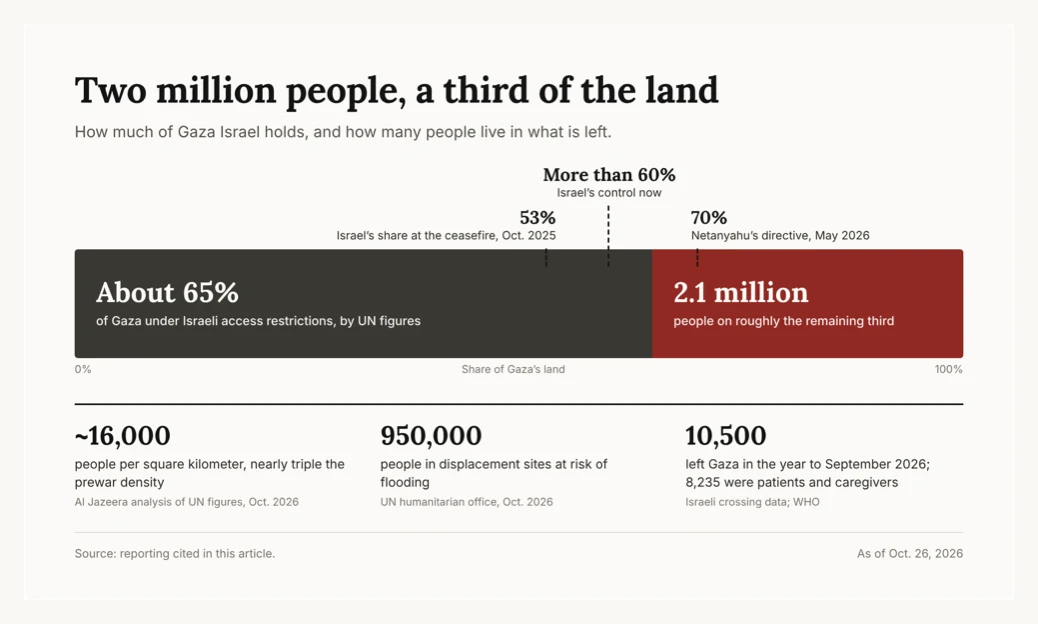
Look at where the Davos plan would build. Reconstruction "would only commence in areas of Gaza where Hamas is fully disarmed," NPR reported, "or already emptied of Palestinians and under Israeli military control." Hamas has not disarmed, according to the Times of Israel. So for now, the Davos plan allows building only on land emptied of Palestinians and held by Israel's army, and that land is growing. Israel held 53% of Gaza when the ceasefire took effect in October 2025, Al Jazeera reported, and now controls more than 60%, according to the Times of Israel. UN figures put about 65% of the Strip under Israeli access restrictions, leaving some 2.1 million people on roughly a third of it, by Al Jazeera's analysis.
Gaza got here in three steps. First, Washington and Israel looked for countries to take Gazans, weighing incentives for their governments, while a plan circulating in the Trump administration put a price on each departure. Second, with no country willing, Trump's own peace plan, which the UN Security Council endorsed, said "we will encourage people to stay." Third, Israel's army has squeezed Gazans onto a shrinking share of the Strip, and until Hamas disarms, the Davos plan would build only where Gazans are gone and Israel's army is in control. Call the last two steps Plan B. Letting Gazans stay is not the problem. Keeping them on a third of their land, with no date by which the rest will be theirs again, is.
For Americans, this is not someone else's project. At the first meeting of the Board of Peace, the international body Trump chairs, the president pledged $10 billion in US money, without saying whether Congress had approved it. Project Sunrise, a reconstruction plan drawn up before Davos by a team led by Kushner and Special Envoy Steve Witkoff, had the United States providing $60 billion to "anchor" the program, The Wall Street Journal reported; the State Department called that "fake news." In June, Sen. Jeanne Shaheen, the top Democrat on the Senate Foreign Relations Committee, said that the State Department had confirmed in a briefing to Congress that the board "had not established the rules and procedures governing the oversight and monitoring of funds." And though the board was set up to oversee Gaza's transition, its charter never mentions Gaza: it creates a standing international body that Trump will chair whether or not he is president.
Plan A was to move Gazans out. Under Plan B, Israel's army squeezes them onto a third of Gaza, and for now new homes are planned only on the rest.
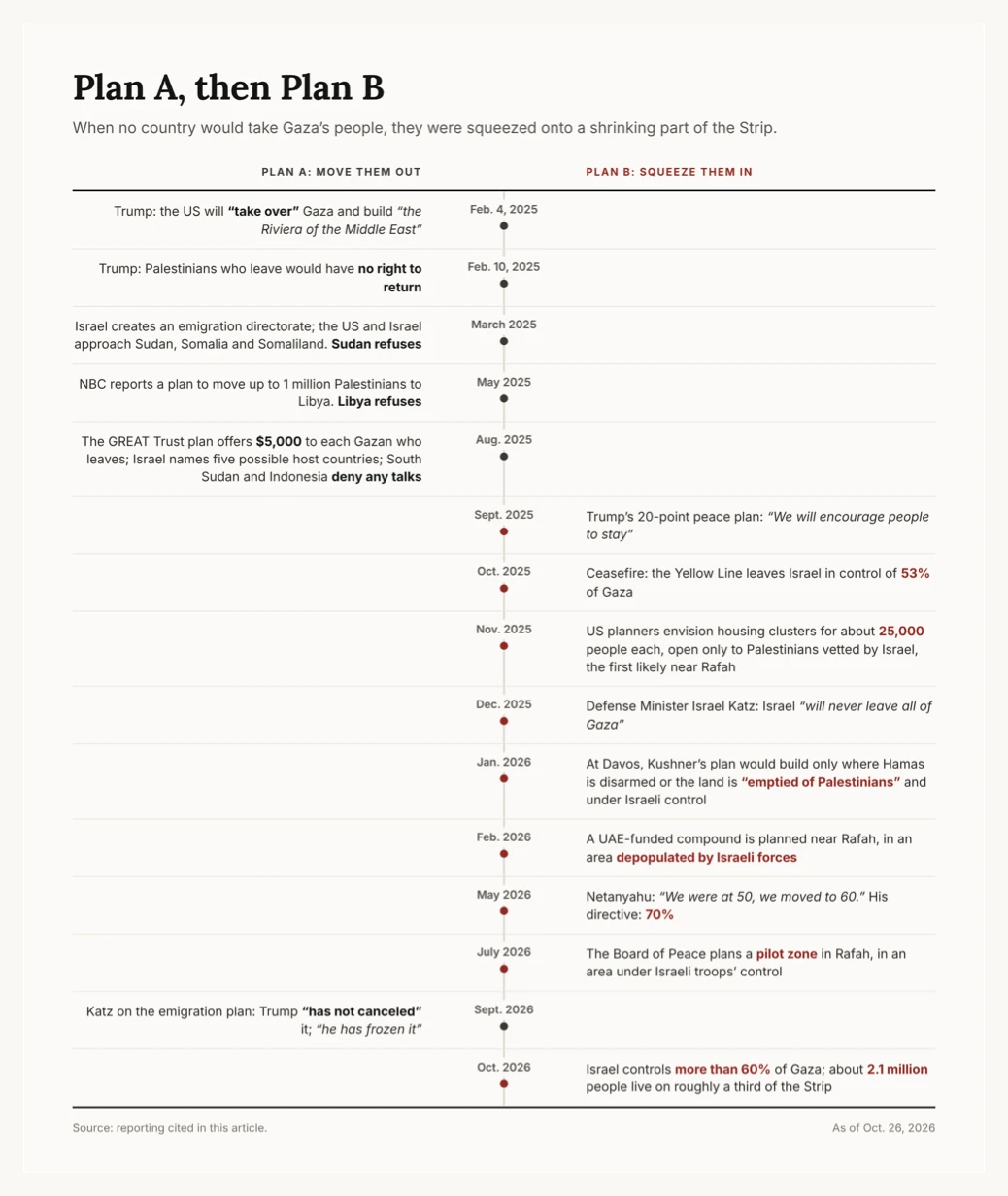
No country would take them
Plan A came with money attached. In March 2025, Israel's security cabinet created a directorate to manage the departure of Gaza residents "who wish to voluntarily depart to third countries," the government said, "in accordance with U.S. President Donald Trump's vision." US and Israeli officials approached Sudan, Somalia and the breakaway region of Somaliland about taking Palestinians, The Associated Press reported; incentives for Sudan's government could include debt relief, weapons and technology. Sudan's military leader, Gen. Abdel Fattah al-Burhan, said his country "categorically rejects" any transfer.
The money was worked out in detail. In July 2025, the Financial Times reported that consultants at the Boston Consulting Group, or BCG, had modeled more than 500,000 Gazans leaving, with relocation packages costing about $9,000 a person. The modeling was for a plan called the Gaza Reconstitution, Economic Acceleration and Transformation Trust, or GREAT Trust, drawn up by a group led by Michael Eisenberg, an Israeli American entrepreneur, and Liran Tancman, a former Israeli military intelligence officer. BCG later said the work had been "orchestrated and run secretly outside any BCG scope or approvals," and that the two senior partners who led the financial modeling had been fired. On Aug. 31, The Washington Post reported on the plan, which it described as "circulating within the Trump administration," and on its 38-page prospectus. The prospectus proposed running Gaza as a US trusteeship for at least 10 years. Each Palestinian who left would get $5,000 in cash, plus four years of rent and a year of food, and by the plan's own estimate, "every individual departure from Gaza would save the trust $23,000," the Post reported. Landowners would get digital tokens in exchange for the right to redevelop their property.
Washington and Israel kept looking for takers. In May, NBC News reported a plan to move up to one million Palestinians to Libya in return for releasing billions of dollars in frozen Libyan funds; the administration called the report "untrue," and Libya's government rejected any resettlement. In August, Netanyahu said Israel was "talking to several countries," and a senior Israeli official named them to CNN: South Sudan, Somaliland, Ethiopia, Libya and Indonesia. All of them, the official said, were seeking "significant financial and international compensation." South Sudan called the reports "baseless." Indonesia said there had been "no discussion nor agreement." After Israel recognized Somaliland in December 2025, Somalia's president said Somaliland had agreed to resettle Palestinians as one of Israel's conditions; Somaliland's foreign ministry called the claims baseless.
Arab states had offered another way. In March 2025, Arab leaders endorsed Egypt's $53 billion plan to build at least 400,000 permanent homes, under which Gazans would not be forced to leave. The United States said the plan failed to address the reality that Gaza was "uninhabitable." "President Trump stands by his vision to rebuild Gaza free from Hamas," Brian Hughes, a National Security Council spokesman, told The National. At the time, that vision still meant moving Gaza's people out.
Few Gazans have left in the past year. In the year to September 2026, about 10,500 of more than two million left, according to Israeli crossing data reported by The Algemeiner, and 8,235 of them were patients and their caregivers, by World Health Organization figures. About 6,000 people returned to Gaza over the same period.
Plan A has not been canceled, according to Israel's defense minister, Israel Katz. "Trump has not canceled this at the moment — he has frozen it," he said on Sept. 2, 2026. He said Arab states had pressed Trump, offering investment and the disarmament of Hamas. "There is no real solution for Gaza in the end without this migration," Katz said. "But for it to happen, we need the US." The next day, Itamar Ben-Gvir, leader of the far-right Jewish Power party, unveiled what he called a voluntary emigration plan to move 1.86 million Gazans out within seven years, ahead of Israel's Oct. 27 election. Moshe Feiglin, No. 2 on the Religious Zionist Party slate led by Finance Minister Bezalel Smotrich, put it more simply: "I want to see Gaza empty."
Take Trump at his word. "Nobody is going to be forced to leave," he said in October 2025, echoing his peace plan. Without force, Plan A needed countries willing to take two million people. None would.
Plan A did not stall for lack of trying. No country would take Gazans, and Israel's defense minister says Trump has frozen the plan, not canceled it.
Two million people on a third of the land
As Plan A stalled, Israel's boundary inside Gaza moved. The October 2025 ceasefire drew a "Yellow Line" across the Strip, marked on the ground by concrete blocks, and left Israel's army in control of everything on Israel's side of it: 53% of Gaza, Al Jazeera reported. The line did not stay put. In May 2026, Netanyahu told a conference at a West Bank settlement that Israel's share of Gaza had grown: "We were at 50, we moved to 60." He has directed the army to take 70%, Reuters reported. By July, an Israeli earth embankment ran more than 1.5 kilometers, nearly a mile, past the line near the al-Mawasi camp, the BBC reported.
Israel's defense minister says Israel will never hand all of Gaza back. "We are located deep inside Gaza and we will never leave all of Gaza. There will never be such a thing," Katz said in December 2025. He also said that "when the time comes," Israel would set up army outposts in northern Gaza in place of the settlements evacuated in 2005, remarks the Times of Israel reported as a vow to build settlements. His office said later that day that the government had "no intention of establishing settlements in the Gaza Strip."
On the other side of the line, the space keeps shrinking: the 2.1 million people there live at nearly triple the prewar density, by Al Jazeera's analysis of UN figures. About 950,000 live in displacement sites at risk of flooding, the UN's humanitarian office reported on Oct. 15. Reconstruction has not begun, and most Palestinians still live in tent camps or the ruins of their homes, the AP reported in September. On Oct. 19, the World Food Programme said funding shortfalls would force it to drop half a million people from its aid. At least 1,500 Palestinians have been killed by Israeli fire since the ceasefire, according to Gaza health officials. Israel says four of its soldiers have been killed by militants over the same period, and its military reported 31 ceasefire violations by Hamas and other armed groups in the first half of October alone.
Plan B has a blueprint. Unpublished US planning from November 2025 envisioned clusters with temporary housing for about 25,000 people each, the first likely near Rafah, open only to Palestinians approved by Israel's Shin Bet security service, The Atlantic reported. In January 2026, the US-led Civil-Military Coordination Center, which US Central Command set up in southern Israel in October 2025 to monitor the ceasefire, presented slides on a "Gaza First Planned Community." It would house up to 25,000 Palestinians in Rafah, on Israel's side of the Yellow Line, and every resident would be "registered with biometric documentation." On land ownership, the slides said that "an examination is required regarding potential private rights holders, including mechanisms for registration and compensation," Drop Site News reported. In February, a Gaza firm was hired to build an Emirati-funded compound for tens of thousands of displaced Palestinians near Rafah, in "an area depopulated and demolished by Israeli forces," Reuters reported. In July, the Board of Peace planned a pilot zone in Rafah for tens of thousands of people, in an area under the control of Israeli troops, the Financial Times reported. An International Crisis Group analyst told the paper that wherever such zones go, the Israeli military will remain the primary authority.
Some of these may be versions of the same Rafah project, but all of them are in, or planned for, the part of Gaza that Israel holds. The housing is meant for Palestinians who pass vetting and registration, under Israel's army. That is the condition Kushner set out at Davos, already drawn on the map: until Hamas disarms, build only where Palestinians are gone and Israel's army is in charge.
So far, Plan B's new homes are planned for Gazans who pass vetting, on land Israel's army has emptied and holds.
Trump's board
In November 2025, the UN Security Council welcomed Trump's Board of Peace as Gaza's "transitional administration," authorized until Dec. 31, 2027.
The board's charter, signed at Davos in January, puts Trump in charge personally. He can be replaced only if he resigns or is incapacitated, according to the charter. He names his own successor. He alone invites member states, and he can expel them unless two-thirds object. Membership lasts three years and costs nothing; a state that pays more than $1 billion in cash within the charter's first year is exempt from the three-year limit, which amounts to a permanent seat.
Beneath Trump, the Board of Peace has an executive board, named by the White House on Jan. 16, whose members include Secretary of State Marco Rubio, Kushner, Witkoff, former British Prime Minister Tony Blair and Marc Rowan, chief executive of the investment firm Apollo Global Management. A second panel, the Gaza Executive Board, named the same day, includes the Israeli-Cypriot real estate billionaire Yakir Gabay. Nickolay Mladenov serves as the Board of Peace's High Representative for Gaza. Two senior advisers, Aryeh Lightstone and Josh Gruenbaum, lead the Board of Peace's day-to-day strategy and operations, the White House said. Lightstone sat on the US team that mapped West Bank annexation under Trump's 2020 peace plan. Tancman, who helped lead the group behind the GREAT Trust, has led the board's work on a Gaza stablecoin, a digital currency pegged to the dollar.
The money is harder to see. At the first meeting, on Feb. 19, pledges included $1.2 billion from the United Arab Emirates, $1 billion each from Qatar, Saudi Arabia and Kuwait, and $10 billion from the United States, the Gulf business publication AGBI reported. By April, less than $1 billion of the roughly $17 billion pledged had arrived, from the UAE, Morocco and the United States, Reuters reported. In May, the World Bank fund set up for Gaza had still received nothing, and donations had gone instead to a JPMorgan account that is "under no obligation to report its financial position to contributors and board members," the Financial Times reported. The board said the World Bank fund was "just one of many funding mechanisms" and accused the paper of trying "to sow doubt." In June, Shaheen asked Rubio whether the board could use US funds to pay Trump, as its chairman, while he is president or after he leaves office, her office said.
Leaked drafts would give the board sweeping powers over Gaza. A draft resolution leaked to Drop Site News in January would let the Board of Peace's executive board "enact new law, or modify or repeal prior" civil and criminal laws in Gaza. It would also restrict access to humanitarian zones to "individuals approved by the Executive Board and the High Representative." The copy was unsigned, and it states that "no one will be forced to leave Gaza." In June, The Guardian reported on a draft that would shield board members and contractors from Gaza's courts and let the board use Gaza's public property without compensation; a board official denied any "immunity framework of the kind described."
Gaza's UN-approved administrator is a board whose chairman can be replaced only if he resigns or is incapacitated. Donations went to an account with no duty to report back to the donors.
The waterfront
The value of the land was never a secret. In February 2024, four months into the war, Kushner told an interviewer from Harvard's Middle East Initiative that "Gaza's waterfront property could be very valuable," The Jewish Chronicle reported. "From Israel's perspective I would do my best to move the people out and then clean it up," he said. He added: "But I don't think that Israel has stated that they don't want the people to move back there afterward." In other words, as Kushner saw it, Israel had not ruled out letting them return.
In September 2025, Smotrich told a real estate conference in Tel Aviv that Gaza could become "a real estate bonanza." "We have done the demolition phase, which is always the first phase of urban renewal — now we need to build," he said. "There is a business plan, put together by the most professional people here, that is on President Trump's desk," he added. "We have to see how we are dividing up the land in percentages."
Three months later, The Wall Street Journal reported the details of Project Sunrise. Its first 10 years would cost $112 billion, and by year 10, "70 percent of Gaza's coastline should be monetized," with more than $55 billion in long-run returns. The seafront “glitzy riviera" would cut into parts of the al-Shati and Nuseirat refugee camps, and the core of the northern city of Jabalia appeared slated to become a park, according to The Intercept.
At Davos, the plan Kushner presented designated the entire coastline for "coastal tourism," NPR reported. "Look at this beautiful piece of property," Trump said there. "I'm a real estate person at heart." Kushner credited work on the plan to Gabay, who he said had "volunteered to do this not for profit." At the board's first meeting a month later, Rowan put a number on the coast. "The coastline alone? 50 billion in value on a conservative basis," he said, The Australian reported. Gabay described a new Mediterranean riviera with 200 hotels and potential islands. Rowan also said the first phase of the board's housing plan would build 100,000 homes for 500,000 residents, the Times of Israel reported. A video the Trump administration prepared for the meeting promised to "fully rebuild Rafah within three years" and to connect Gaza to the world "through an Abrahamic gateway" reaching India and Europe. The GREAT Trust prospectus had already spelled out Gaza's trade role: "Gaza to serve as major hub for IMEC," the India-Middle East-Europe Economic Corridor, a trade route planned from India across the Gulf and through Israel to Europe.
The plans are precise about towers and hotels. They say little about who owns the land. The Davos plan "makes no reference to land deed transfers nor how new housing would be allocated," NPR reported. About two-thirds of Gaza's land is privately owned, the Carnegie Endowment for International Peace noted, citing a World Bank assessment. At the Feb. 19 meeting, Rowan also proposed gathering Gaza's rebuilt housing, its coastline and its offshore gas fields into one structure, with the board as its interim steward, or caretaker. Palestinians moved into the temporary compounds near Rafah would have to choose between waiting there for permanent housing and accepting resettlement outside Gaza, Carnegie's analysis argued. “Whatever their ‘choice,’ they may be required to give up their property rights to the Board of Peace first,” it warned.
The plans put a price on Gaza's coast. They do not promise Gazans their land.
Who stands to profit
The plans drew would-be contractors early. In December 2025, The Guardian reported that Gothams, the contractor that helped run the Florida immigration detention site known as “Alligator Alcatraz," had been the apparent frontrunner to run Gaza's logistics. The paper estimated that such a master contractor could gross $1.7 billion a year from trucking fees alone. Gothams' founder said the company "will not be participating." The paper later reported that Gothams had sent White House officials a draft plan in November 2025 that asked for a minimum return of three times its capital expenditure and seven years of exclusivity. A Gothams partner said there was no contract, and the State Department told the paper that "no procurement process or contracting mechanism has been stood up."
Kushner's own investments reach into Israel's arms industry. His private equity firm, Affinity Partners, is the largest shareholder in the Israeli insurer Phoenix, which holds at least $265 million in the Israeli defense company Elbit Systems, CNN reported on Oct. 1. Kushner's lawyer said he "has never participated in or directed Phoenix's investment decisions." Phoenix was also the largest institutional shareholder in Smart Shooter, an Israeli maker of AI-assisted rifle sights whose technology the Israeli army has used in Gaza and which has won a US military contract worth up to $150 million, The Telegraph reported. The board called the report "a sensationalized headline" and said that on Phoenix there had been "zero demonstrated personal benefit." A source close to the board told The Telegraph: "We literally have never had a single discussion at any point about business interests."
The questions have reached Congress and the courts. On Oct. 5, Rep. Robert Garcia, the top Democrat on the House Oversight Committee, asked Kushner for a list of Affinity's investments since January 2025 in Gaza, Israel, the Gulf and elsewhere in the Middle East. On Oct. 14, the watchdog group Citizens for Responsibility and Ethics in Washington sued the White House, arguing that Kushner's work as an envoy for Trump requires him to file financial disclosures. The White House says his business is unrelated to his diplomacy, and his lawyer said the suit "is without merit," adding that ethics counsel had confirmed his arrangements "comply with applicable ethics requirements."
A source close to the board says members' business interests never come up. The top Democrat on the House Oversight Committee and a watchdog group are now asking about Kushner's.
What stands in the way
For now, Israel, not just Hamas, is holding the board back. In early August, the board chose Louisiana-based Arkel International for its first construction contract: an outpost for about 150 troops of the International Stabilization Force, the multinational force the UN Security Council authorized for Gaza. Board officials call the outpost the essential prerequisite for all later recovery work. Two months later, Israel still had not let the contractors into Gaza, The Guardian reported. In January, Israel did not let the Palestinian technocratic committee chosen to run Gaza's daily affairs enter Gaza, +972 Magazine reported; in October, the committee was still awaiting authorization to enter and working from Cairo. In September, the board unveiled a $2.45 billion recovery plan to begin rebuilding Gaza. Netanyahu had agreed to parts of it only in principle and had not begun carrying them out, Axios reported.
Disarmament is stuck on who moves first. At the end of July, Hamas accepted a board roadmap that Trump called an agreement for Hamas's "complete disarmament," but Hamas says it will not take any step toward disarming before Israel withdraws. On Aug. 9, Netanyahu rejected the board's 15-point plan for the ceasefire's next phase; Hamas says it remains committed to that plan. The Israeli army "will not carry out any withdrawal until Hamas is genuinely disarmed," Netanyahu said. Kushner, Blair and Mladenov met him in Jerusalem on Aug. 17. Israel and the board agreed to set up working groups, including one on disarming Gaza, and said disarmament should be finished before reconstruction starts, The National reported. As of Oct. 25, Trump's peace plan had stalled, "with Hamas refusing to disarm and Israel refusing to withdraw from any part of Gaza until that condition is met," the Times of Israel reported.
Israel and the board agree on one thing. Both want Hamas disarmed first: Netanyahu before any Israeli withdrawal, the board before reconstruction starts. Until then, Gazans stay on their third of the Strip, and the board's pilot zone sits on land Israel holds.
The board has been waiting for the elections. It believes Israel's government will let the troop outpost go ahead after Israel's Oct. 27 vote, a person familiar with the matter told The Guardian, and it plans to step up its efforts after both that vote and the US midterms on Nov. 3, according to The Telegraph. The pilot zone was to begin taking in residents in November, pending progress on a deal to disarm Hamas, Israel's Channel 12 reported in July.
No country has agreed to resettle Gaza's people, reconstruction has not begun, and the towers exist only on slides. But on the ground, the Yellow Line has already drawn the map: about two million people on a third of the land, while a board Trump chairs makes plans for the coast.
Kushner said there is no Plan B. Two million people already live in it.
Sources
- ABC News: Trump says the US will take over the Gaza Strip (Feb. 4, 2025)
- Axios: Trump's vision for a "Riviera of the Middle East" in Gaza (Feb. 5, 2025)
- AFP via EWN: Trump says no right of return for Palestinians under his Gaza plan (Feb. 10, 2025)
- NPR: Trump meets Jordan's King Abdullah II at the White House (Feb. 11, 2025)
- Al Jazeera: key takeaways from Trump's meeting with King Abdullah (Feb. 11, 2025)
- NPR: what Jared Kushner’s new Gaza plan includes and what it leaves out (Feb. 2, 2026)
- Times of Israel: Kushner presents his plan for a glitzy Gaza rebuild at Davos (Jan. 22, 2026)
- Times of Israel: Hamas said to threaten an Oct. 7-style attack over the IDF's advance in Gaza (Oct. 25, 2026)
- Al Jazeera: maps show how Israel's Yellow Line keeps squeezing Palestinians in Gaza (Oct. 12, 2026)
- United Nations: Security Council Resolution 2803, endorsing Trump's 20-point plan to end the Gaza conflict (Nov. 17, 2025)
- AGBI: Gulf states pledge billions for the Board of Peace's Gaza plans (Feb. 2026)
- Reuters via Malay Mail: Trump launches the Board of Peace with a $10 billion pledge (Feb. 20, 2026)
- Times of Israel, citing The Wall Street Journal: the US pitches Project Sunrise (Dec. 20, 2025)
- Yahoo News: the State Department denies a $60 billion US commitment to Gaza
- Senate Foreign Relations Committee: Shaheen presses the State Department on Board of Peace oversight (June 11, 2026)
- NPR: the Board of Peace charter and its $1 billion permanent membership (Jan. 19, 2026)
- Institute for National Security Studies: an analysis of the Board of Peace charter
- L'Orient Today: Israel approves a directorate for the "voluntary departure" of Gaza residents (March 2025)
- AP via ClickOnDetroit: the US and Israel look to Africa to resettle Palestinians from Gaza (Mar. 14, 2025)
- L'Orient Today, citing the Financial Times: BCG reportedly modeled Gaza relocation plans (July 2025)
- Israel Hayom: the GREAT Trust plan offers Palestinians $5,000 to leave (Aug. 31, 2025)
- The New Arab: two BCG executives lose their roles over the Gaza displacement plan (July 2025)
- The Washington Post via The Boston Globe: Gaza postwar plan envisions relocating the entire population (Aug. 31, 2025)
- NBC News: the US reportedly developed a plan to resettle 1 million Gazans in Libya (May 2025)
- Libya Security Monitor: Libya's government rejects any resettlement of Palestinians (May 17, 2025)
- CNN: Israel says it is in talks with several countries to take Gazans (Aug. 2025)
- The Algemeiner: South Sudan denies talks on resettling Palestinians (Aug. 13, 2025)
- Indonesia Business Post: Indonesia's foreign ministry denies talks with Israel on resettlement (Aug. 15, 2025)
- Al Jazeera: Somaliland denies agreeing to host Israeli bases or resettle Palestinians (Jan. 1, 2026)
- Al Jazeera: what is Egypt's plan for the reconstruction of Gaza (Mar. 4, 2025)
- The National: the White House says the Arab plan fails to address the reality that Gaza is uninhabitable (Mar. 5, 2025)
- The Algemeiner: 10,500 Palestinians left Gaza in the past year, new data show (Sept. 11, 2026)
- Ynet: Katz says Trump has frozen the emigration plan, not canceled it (Sept. 2, 2026)
- Khaleej Times: Katz says Israel is ready to remove Gaza's population if the US approves (Sept. 2026)
- Times of Israel: Ben-Gvir unveils a "voluntary emigration" plan aimed at removing 1.86 million Palestinians from Gaza (Sept. 3, 2026)
- Jerusalem Post: Moshe Feiglin, No. 2 on the Religious Zionist Party slate (Oct. 2026)
- The Washington Times: Trump says no Gazans will be forced to leave (Oct. 9, 2025)
- Dawn, citing the BBC: Israel builds new barriers past the Yellow Line in Gaza (July 31, 2026)
- Reuters via The Algemeiner: Netanyahu directs Israeli forces to expand control of Gaza to 70% (May 29, 2026)
- Reuters via Al-Monitor: Israel's defense minister vows the military will remain in Gaza (Dec. 23, 2025)
- Times of Israel: Katz vows settlements in northern Gaza, then walks back his comments (Dec. 23, 2025)
- UN OCHA: Gaza humanitarian situation report (Oct. 15, 2026)
- AP via PBS NewsHour: the Board of Peace proposes a $2.45 billion blueprint for Gaza reconstruction (Sept. 23, 2026)
- World Food Programme: funding cuts force WFP to drastically reduce assistance in Gaza (Oct. 19, 2026)
- Reuters via GV Wire: Israeli fire kills four people in Gaza, medics say (Oct. 20, 2026)
- FDD's Long War Journal: Israel reportedly blocks a Board of Peace base in Gaza; the IDF reports 31 ceasefire violations (Oct. 15, 2026)
- Al-Quds, citing The Atlantic: US planning for vetted housing clusters in Gaza (Nov. 12, 2025)
- Drop Site News: leaked CMCC documents on a Gaza residential zone in Rafah (Jan. 21, 2026)
- Reuters via Al-Monitor: a Gaza firm will build a UAE-funded housing compound in the Israeli-held south (Feb. 25, 2026)
- Financial Times via The Irish Times: the Board of Peace plans a pilot zone in Gaza (July 22, 2026)
- Times of Israel: full text of the Board of Peace charter (Jan. 2026)
- AP via PBS NewsHour: a $1 billion contribution secures a permanent seat on the Board of Peace (Jan. 2026)
- The White House: statement naming the Board of Peace's executive boards (Jan. 16, 2026)
- Calcalist: who is Yakir Gabay (Jan. 18, 2026)
- Times of Israel: Netanyahu meets the US mapping team for West Bank annexation (2020)
- The Block, citing the Financial Times: the Board of Peace explores a Gaza stablecoin (2026)
- Times of Israel, citing Reuters: the Board of Peace has received a tiny fraction of $17 billion pledged (April 2026)
- Jerusalem Post, citing the Financial Times: Board of Peace donations go to a JPMorgan account (May 27, 2026)
- Arab News: the Board of Peace responds to the Financial Times report on its funding (May 27, 2026)
- Drop Site News: leaked Board of Peace resolution outlines a US-led plan to rule Gaza (Jan. 26, 2026)
- Jerusalem Post, citing The Guardian: a Board of Peace draft would grant immunity in Gaza (June 28, 2026)
- The Jewish Chronicle: Kushner highlights the real estate potential of Gaza's waterfront (March 2024)
- Ynet: Smotrich calls Gaza "a real estate bonanza" (Sept. 17, 2025)
- CNN via KRDO: Smotrich suggests a real estate bonanza will follow the war (Sept. 18, 2025)
- Times of Israel: Smotrich says Israel is talking with the US about dividing up Gaza (Sept. 17, 2025)
- The Intercept: Project Sunrise and the second phase of the Gaza ceasefire (Jan. 21, 2026)
- NBC News: Jared Kushner’s vision for Gaza clashes with reality (Jan. 24, 2026)
- Responsible Statecraft: Kushner, the Board of Peace and the profits (Feb. 2026)
- Times of Israel: Board of Peace official says homes for 500,000 residents in the first phase (Feb. 19, 2026)
- The GREAT Trust prospectus, PDF via Protagon (2025)
- Carnegie Endowment for International Peace: Gaza's refugees, displacement and the Board of Peace (July 2026)
- The Guardian via TMS: the Alligator Alcatraz contractor and Gaza logistics (Dec. 14, 2025)
- The Guardian via Yahoo News: a US contractor's Gaza plan sought 300% returns (Feb. 2026)
- Ynet, citing CNN: Kushner's Affinity, Phoenix and Israeli defense stocks (Oct. 1, 2026)
- Arab News, citing CNN: Kushner's Gaza role raises questions over his Israeli investments (Oct. 2, 2026)
- Jerusalem Post, citing The Telegraph: Board of Peace conflict-of-interest report and the board's response (Oct. 12, 2026)
- House Oversight Democrats: Rep. Robert Garcia's letter to Jared Kushner (Oct. 5, 2026)
- Bloomberg Law: White House sued over Kushner's government work by watchdog (Oct. 14, 2026)
- The Guardian via The Irish Times: the Board of Peace issues its first building contract, for a military base (Aug. 6, 2026)
- The Week, citing The Guardian: Gaza reconstruction stalls as Israel blocks contractors (Oct. 15, 2026)
- The Guardian via the Irish Examiner: Israel blocks the Board of Peace's first construction project (Oct. 2026)
- +972 Magazine: how Netanyahu is sabotaging Gaza's technocratic committee (Jan. 29, 2026)
- World Israel News, citing The Telegraph: the Board of Peace will push reconstruction after the US and Israeli elections (Oct. 12, 2026)
- La Voce di New York, citing Axios: the Board of Peace unveils a $2.45 billion Gaza recovery plan (Sept. 23, 2026)
- Al-Monitor: Hamas agrees to disarm under Trump's plan (July 30, 2026)
- Dawn: Hamas says no disarmament before Israel withdraws (Aug. 1, 2026)
- ABC News: Netanyahu rejects the Board of Peace’s 15-point plan (Aug. 9, 2026)
- The Irish Times: Netanyahu rejects the US Gaza plan and vows no withdrawal until Hamas disarms (Aug. 9, 2026)
- World Israel News: Kushner, Blair and Mladenov press Netanyahu on the Board of Peace plan (Aug. 17, 2026)
- The National: Kushner meets Netanyahu to break the Board of Peace deadlock (Aug. 17, 2026)
- Times of Israel, citing Channel 12: the Board of Peace pilot zone in Gaza to open in November (July 30, 2026)
Video article: footage, photo, map and document credits
Scenes of the people in this story come from official U.S. government video and photographs (works of the United States government, public domain) and from photographs published under Creative Commons licences. The map is a satellite image of the Gaza Strip with lines drawn from published UN and research data. Documents shown are the published pages of the documents the narration quotes. Creative Commons material, with the credit each licence requires:
- Aerial view of destruction in Beach refugee camp, Gaza Strip — Abedallah Alhaj, CC BY-SA 3.0 igo
- An aerial view of Al-Mawasi area where displaced Palestinians live in tents, Gaza Strip — Ashraf Amra, CC BY-SA 3.0 igo
- An aerial view showing destruction in Rafah after Israeli forces withdrawal and as the ceasefire took hold, Gaza Strip — Ashraf Amra, CC BY-SA 3.0 igo
- Bezalel Smotrich — Avi Ohayon, CC BY-SA 3.0
- Chairman of the Sovereignty Council of Sudan Abdel Fattah Abdelrahman Burhan in October 2019 (cropped) — Kremlin.ru, CC BY 4.0
- Egyptian Convoy to Gaza, Palestine — Gigi Ibrahim, CC BY 2.0
- Flooded tents of displaced Palestinians due to heavy rain in Deir el-Balah, Gaza Strip — Ashraf Amra, CC BY-SA 3.0 igo
- Hassan Sheikh Mohamud, President of Somalia - 2023 — Nicolas Landemard / European Union, 2023 / EC - Audiovisual Service, CC BY 4.0
- Images of war 23-25 from Gaza, by Jaber Badwen, IMG 5458 — Jaber Jehad Badwan, CC BY-SA 4.0
- Israel Katz (SHL 9694) — Shlomi Amsalem, CC BY-SA 4.0
- Israel Katz, the appointed Minister of Defence of Israel and the outgoing minister, Yoav Galant, November 2024. II — Spokesperson and Public Relations Division, Israel Ministry of Defense, CC BY-SA 4.0
- Itamar Ben Gvir - 2021 (3B0A9778) — Alexander Khanin, CC BY-SA 4.0
- Michael Eisenberg, Aleph VC — Shaiknecht18, CC BY-SA 4.0
- Moshe Feiglin4202 — Yaakov (Wikimedia Commons user יעקב), CC BY-SA 4.0
- Visit of Aryeh Lightstone, United States Senior Advisor to the Board of Peace, to the EC (P-070233-00-03) — Europäische Kommission - Audiovisueller Dienst, Yügen, CE - Service audiovisuel,, CC BY 4.0
- Visit of Nickolay Mladenov, High Representative for Gaza of the Board of Peace, to the European Commission (P-070250-00-03) — Europäische Kommission - Audiovisueller Dienst, Claudio Centonze, Yügen, CE - Se, CC BY 4.0
- ביקור השר לבטחון לאומי איתמר בן גביר במשמר לאומי — Israel Police (recruitment office), CC BY-SA 4.0
- الدمار في شارع الرشيد، دوار 17 في غزة، نتيجة الغارات الجوية الإسرائيلية — Jaber Jehad Badwan, CC BY-SA 4.0
- Benjamin Netanyahu portrait: official portrait, Israeli Government Press Office — CC BY-SA 3.0 · Avi Ohayon
- Marc Rowan portrait: Marc Rowan in Mercatus Center interview 2024 — CC BY 3.0 · Mercatus Center
- Tony Blair portrait: Tony Blair 2024 — CC BY-SA 2.0 · Ricardo Stuckert / Presidência da República
- Yakir Gabay and Liran Tancman: frames from the White House video of the Board of Peace meeting, Feb. 19, 2026 (public domain)
Map data:
- Satellite image: Contains modified Copernicus Sentinel data 2026 (Sentinel-2, Oct. 23, 2026)
- Gaza Strip boundaries: OCHA / HDX COD-AB, source Palestinian Authority Ministry of Planning — CC BY-IGO
- Yellow Line, October 2025: Stephane Cohen, Data Analytic Center, Institute for National Security Studies
- Yellow Line as mapped by UNRWA, May 2026; access-restricted (coordination) zone, June 23, 2026: UN Department of Safety and Security and IOM working layers
- Place positions: © OpenStreetMap contributors (ODbL)
- Region map: Natural Earth (public domain)
Cover image, a composite of these photographs over the video's map:
- Donald Trump at the Board of Peace meeting, Feb. 19, 2026 — The White House (Daniel Torok), public domain
- Jared Kushner and Benjamin Netanyahu at the White House, Sept. 29, 2025 — The White House (Joyce N. Boghosian), public domain
- Steve Witkoff in Tel Aviv, May 13, 2025 — U.S. Embassy Jerusalem, CC BY 2.0
- Marc Rowan in Mercatus Center interview 2024 — Mercatus Center, CC BY 3.0
Public-domain sources (The White House, U.S. Department of Defense/DVIDS, U.S. Department of State, U.S. Army, U.S. Senate, U.S. House of Representatives, NASA, U.S. General Services Administration):
- 250718-D-FN350-2348 SecDef Pete Hegseth Hosts Israeli Defense Minister Israel Katz at The Pentagon (U.S. Department of Defense (U.S. Air Force Staff Sgt. Madelyn Keech))
- 250718-D-FN350-2514 SecDef Pete Hegseth Hosts Israeli Defense Minister Israel Katz at The Pentagon (U.S. Department of Defense (U.S. Air Force Staff Sgt. Madelyn Keech))
- Brian Hughes official portrait, 2025 (NASA/Bill Ingalls)
- High Representative for the Administration of Gaza Visits CMCC (9501944) (U.S. Army USARCENT by Staff Sgt. Michael Ito)
- Josh Gruenbaum (U.S. General Services Administration)
- Official portrait of Secretary Marco Rubio, January 2025 (U.S. Department of State)
- P20250929DT-1484 President Donald Trump and Israeli Prime Minister Benjamin Netanyahu hold a joint press conference (The White House (Daniel Torok))
- P20250929JB-0176 President Donald Trump and Israeli Prime Minister Benjamin Netanyahu hold a joint press conference (The White House (Joyce N. Boghosian))
- P20250929JB-0493 President Donald Trump and Israeli Prime Minister Benjamin Netanyahu hold a joint press conference (The White House (Joyce N. Boghosian))
- P20250929JB-0525 President Donald Trump and Israeli Prime Minister Benjamin Netanyahu hold a joint press conference (The White House (Joyce N. Boghosian))
- P20251105MR-1623 President Donald Trump participates in an interview with Fox News’ Bret Baier in the Chapel Room of the Kaseya Center (The White House (Molly Riley))
- P20251105MR-1645 President Donald Trump participates in an interview with Fox News’ Bret Baier in the Chapel Room of the Kaseya Center (The White House (Molly Riley))
- P20260219DT-0306 (The White House (Daniel Torok))
- P20260219DT-0540 (The White House (Daniel Torok))
- P20260219DT-1078 (The White House (Daniel Torok))
- President Donald Trump participates in a multilateral meeting with Arab and Muslim leaders at the United Nations Headquarters (54822741907) (The White House (Daniel Torok))
- President Trump Participates in a Bilateral Meeting with the President of the Republic of Finland (20251009) (White House, bilateral with Finland's president, Oct 9, 2025, 23:45 to 24:30, Commons mirror)
- Robert Garcia 119th Congress (House Creative Services)
- SD Hegseth hosts Israel MOD Katz at the Pentagon, July 18, 2025 (DoD, DVIDS 971352)
- Shaheen Senate Portrait (U.S. Senate Photographic Studio, John Klemmer)
- Shaheen Senate Portrait (U.S. Senate Photographic Studio, John Klemmer)
- The White House, Board of Peace charter event, Davos, Jan. 22, 2026
- The White House, Board of Peace meeting, Feb. 19, 2026
- White House, bilateral with the King of Jordan, Feb 11, 2025
- White House, press conference with Netanyahu, Feb 4, 2025
Documents shown:
- Board of Peace Resolution 2026/1, unsigned draft, obtained by Drop Site News
- CREW v. Kushner et al., complaint, D.D.C. No. 1:26-cv-03580, Oct. 14, 2026
- Charter of the Board of Peace, signed copy, Board of Peace
- Civil-Military Coordination Center slides, January 2026, obtained by Drop Site News; copy hosted by The Guardian
- Rep. Robert Garcia's letter to Jared Kushner, Oct. 5, 2026, House Oversight Committee Democrats
- Sen. Jeanne Shaheen's letter to Secretary of State Marco Rubio, June 11, 2026, Senate Foreign Relations Committee
- The Board of Peace Davos slide deck, Jan. 22, 2026; copy hosted by The Guardian
- The GREAT Trust prospectus, as published by Protagon; reported by The Washington Post
- UN Security Council Resolution 2803 (2025), United Nations
The appearance of U.S. Department of Defense visual information does not imply or constitute endorsement.