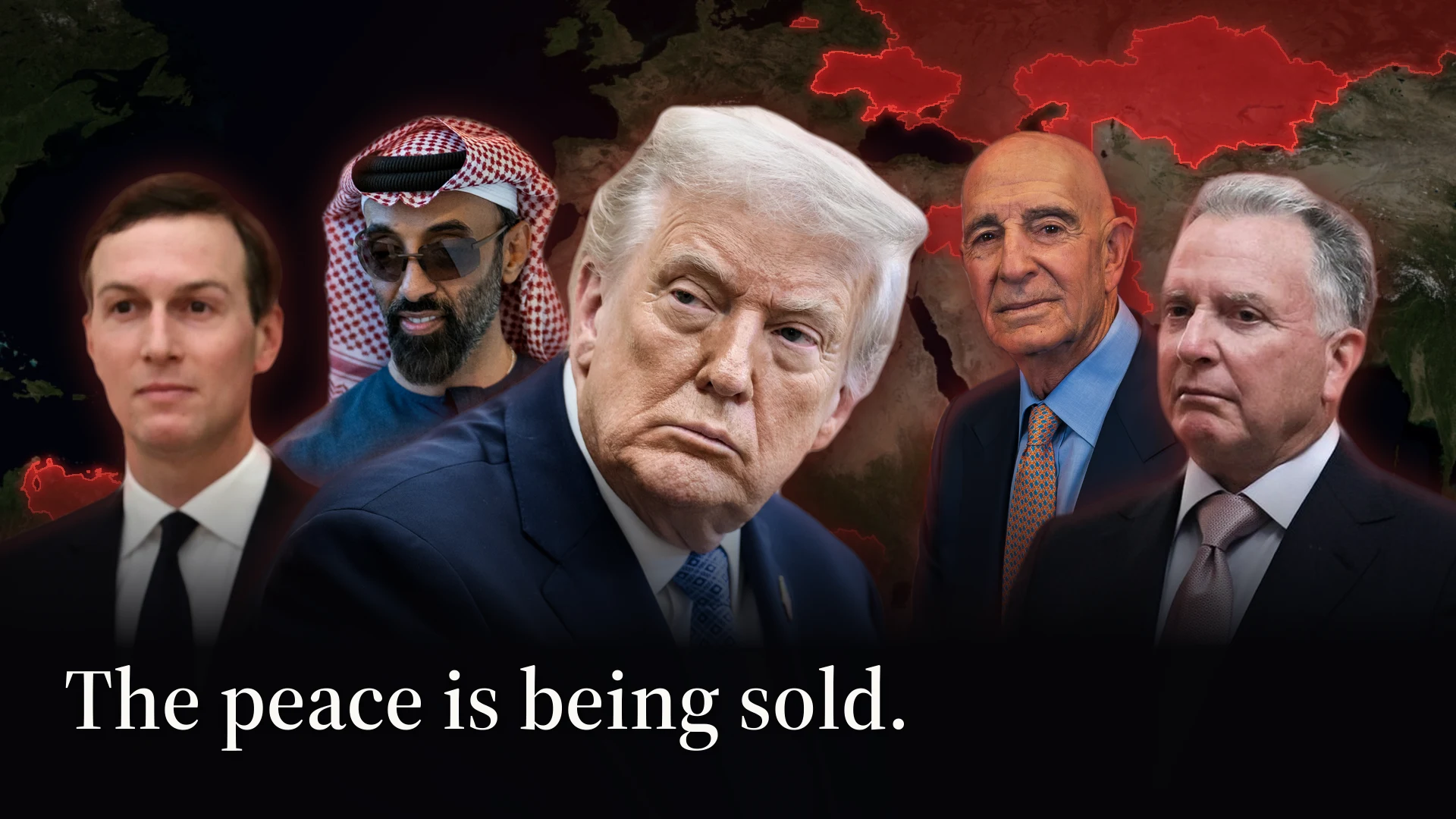
Key players- Donald TrumpThe deal-maker; his family’s firms are in it
- Alejandro BetancourtVenezuelan billionaire with the Pentagon oil deal
- The KhayyatsSyrian brothers at every table
- Todd BoehlyTrump donor leading the Lukoil bid
All 17
Washington
- Donald Trump
- President. Removed Venezuela’s ruler, chairs the Board of Peace, and his family’s companies turn up in Kazakhstan, Russia and the Gulf.
- Marco Rubio
- Secretary of State. Signed the Venezuela oil deal; Venezuela’s budgets now go to him for approval.
- Pete Hegseth
- Defense secretary. Co-signed the Venezuela deal; the Pentagon is in line for 35 percent of the venture.
- Steve Witkoff
- Envoy. With Kushner, negotiating Ukraine and Iran while the Lukoil sale and frozen Russian assets are on the table.
- Jared Kushner
- Trump’s son-in-law and envoy. Investments reach Israel’s arms industry; Dmitriev calls him “a Peacemaker.”
- Tom Barrack
- Envoy to Syria and Iraq. Kept financial ties to TI Capital, a firm in the Iraq-Syria pipeline deal.
- Massad Boulos
- Trump’s Africa adviser and Tiffany Trump’s father-in-law; defends the Libya and Congo deals.
- Eric Trump and Donald Trump Jr.
- Bought stakes in Skyline, which holds 20 percent of Kazakhstan’s tungsten project, six days before the minerals deal.
Venezuela
- Alejandro Betancourt
- Billionaire investigated by US and Swiss prosecutors; worked the phones on the night of the raid and got a 100-year oil concession.
- Delcy Rodríguez
- Acting president. Elections promised, no date given.
- Mauricio Claver-Carone
- Trump’s point man on Venezuela, on the phone with Betancourt during the raid; out by July 31.
Syria and Iraq
- The Khayyat brothers and UCC Holding
- Qatar-based Syrian family in the Syria power and airport deals, the Iraq pipeline, a Libya oil block, Venezuela’s Loran gas, Kushner’s Albanian resort and the Lukoil bid.
Russia and Ukraine
- Todd Boehly
- Trump donor leading the bid for Lukoil’s foreign assets, which needs a Treasury license.
- Lukoil
- Russia’s second-largest oil company, sanctioned by the Treasury; about $20 billion of foreign assets for sale.
- Kirill Dmitriev
- Head of Russia’s sovereign wealth fund; Witkoff and Kushner’s counterpart in the Ukraine talks.
- Ronald Lauder
- Cosmetics heir whose Rock Holdings co-owns Ukraine’s Dobra lithium deposit.
The Gulf
- Sheikh Tahnoon bin Zayed
- UAE national security adviser. His IHC helps lead the Lukoil bid and his ADQ is in the Congo mines deal.
On Aug. 30, Secretary of State Marco Rubio and Defense Secretary Pete Hegseth signed an 18-page oil agreement with a Venezuelan billionaire, ProPublica reported. The White House says the deal covers 17 Venezuelan oil fields holding an estimated 65 billion barrels. For comparison, the entire United States has about 46 billion barrels of proven reserves.
The fields are run by North American Blue Energy Partners, the company of the billionaire, Alejandro Betancourt. A US official said Venezuela's interim government had granted it concessions for 100 years, a term ProPublica found nowhere in the agreement and one that appears to break Venezuela's 25-year legal limit. The United States can take 35 percent of the venture's parent company, which is registered in Barbados, through warrants priced at a penny a share, in a transaction a Pentagon office is to carry out. It also gets the right to buy a fifth of the company's oil at $30 a barrel and first claim on the rest for 50 years. One of the deal's own supporting documents puts that price at less than a third of what oil has recently sold for, ProPublica reported.
Betancourt is an unusual partner for the American government. Federal prosecutors in Florida investigated him over an alleged scheme to embezzle more than $1 billion from Venezuela's state oil company and launder it through Miami real estate, Reuters reported. Swiss prosecutors have been investigating him since 2019. He has never been charged and denies wrongdoing. In 2019, Rudy Giuliani, then Trump's personal lawyer, urged Justice Department prosecutors to go easy on him, Reuters reported, citing his associate Lev Parnas and a person with direct knowledge of the meeting.
Then he made himself useful to Washington. In the early hours of Jan. 3, as American forces were seizing Nicolás Maduro in Caracas, the president's point man on Venezuela, Mauricio Claver-Carone, was on the phone with Betancourt, and Betancourt was in touch with Delcy Rodríguez, the vice president about to take over the country. A Betancourt ally told Axios that Rodríguez at first believed the Americans had killed Maduro, and that Betancourt calmed her and helped persuade her to talk to Rubio. One US official put his importance bluntly to Axios: "No Betancourt, no energy-security deal."
In the months that followed, the pressure on him eased. The Florida prosecutors paused their investigation, Reuters reported. Pam Bondi, then the attorney general, and Todd Blanche, then her deputy, asked Switzerland to avoid criminal charges or prison for him, according to The Washington Post. In May, Switzerland withdrew its request to extradite him from Britain. In June, he got an American visa. In August, he got the oil deal.
Put plainly: after removing Venezuela's president and taking custody of its oil money, Washington went into the oil business with a man American prosecutors had investigated, who had worked the phones for it on the night of the raid. The Pentagon is in line for more than a third of the venture.
Venezuela is not an exception. It is the template. Since Trump returned to office, his administration has made the same deal at least eight times, mostly in places at war or under sanctions. It works in three steps.
First, Washington opens a door: it brokers a ceasefire, lifts sanctions, signs a strategic pact or, in Venezuela, removes a ruler. Second, behind the door sits something valuable: oil fields, a pipeline, mines, a trade route, frozen money. Third, Washington has a say in who walks through.
In most of these deals, the American government takes a cut: an equity stake, a share of the profits or control of the country's money. The private side goes to a small circle that keeps reappearing: the president's donors, business partners of his envoys and his family, and funds chaired by an Abu Dhabi sheikh whose company signed a deal four days before the inauguration that sent $187 million to the president's family. The people who live there are the last to be asked.
The eight are Venezuela, Syria, Iraq, Russia's war on Ukraine, Armenia, Kazakhstan, Congo and Iran.
This isn't diplomacy with business on the side. It's business, with diplomacy as the sales pitch.
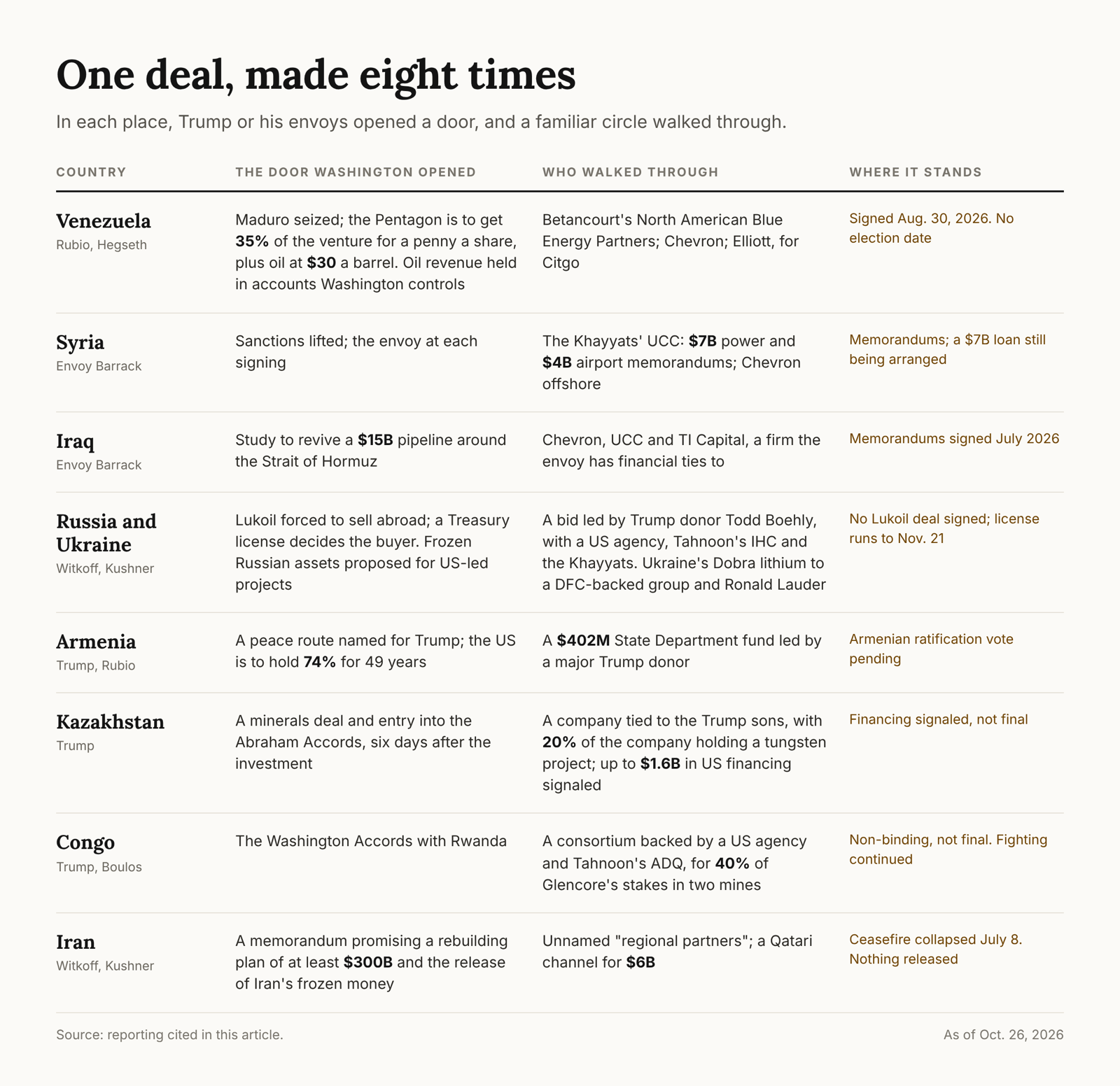
A peace broker is supposed to be indifferent to who profits from the peace. These brokers aren't. When the men negotiating a ceasefire also help decide who invests after it, no one can tell whether the terms were written for the people living through the war or for the investors waiting behind it. When the American government holds a stake, it has a financial interest in how a foreign war ends. The people of these countries see their oil, minerals and money divided up before they get a say. And because the stakes sit with American agencies rather than with the envoys personally, the rules written to catch conflicts of interest barely apply.
A country run from Washington
To see what this looks like from the inside, follow Venezuela's money.
Since January, it hasn't gone straight to Venezuela. Under an executive order Trump signed that month, the proceeds of Venezuelan oil sales are treated as the Venezuelan government's property, held by the United States "solely in a custodial and governmental capacity." Washington holds the money and decides when Venezuela gets it. The first sale brought in $500 million, held in US-controlled accounts, the main one in Qatar, Semafor reported. By April, about $8 billion of oil had been sold this way, the Council on Foreign Relations estimated, and the State Department told Congress it had authorized about $3 billion for payout. By late July, Trump put the total taken in above $13 billion. Rubio told Congress that Venezuela would submit monthly budgets for American approval.
Trump has been plain about who is in charge. "We're going to run it," he said the day of the raid. In July he floated sending Venezuela's oil money to the American military. It "can go to the military, Congress has to approve it," he said, and suggested Congress pass a law allowing it.
A country whose budget goes to Washington for approval, whose oil money sits in accounts Washington controls and whose biggest new oil venture has the Pentagon lined up as a partner is not independent in any ordinary sense of the word. It is a franchise.
Big money has followed. On Sept. 2, at the presidential palace in Caracas, Chevron announced a joint venture to invest more than $7 billion over five years in the Orinoco Belt, NPR reported. Citgo, Venezuela's American refining company, is set to go to an affiliate of Elliott, the firm of the Republican megadonor Paul Singer, under a $5.9 billion court-ordered sale. The sale still needs a Treasury license, and an appeals court heard Venezuela's challenge on Oct. 21.
What Venezuelans haven't gotten is a vote. Rodríguez, still acting president though her interim term officially expired in April, promised elections at the United Nations in September but gave no date, and Reuters reports the vote may not come until late 2027 at the earliest. María Corina Machado, the opposition leader who won the 2025 Nobel Peace Prize, spent ten months abroad; at least seven of her attempts to come home were blocked, by the count of the Spanish daily ABC. She finally made it on Oct. 25. Rubio credited her safe return to US-backed reconciliation talks, which the government is holding with a different opposition faction and which ended a third round this month without an election schedule. His plan for Venezuela, laid out in January, runs in three phases: stabilization, recovery and then transition, with no early elections. Washington's first claim on the new venture's oil runs for 50 years. The election has no date.
Claver-Carone, the man on the phone the night of the raid, was out of the Venezuela job by July 31; sources told Reuters he was forced out, which he denies. A month later, Rubio and Hegseth signed the deal with the man on the other end of that call. That is how a template works: an envoy can leave, and the deal goes ahead anyway.
The family from Damascus
If Venezuela shows how the deal works, Syria shows who keeps winning it.
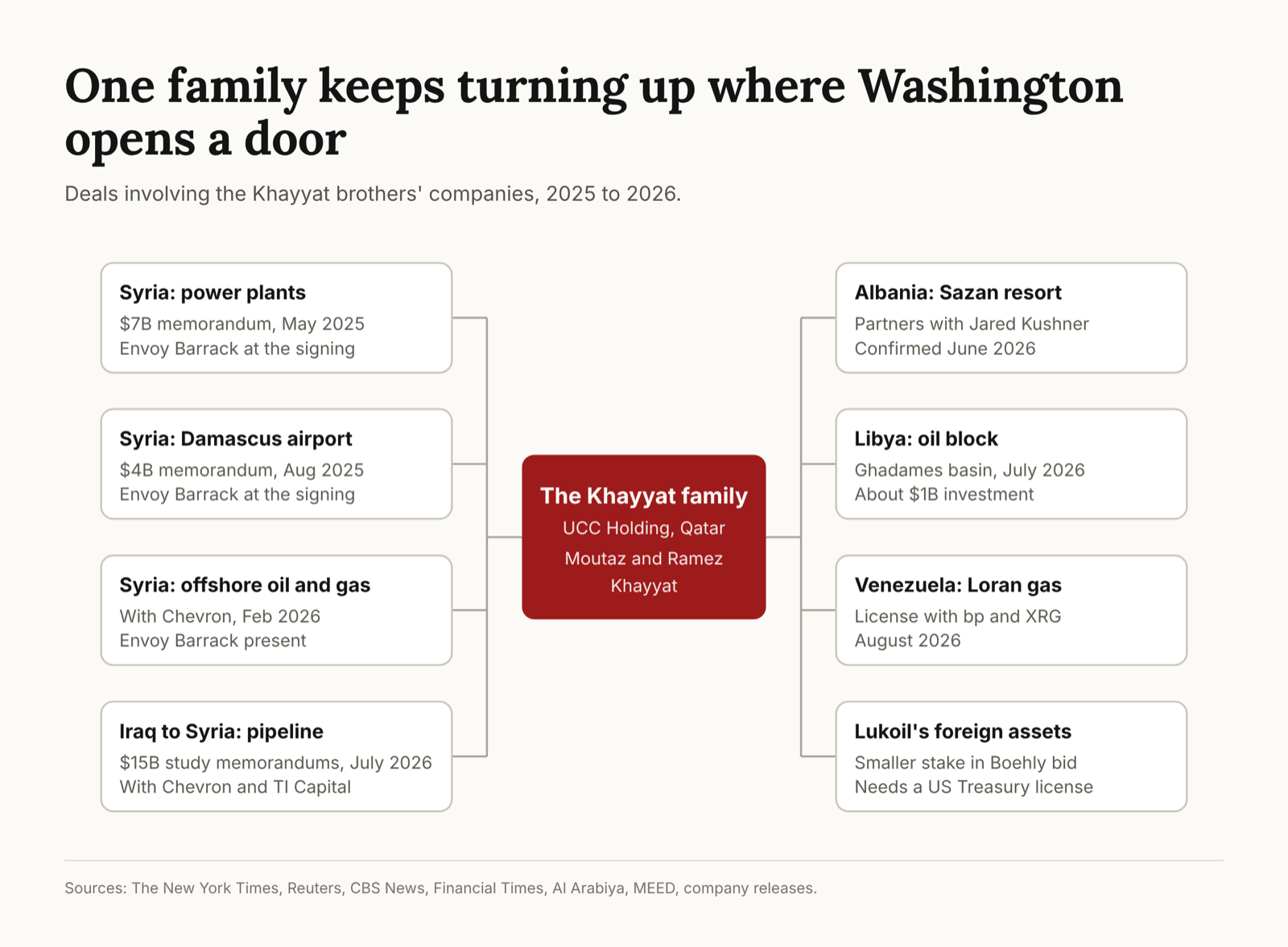
Moutaz and Ramez Khayyat are Syrian brothers whose company, UCC Holding, is based in Qatar. After Bashar al-Assad fell in December 2024, Syria's new government needed nearly everything rebuilt, from its power plants to the capital's airport. The Khayyats won some of the biggest deals, and an American envoy was there each time.
On May 29, 2025, at the presidential palace in Damascus, Syria's government signed a $7 billion memorandum with a UCC-led group to build about 5,000 megawatts of power plants, Al Arabiya reported. Tom Barrack, Trump's ambassador to Turkey and his envoy for Syria, attended. In August he was back at the palace when another UCC-led group signed a $4 billion memorandum to rebuild Damascus airport. In February 2026 he was there when Syria signed an offshore exploration memorandum with Chevron and UCC. The New York Times later counted more than $12 billion in Syrian government contracts for the brothers, with Barrack appearing alongside them for each.
The contracts needed something only Washington could give. America's Caesar Act threatened penalties on anyone doing business with Syria's government, which made it hard to raise money for a Syrian power plant. Trump had suspended the sanctions, but only Congress could repeal them. Much of the lobbying was done by Tarek Naemo, a Syrian-American businessman in Florida and a childhood friend of the third Khayyat brother, Mohamad. Naemo and his wife courted dozens of members of Congress, including Speaker Mike Johnson and Rep. Joe Wilson of South Carolina, the Times reported. Congress repealed the Caesar sanctions in the annual defense bill, which Trump signed on Dec. 18, 2025. By August, JPMorgan had joined Gulf banks to arrange a $7 billion loan for the power plants, guaranteed by Qatar National Bank, whose largest shareholder is Qatar's sovereign wealth fund.
Mohamad also proposed a golf course on Syria's coast near Latakia; Wilson suggested naming it after Trump. The Trump Organization says there has been no discussion of it. And the brothers became business partners of the president's son-in-law. Assets Group, another company they run, is a partner in Jared Kushner's planned luxury resort on Albania's Sazan island: corporate documents reviewed by CBS News list it as one, and a project spokesperson confirmed the brothers' involvement.
Then came the pipeline. Iraq ships most of its oil out through the Strait of Hormuz, a chokepoint Iran can block. In July 2026, Iraq and Syria signed memorandums with Chevron, UCC and a firm called TI Capital to study reviving a roughly $15 billion pipeline that would carry Iraqi oil across Syria to the Mediterranean instead. By then Barrack's job covered both countries: on May 31, Trump had made him special envoy to Syria and Iraq. According to Reuters, Barrack pressed Iraqi and Syrian officials to include TI Capital. He has kept financial ties to that firm: a right to 20 percent of the profits, once earnings pass a set level, in a California housing venture it manages, and a paid consulting role with that venture in 2024. Reuters found no ethics waiver on file. The State Department says Barrack has "no affiliation with, role in, or financial interest in" the pipeline, and Reuters found no evidence he profits from it.
Take the State Department at its word. The envoy didn't need a stake in the pipeline. As America's envoy to both countries, he promoted it and pushed for a firm he does business with to be part of it, alongside the family that is Kushner's partner in Albania. Reuters says the push appears to violate federal ethics rules.
The Khayyats keep turning up wherever Washington has a hand in the outcome. In July, UCC signed for an oil block in Libya's Ghadames basin. In August, Venezuela, its oil money now in American custody, licensed the second phase of its offshore Loran gas field to bp, Abu Dhabi's XRG and a unit of UCC. In September, the Financial Times reported that the family would take a smaller stake in the leading bid for Lukoil's foreign assets, a sale that needs a license from the US Treasury.
One family, from Syria to Albania to Venezuela, with a Trump envoy at the table again and again. In Syria, the Khayyats needed Washington to lift sanctions, and Washington lifted them. For Lukoil, they need a Treasury license. In Albania, they share a project with the president's son-in-law. This is what a recurring partner looks like.
Russia's oil, America's cut
The war in Ukraine is where the deal is biggest, and where it is easiest to see.
Start with Lukoil, Russia's second-largest oil company. In October 2025, the Treasury sanctioned it, which forced it to sell its oil fields, refineries and gas stations outside Russia, worth about $20 billion. That made the Treasury the gatekeeper of the sale: no buyer can close without its license.
The first bid, from the trader Gunvor, collapsed after the Treasury called the company a Kremlin puppet. The private equity firm Carlyle signed a deal in January; it expired in July without a license, and on Oct. 9 Carlyle said it was no longer actively pursuing the purchase, S&P Global reported.
The bid now in front reads like a guest list. It is led by Todd Boehly, who with his company has given at least $2 million to the president's super PAC and inauguration. The Development Finance Corporation, the American government's development bank, would take a stake in the mid-teens. IHC, an Abu Dhabi holding company chaired by Sheikh Tahnoon bin Zayed, the royal whose company paid the president's family $187 million, would help lead it. The Khayyats would take a smaller piece. Boehly and the American agency would control the board, the Financial Times reported.
According to The New York Times, the deal became part of Witkoff and Kushner's Ukraine talks with the Kremlin, with a substantial upfront payment and a share of the profits for the United States. Putin first raised Lukoil with them at a meeting on Sept. 5. He proposed the deal, and the Americans said they would work on it. After he met Witkoff again in St. Petersburg on Oct. 21, his aide Yuri Ushakov confirmed that the two sides were discussing Lukoil's foreign assets. The Treasury license that allows sale talks runs until Nov. 21.
Witkoff's spokeswoman says he has "no financial stake." As the Times story circulated, Kirill Dmitriev, the head of Russia's sovereign wealth fund, jumped into Kushner's replies on X: "Jared is a Peacemaker."
Follow the sequence. The Treasury sanctions a Russian company. The Treasury decides who may buy what the company is forced to sell. The envoys negotiating peace with the Kremlin pursue the sale as part of the peace. And the buyers in front are a presidential donor, an American agency, the sheikh whose company paid the president's family and the family that partners with the president's son-in-law. A sanction is supposed to punish. This one created a $20 billion sale, and Washington, which decides whether any buyer gets a license, is also inside the bid in front.
The envoys have eyed Russia's frozen money too. About $300 billion of Russian central bank money is frozen in the West, most of it in Europe. The first draft of Washington's peace plan, the 28 points that surfaced in November 2025, would have sent $100 billion of it into rebuilding Ukraine under American leadership, with the United States receiving "50% of the profits." In early October 2026, at talks in Miami, Witkoff and Kushner proposed moving part of the money into a vehicle under Washington's control. Europe said no, the FT reported.
The idea didn't start in Washington. A year earlier, Dmitriev pitched tapping roughly $300 billion of frozen Russian assets for American-Russian projects and an American-led rebuilding of Ukraine, during a visit to Witkoff's waterfront estate in Miami Beach, The Wall Street Journal reported. It wasn't the first Dmitriev plan to reach Kushner. After the 2016 election, his plan for US-Russian relations was passed to Kushner, according to the Mueller report.
People close to the president have their own business near this negotiation. Witkoff negotiates with Kyiv as well as Moscow. His financial disclosure lists a stake in the $50 million-or-more category in a Manhattan condo development he co-owns with Len Blavatnik, a billionaire Ukraine sanctioned in 2023, Popular Information reported. Gentry Beach, a Texas investor and longtime friend of Donald Trump Jr., quietly signed an agreement in the fall of 2025 for Novatek, the Russian gas giant whose Arctic LNG 2 project is under US sanctions, to develop natural gas in Alaska, The New York Times reported. Novatek says it is in talks over the potential use of its gas technology there.
Ukraine's own resources are being divided too. In January, Ukraine's government awarded the Dobra deposit, one of the country's largest reserves of lithium, a key battery metal, to a group owned by TechMet, whose largest shareholder is the US Development Finance Corporation, and by the Rock Holdings of Ronald Lauder, the cosmetics heir and the president's longtime friend.
On both sides of the front line, the peace is being sold before it exists.
Corridors and mines
The deal travels well beyond oil.
Armenia. At the White House in August 2025, Trump brokered a peace deal between Armenia and Azerbaijan. It came with a route named after him: the Trump Route for International Peace and Prosperity, a transit corridor through southern Armenia that links Azerbaijan to its exclave of Nakhchivan and runs along Iran's northern border. Under terms Washington and Yerevan announced in January, the United States will hold 74 percent of the company that will build and run it, with rights for an initial 49 years, JAMnews reported. If the term is extended by another 50 years, Armenia's share rises to 49 percent. Rubio signed the agreement in June. The State Department has committed $201 million to an investment fund named after the route, and the man chosen to lead it, Konstantin Sokolov, is a donor to Trump's White House ballroom who gave more than $10 million to the president's super PAC in 2025, according to the International Consortium of Investigative Journalists. Armenia's parliament is set to take up ratification on Oct. 27.
A route named for the president, to be three-quarters owned by his government for half a century, with a major donor running the $201 million fund that bears its name. That is the deal in its purest form.
Kazakhstan. Tungsten goes into armor-piercing ammunition and industrial cutting tools, and China mines most of the world's supply. On Oct. 31, 2025, a company called Skyline Builders agreed to pay $20 million for 20 percent of the company that holds a Kazakh tungsten project, which its developer calls the world's largest known undeveloped deposit. Donald Trump Jr. and Eric Trump had been buying stakes in Skyline through a shell company, the Financial Times reported. Six days later, Kazakhstan signed a critical-minerals agreement with the United States and announced it would join the Abraham Accords. The same day, the project announced that two US government lenders, the Export-Import Bank and the Development Finance Corporation, had signaled interest in financing it; together they have signaled up to $1.6 billion. Cantor Fitzgerald, now run by the sons of Commerce Secretary Howard Lutnick, helped raise $210 million for one of the project's key investors.
A company tied to the president's sons buys in. Six days later, the country signs a minerals deal with their father's government, and their father's government signals it will help finance the project. The New York Times has counted at least 14 critical-minerals projects or companies with ties to the Trump or Lutnick families that have received, or are seeking, more than $8.9 billion in federal support.
Congo. Congo mines most of the world's cobalt, a metal that goes into the batteries of phones and electric cars. On Dec. 4, 2025, Trump hosted the signing of the Washington Accords between Congo and Rwanda, with ministers from Qatar and the United Arab Emirates in the room. Six days later, the Rwanda-backed M23 rebels announced they had taken Uvira, a major city in South Kivu. Under American pressure, they pulled out in January, and in March the United States sanctioned Rwanda's army.
The minerals side of the peace moved faster, at least on paper. In February, a consortium backed by the Development Finance Corporation and Abu Dhabi's ADQ, a state fund chaired by the same Sheikh Tahnoon, signed a non-binding agreement to buy 40 percent of Glencore's stakes in two of its biggest copper and cobalt mines in Congo, in a deal that valued the mines at about $9 billion. In September, AFP described American efforts to end the fighting as unsuccessful so far, and an executive of the American mining company KoBold told the agency that "American investment hasn't poured in."
The peace came with a minerals deal attached. Neither has been delivered.
The man running Washington's Africa files is Massad Boulos, the father-in-law of Tiffany Trump. He handles Congo, Sudan and Libya. In Libya, he has defended a US plan that, according to reports, would make Saddam Haftar, son of the eastern warlord Khalifa Haftar, the country's president, with Prime Minister Abdul Hamid Dbeibah staying on, calling it "an absolute partnership," Semafor reported. The Khayyats' company had already signed for an oil block there in July.
The biggest pot
Iran was supposed to be the biggest deal of all.
Before it was signed, mediators told The New York Times in May that Witkoff and Kushner had floated real estate projects in Tehran and an investment fund. The memorandum the United States and Iran signed on June 17 put a version of it in writing. In paragraph 6, Washington "undertakes with regional partners to develop a definitive mutually agreed plan with at least USD 300 billion" for Iran's reconstruction and economic development. The partners were not named. In paragraph 11, Washington promised to make Iran's frozen money "fully available" once the deal was carried out. Iran puts that money at more than $100 billion; other estimates run as low as $50 billion.
Read those two clauses together. Iran would get its own money back only by carrying out a deal with Washington, and Washington, with partners it didn't name, would put together a $300 billion plan to rebuild a country it had just been at war with.
The first money slated to move was the $6 billion that has sat in Qatari banks since 2023. Under a plan Washington was working out with Doha, it would be released to buy food and medicine. Trump said the food would be "bought exclusively through the United States." Vice President JD Vance credited the arrangement to the president's son-in-law: "Jared Kushner actually came up with a very interesting solution with the Qataris."
None of it was released. The ceasefire broke down on July 8, the 60-day window to set up the plan ran out, and strikes have come and gone since. In August, the Justice Department was reported to be planning to claim seized Iranian oil as war prizes, through Civil War-era courts it wants to revive. In September, two seized supertankers were weeks from reaching the United States and a third was crossing the Atlantic, with almost $600 million of Iranian crude among them, gCaptain reported.
The deal fell apart. The design didn't. Look at where the money of three countries ended up, or was meant to end up. Venezuela's oil money is held in accounts Washington controls. Russia's frozen reserves were proposed first for American-led projects with half the profits going to the United States, then for a vehicle under Washington's control. Iran's first $6 billion was to buy food and medicine, with the food bought through the United States, under a Qatari arrangement Vance credited to Kushner, alongside a $300 billion rebuilding plan with partners Washington wouldn't name.
Frozen money used to be leverage. Under this administration, it is inventory.
Peace as a product
The envoys' defense is simple: they don't own any of it. Witkoff's spokeswoman says he has no financial stake in the Lukoil deal. The State Department says Barrack has no interest in the pipeline. In most of these deals the stake belongs to an American agency, not to a person, and nothing in the record shows Trump, Witkoff or Kushner pocketing a share.
Grant all of it. The deal doesn't need anyone to pocket a dollar to work. It only needs the same small group of men to decide, again and again, which ceasefire terms to accept and who gets to invest once the guns go quiet, and to keep choosing from the same circle: the president's donors, his family's business partners and the funds of the sheikh whose company paid his family $187 million. That is not a coincidence repeated eight times. It is a system.
And the system has a record. Where there was fighting to stop, it mostly hasn't stopped: Iran's ceasefire collapsed, Congo's rebels took a city six days after the signing, and Russia's war goes on. Where there was money to hand out, the winners are lined up: Betancourt has his oil fields, the Khayyats have their memorandums and a $7 billion loan in the works, Sokolov has his fund, and Boehly's group leads the race for Lukoil. Peace sold as a product is judged the way products are: by who gets paid.
The costs land on people who were never at the table. Venezuelans whose budget goes to a foreign government for approval. Syrians whose new power plants and airport were promised to groups led by one family's company in palace ceremonies, with an American envoy watching. Ukrainians whose lithium was awarded while their war was still being fought. Armenians whose new trade route will be three-quarters American-owned for half a century. And Americans, whose government is taking stakes in the deals meant to end other countries' wars, which gives it a financial interest in how those wars end.
The wars are different. The maps are different. The deal is the same, and so are the names on it.
Sources
- ProPublica: the terms of Trump's Venezuela oil agreement (Oct. 20, 2026)
- World Oil: the Venezuela deal covers 17 fields and 65 billion barrels
- US Energy Information Administration: US proved reserves at year-end 2024 (Apr. 29, 2026)
- Reuters via Gulf Times: US-investigated billionaire now has a Pentagon oil deal
- Swissinfo: did the United States pressure the Swiss judiciary for Betancourt?
- Reuters via CNBC: Giuliani told the US his client deserves leniency (Jan. 22, 2020)
- The Washington Post: US officials interceded for Betancourt (Aug. 27, 2026) · free summary via Voz
- Axios: the Venezuelan oil baron behind Trump's energy deal (Sept. 1, 2026)
- Yahoo Finance: inside the $187 million deal between the Trump family and Abu Dhabi
- Federal Register: Executive Order 14373 on Venezuelan oil revenue (Jan. 15, 2026)
- Semafor: first $500 million held in Qatar (Jan. 14, 2026)
- Council on Foreign Relations: where Venezuela's oil money has gone
- Truthout: Trump on sending Venezuela's oil money to the military (July 27, 2026)
- The White House: Trump aboard Air Force One, "It can go to the military" (July 27, 2026)
- Semafor: Rubio says Venezuela will submit its budgets to the US (Jan. 28, 2026)
- Yahoo News: "We're going to run it" (Jan. 3, 2026)
- NPR: Chevron's Venezuela joint venture (Sept. 2, 2026)
- Argus: the Citgo sale hangs in the balance
- Reuters via Devdiscourse: Citgo fight at the US appeals court (Oct. 22, 2026)
- Time: Machado returns to Venezuela (Oct. 26, 2026)
- Al Jazeera: Rodríguez promises elections at the UN, gives no date (Sept. 24, 2026)
- Reuters via BOE Report: Venezuela's promised elections face long delays (Sept. 25, 2026)
- Voz, citing ABC: seven failed attempts by Machado to return (Sept. 23, 2026)
- Latin Times: Machado returns to Venezuela (Oct. 25, 2026)
- Latin Times: Rubio on Machado's return and the US-backed talks (Oct. 26, 2026)
- IANS: Rubio outlines a three-phase plan for Venezuela, no early elections (Jan. 8, 2026)
- Reuters via The Star: Claver-Carone leaves his Venezuela role (Aug. 1, 2026)
- Al Arabiya: Syria signs $7 billion power deal with UCC-led consortium (May 29, 2025)
- MEED: UCC-led consortium wins Damascus airport deal
- Offshore Magazine: Syria's offshore deal with Chevron and UCC (Feb. 2026)
- The New York Times report on the Khayyats, republished in Albanian by Shqiptarja (Apr. 20, 2026)
- Enab Baladi: Trump signs the repeal of the Caesar sanctions law (Dec. 2025)
- CRS: the FY2026 defense bill, signed Dec. 18, 2025
- IFP Expo: JPMorgan and Gulf banks arrange $7 billion Syria loan
- CBS News: Kushner's Albanian resort and the Khayyat partners (June 22, 2026)
- Bloomberg Government: Trump adds Iraq to Barrack's role (May 31, 2026)
- Reuters via The Star: Trump envoy kept financial ties to firm behind pipeline plan (Oct. 9, 2026)
- UCC Holding: Libya exploration and production-sharing agreement
- Enerdata: Venezuela grants bp-led consortium the Loran gas field
- Logos Press: Lukoil writes off $20 billion of overseas assets after US sanctions
- gCaptain: Gunvor drops its Lukoil bid after the US calls it a Kremlin puppet
- S&P Global: Carlyle ends pursuit of Lukoil's international assets (Oct. 9, 2026)
- LA Public Press: Boehly's donations to MAGA Inc. and the inauguration (Sept. 2026)
- Caliber, citing the FT: Boehly leads a new bid for Lukoil's international business
- The New York Times via DNyuz: US-Russia talks on Ukraine now involve an oil deal tied to Trump allies (Oct. 3, 2026)
- Kyiv Post: Kremlin confirms Lukoil talks after Putin meets Witkoff (Oct. 2026)
- OFAC: General License 131K
- The Daily Beast, citing the NYT: Kremlin rushes to defend Kushner
- Reuters via Yahoo Finance: where Russia's frozen assets are
- Il Sole 24 Ore: frozen Russian funds in the 28-point plan
- Meduza, citing the FT: Europe rejects a US-controlled vehicle for Russian assets (Oct. 15, 2026)
- To Vima, citing the WSJ: Dmitriev's pitch at Witkoff's estate
- The Moscow Times: the Russia-Trump links in the Mueller report (Apr. 22, 2019)
- Popular Information: Witkoff's partnership with Blavatnik
- Reuters via Internazionale, citing the NYT: Trump ally ties up with Novatek on Alaska gas (Feb. 20, 2026)
- S&P Global: TechMet and Rock Holdings win Dobra lithium
- Ukrainska Pravda: Dobra lithium goes to TechMet and Lauder's Rock Holdings (Jan. 12, 2026)
- JAMnews: the US stake in the TRIPP corridor
- Armenian Foreign Ministry: the TRIPP framework signed (June 4, 2026)
- USAspending.gov: the State Department's grant to the TRIPP+ Enterprise Fund, $201 million
- ICIJ: the ballroom donor and the TRIPP fund
- Armenpress: parliament to take up ratification on Oct. 27
- Business Wire: Cove Capital and Kazakhstan's national mining company announce the tungsten venture (Nov. 6, 2025)
- Mining.com, citing the FT: Trump sons' tungsten investment in Kazakhstan
- Al Jazeera: Kazakhstan joins the Abraham Accords (Nov. 6, 2025)
- Cato Institute: Cantor Fitzgerald and the Kazakh tungsten deal
- Mediaite, citing the NYT: Trump sons and the Kazakhstan mining deal
- Qatar Tribune: Qatar at the Washington Accords signing
- UAE Foreign Ministry: Shakhboot bin Nahyan at the Congo-Rwanda signing (Dec. 5, 2025)
- AllAfrica: M23 takes Uvira (Dec. 2025)
- Critical Threats: M23 completes its Uvira withdrawal (Jan. 21, 2026)
- The Star (Kenya): US sanctions Rwanda's military over M23 support (Mar. 3, 2026)
- BusinessDay: Glencore to sell 40% of Congo assets to a White House-backed firm (Feb. 3, 2026)
- Abu Dhabi Media Office: Tahnoon bin Zayed chairs ADQ's board
- AAP: Orion consortium's non-binding agreement for Glencore's Congo assets (Feb. 3, 2026)
- Malay Mail, citing AFP: US mining in Congo (Sept. 25, 2026)
- Semafor: Boulos defends proposed Libyan deal (Sept. 22, 2026)
- The New Republic, citing the NYT: Witkoff and Kushner's Tehran pitch
- The New Arab: text of the US-Iran memorandum
- Al Jazeera: Iran's frozen assets and where they are held
- Majalla: estimates of Iran's frozen assets
- Iran International: the US-Qatar plan for $6 billion (June 20, 2026)
- Farms.com: Iran could buy US farm goods with frozen funds (June 25, 2026)
- IANS: Vance on Kushner's solution with the Qataris
- CNN via FDD: Trump orders new strikes in Iran after calling the ceasefire over (July 8, 2026)
- Council on Foreign Relations: US-Iran conflict tracker
- Bloomberg Law: US aims to revive Civil War-era court to claim Iran oil as prize (Aug. 2026)
- gCaptain: seized Iranian tankers head to the US
Cover image credits
Cover image, a composite of these photographs over a NASA map:
- Donald Trump in the Oval Office, Dec. 4, 2025 — The White House (Daniel Torok), public domain
- Jared Kushner at the Kremlin, Dec. 2, 2025 — Kremlin.ru, CC BY 4.0
- Steve Witkoff at the Kremlin, Sept. 5, 2026 — Kremlin.ru, CC BY 4.0
- Sheikh Tahnoon bin Zayed at the White House, March 18, 2025 — The White House (Daniel Torok), public domain
- Tom Barrack, official portrait — U.S. Department of State, public domain
Map: NASA Blue Marble: Next Generation (NASA Earth Observatory, via NASA GIBS), public domain. Borders: Natural Earth, public domain.
Video article: footage, photo, map and document credits
Scenes of the people in this story come from official U.S. government video and photographs (works of the United States government, public domain) and from photographs published under Creative Commons licences. The maps are NASA's Blue Marble satellite image with borders, places and routes drawn from public data. Documents shown are the published pages of the documents the narration quotes. Creative Commons material, with the credit each licence requires:
- 14 06 2022 Cerimônia de Abertura do 5º Fórum de Investimento Brasil 2022 (52146005663) — Palácio do Planalto from Brasilia, Brasil, CC BY 2.0
- 2013 street Kinshasa 8756715873 — Antoine Moens de Hase, CC BY 2.0
- 2019 Rudolph Giuliani, Ex-Prefeito de Nova York - 48790151846 — Palácio do Planalto, CC BY 2.0
- Al-Hamidiyah Souq 02 — Bernard Gagnon, CC BY-SA 3.0
- Alejandro Betancourt — Alejandro Betancourt web, CC BY-SA 3.0
- Aras river and Armenian-Iranian border near Meghri — Jelger Groeneveld, CC BY 4.0
- Balancín petrolero I — Rjcastillo, CC BY-SA 3.0
- Bashar al-Assad (2018-05-17) 03 — kremlin.ru, CC BY 4.0
- Bulevar de Sabana Grande Caracas Venezuela 2018 La Poma — QuinteroP, CC BY 4.0
- Central Gas Facility, Prudhoe Bay, Alaska — FairbanksMike, CC BY 2.0
- Consensus 2025 - Eric Trump 10 — Xuthoria, CC BY-SA 4.0
- Damascus-international-airport-january-2007 — Yazan Badran, CC BY 2.0
- Destructions in Kharkiv after Russian attack, 2024-05-25 (10) — Kharkiv Regional State Administration, CC BY 4.0
- Destructions in Kyiv after Russian attack, 2024-01-02 (09) — Oleksiі Samsonov / Kyiv City State Administration, CC BY 4.0
- Doha West Bay Skyline Qatar Jan 2020 — Thameur Belghith, CC BY-SA 4.0
- Donald Trump, Jr. (55021618832) (cropped 2) — Gage Skidmore from Surprise, AZ, United States of America, CC BY-SA 4.0
- ELEICOES 2013 NA VENEZUELA (8639299564) — Joka Madruga from Curitiba, Brasil, CC BY 2.0
- Fishing boats off the coast of Ibn Hani near Latakia, Syria — Abd Alsattar Ardati, CC BY-SA 4.0
- Flying over Manono, Katanga — Tom Skrinar, CC BY-SA 2.0
- Foreign Secretary Yvette Cooper meets Senior Advisor Boulos (54974359152) — Foreign, Commonwealth & Development Office, CC BY 4.0
- Julien Paluku Kahongya, Jozef Síkela, and Massad Boulos - 2025 — Lukasz Kobus / European Union , 2025 / EC - Audiovisual Service, CC BY 4.0
- Kamoto Mine - panoramio — Martin Tuchscherer, CC BY-SA 3.0
- Kirill Dmitriev at a meeting with Steve Witkoff and Jared Kushner, Sept. 5, 2026 — Kremlin.ru, CC BY 4.0
- Kirill Dmitriev, Jared Kushner and Steve Witkoff, Sept. 5, 2026 — Kremlin.ru, CC BY 4.0
- Kushner Putin handshake — kremlin.ru, CC BY 4.0
- Kushner and Witkoff at the Kremlin — kremlin.ru, CC BY 4.0
- Lac Tanganyika, Uvira, Uvira Territory, DR Congo — EdwinAlden.1995, CC BY-SA 4.0
- Lukoil gas station in Zabrze, Silesian Voivodeship, Poland, September 2018 — MichalPL, CC BY-SA 4.0
- Mina de Mutanda na República Democrática do Congo — Coordenação-Geral de Observação da Terra/INPE, CC BY-SA 2.0
- Morning in Caracas (41787847611) — Stig Nygaard, CC BY 2.0
- Morning in Goris, Armenia (28253274316) — Clay Gilliland from Chandler, U.S.A., CC BY-SA 2.0
- Palacio de Miraflores desde El Calvario, 2015 — Guillermo Ramos Flamerich, CC BY-SA 4.0
- President Vladimir Putin Meeting with Supreme Commander of the Libyan National Army Khalifa Haftar 03 — Kremlin.ru, CC BY 4.0
- Reuven Rivlin hosting young scientists who have been awarded the Blavatnik Awards for Young Scientists, February 2018 (4568) — Mark Neyman, CC BY-SA 3.0
- Robert F. Kennedy Department of Justice Building — APK, CC BY 4.0
- Ronald Lauder at the Munich Security Conference, Feb. 15, 2025 — BMEIA / Michael Gruber, CC BY 2.0
- Russia US talks 2026-09-05 — kremlin.ru, CC BY 4.0
- Sazan Island, Albania 2016 02 — Pasztilla aka Attila Terbócs, CC BY-SA 4.0
- Steve Witkoff (2025) (cropped) — U.S. Embassy Jerusalem, CC BY 2.0
- Syria, Panorama of Damascus city — Vyacheslav Argenberg, CC BY 4.0
- Tehran skyline view from top of Milad Tower 2011-09-28 — Simisa, CC BY-SA 3.0
- The Global Financial Context Paul Singer (cropped) — World Economic Forum, CC BY-SA 2.0
- The White House North Portico in Washington, D.C — Harrison Keely, CC BY 4.0
- Todd Boehly Official Headshot 2024 — Eric van den Brulle, CC BY-SA 4.0
- Trump Tower main entrance — Quintin Soloviev, CC BY 4.0
- Us-treasury-building — MeanieHyaena, CC BY 4.0
- Visit of Abdul Hamid Dbeibah, Prime Minister of the Government of National Unity of Libya, to the European Commission 04 — © European Union, 2024, CC BY 4.0
- Visit of Hadja Lahbib, to Venezuela (P-070265-00-11) — © European Union, 2026, CC BY 4.0
- Visit of Hadja Lahbib, to Venezuela (P-070265-00-12) — © European Union, 2026 (EC Audiovisual Service), CC BY 4.0
- Witkoff Kushner Kremlin — kremlin.ru, CC BY 4.0
- Witkoff Putin handshake — kremlin.ru, CC BY 4.0
- Yuri Ushakov at a meeting with Steve Witkoff and Jared Kushner — kremlin.ru, CC BY 4.0
Map data:
- Base map: NASA Blue Marble: Next Generation, via NASA GIBS (public domain)
- Borders: Natural Earth (public domain)
Public domain (works of the United States government, and photographs their authors released into the public domain):
- 2026 gift to President Donald Trump of the Nobel Peace Prize medal awarded to Maria Corina Machado at the White House Oval Office on 15 January (cropped) (The White House)
- A swearing-in ceremony for Senior Adviser and Special Envoy Steve Witkoff, May 6, 2025 (The White House)
- AG Todd Blanche Official Portrait (cropped) (Ryan M. Biller)
- Attorney General Bondi Announces $50M for arrest of Venezuelan President Nicolás Maduro (United States Department of Justice & Drug Enforcement Administration)
- Benghazi Waterfront (Jaw101ie)
- CitgoHQ (WhisperToMe)
- Department of War, Apr. 21, 2026: boarding of the stateless sanctioned M/T Tifani, INDOPACOM (U.S. Department of War)
- Donald Trump signs Islamabad Memorandum of Understanding (P20260617DT-4957) (The White House)
- Donald Trump takes the oath of office (2025) (cropped) (Joint Congressional Committee on Inaugural Ceremonies)
- Exterior of the United States Department of State Harry S. Truman Building, Washington, D.C., spring 2024 - 16 (U.S. Department of State)
- Federal Courthouse in Miami (The original uploader was Miami92 at English Wikipedia.)
- Gentry Beach Meeting Muhammad Yunus Dhaka 2025-01-30 (PID-0003795) (Press Information Department)
- Howard Lutnick 2025 (cropped) 2 (Daniel Torok)
- Jared Kushner 2025 (The White House)
- Joe Wilson official congressional photo (4x5) (United States Congress)
- Maritime Interdiction Operation, Jan. 20, 2026: M/V Sagitta apprehended, Operation Southern Spear (U.S. Department of War)
- P20260103MR-0701 President Donald Trump, CIA Director John Ratcliffe, Secretary of State Marco Rubio and Secretary of Defense Pete Hegseth monitor U.S. military operations in Venezuela (Official White House Photo by Molly Riley)
- P20260103MR-1127 President Donald Trump and Secretary of State Marco Rubio monitor U.S. military operations in Venezuela (Official White House Photo by Molly Riley)
- P20260905DT-1547 (55519063708) (The White House)
- Panoramic view of Caracas 3 (Wilfredor)
- Petare, Caracas, Venezuela (Unsplash) (Andrés Gerlotti agerlotti)
- Secretary Pete Hegseth official portrait (cropped) (Chad McNeeley)
- Secretary Rubio Meets with Armenian Foreign Minister (55039879923) (U.S. Department of State)
- Secretary Rubio Meets with Libyan National Army Deputy Commander (55364728101) (U.S. Department of State)
- Secretary Rubio Meets with Libyan National Army Deputy Commander (55365135560) (U.S. Department of State)
- Secretary Rubio Participates in Memorandum of Understanding with Armenian Foreign Minister (55294061657) (U.S. Department of State (Flickr statephotos 55294061657, Yerevan, May 26, 2026))
- Senate Foreign Relations Committee, Rubio oversight hearing on Venezuela, Jan. 28, 2026 (U.S. Senate Committee on Foreign Relations)
- Southbeachskylinesouth (Marc Averette)
- Speaker Mike Johnson Official Portrait (3x4 cropped) (United States Congress)
- Spodumene (GeoDIL number - 401) (Shannon Heinle)
- Tahnoun bin Zayed Al Nahyan at the White House 2025 (The White House)
- The Pentagon US Department of Defense building ("DoD photo by Master Sgt. Ken Hammond, U.S. Air Force.")
- Tom Barrack met with Ahmed al-Sharaa in Syria in May 2025 (Ambassador Tom Barrack)
- U S Ambassador Barrack Makes First Visit to Incirlik Air Base (9146546) (U.S. Air Force photo by Staff Sgt. Koby Saunders)
- U.S. Ambassador to Türkiye, May 29, 2025: "Meeting President al-Sharaa in the Presidential Palace" (U.S. Embassy Türkiye / Ambassador Tom Barrack)
- U.S. Central Command / DVIDS, "U.S. Forces Complete New Round of Retaliatory Strikes Against Iran" (1013909)
- U.S. Senator Jeanne Shaheen, U.S. Congressman Joe Wilson, U.S. envoy to Syria Tom Barrack, and Syrian President Ahmed al-Sharaa (2025) (Joe Wilson)
- USDA Farmers Market (20170609-AMS-LSC-0372) (USDAgov)
- United States Ambassador to Turkey Thomas Joseph Barrack Jr (cropped) (US State Department)
- United States Capitol - west front (Architect of the Capitol)
- White House, "President Trump Gaggles with Press on Air Force One En Route Waterford Township, MI, Jul. 27, 2026" (The White House)
- White House, "President Trump Holds a Press Conference, Jan. 3, 2026", Mar-a-Lago (The White House)
- White House, "President Trump Participates in a Bilateral Meeting with the President of the Syrian Arab Republic", NATO summit, Ankara, July 8, 2026 (The White House)
- White House, "President Trump Participates in a Dinner with Central Asian Countries", Nov. 6, 2025 (The White House)
- White House, "President Trump Participates in a Signing Ceremony with the Presidents of Rwanda and Congo", Dec. 4, 2025 (The White House)
- White House, "President Trump Participates in a Trilateral Signing with Armenia and Azerbaijan", Aug. 8, 2025 (The White House)
- White House, "President Trump Signs Executive Orders, Jun. 22, 2026", Oval Office (The White House)
- White House, "President Trump Signs Iran Memorandum of Understanding", Versailles, June 17, 2026 (The White House)
- White House, "Vice President JD Vance Delivers Remarks in Lucerne, Switzerland", posted June 22, 2026 (The White House)
- Wolframite with quartz (GeoDIL number - 195) (Shannon Heinle)
- Marco Rubio: Public domain, State Dept
- Steve Witkoff: Public domain, White House
Documents shown:
- Federal Register, Executive Order 14373, Jan. 15, 2026 (GovInfo), public domain
- OFAC General License 131K, Oct. 21, 2026, public domain
- OGE Form 278e, Steven C. Witkoff, posted by the White House Sept. 2025, public domain
- Public Law 119-60 (FY2026 NDAA), GovInfo, public domain
- The White House, fact sheet, Aug. 31, 2026, public domain
- U.S. Department of Justice, Report on the Investigation into Russian Interference (2019), public domain
- U.S. Department of the Treasury, Mar. 2, 2026, public domain
- U.S. Department of the Treasury, Oct. 22, 2025, public domain
The appearance of U.S. Department of Defense visual information does not imply or constitute endorsement.